
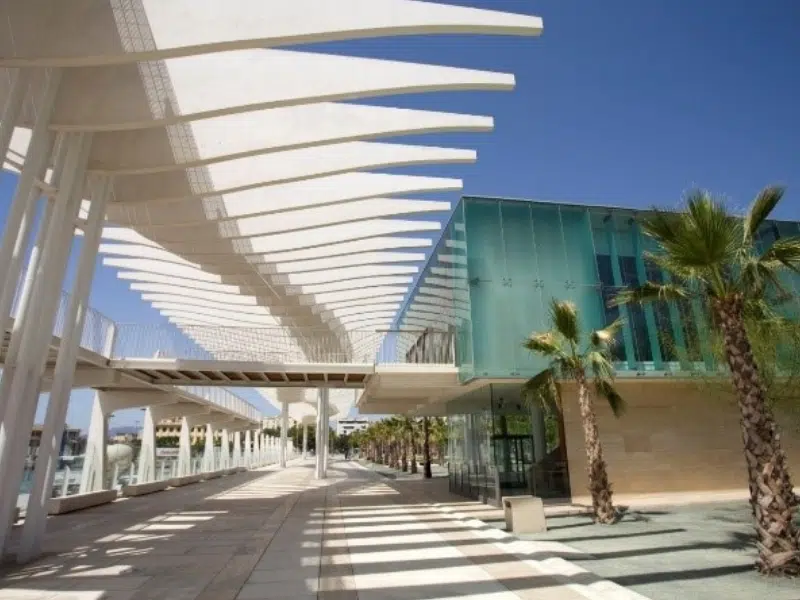
The Palmeral de las Sorpresas, the Palm Grove of Surprises, is the promenade on Quay 2 of Málaga's port, between the old town and the sea. Its signature is a long, wave-like white pergola made of concrete slats, running beside rows of palm trees for about 400 metres. Until the port was opened up to the city around 2011, this was a working dock that most people never set foot on.
Palmeral de las Sorpresas at a glance
- Where: on Quay 2 (Muelle Dos) of the port, between Plaza de la Marina and Muelle Uno, a few minutes from the cathedral and Calle Larios.
- Opened: completed in 2011 as part of the redevelopment that joined the port to the city centre.
- By: Junquera Arquitectos (Jerónimo Junquera and his team) with Liliana Obal, who won the design competition.
- What it is today: a free public promenade and garden, with cafés, play areas and boat trips leaving from the quay.
- Time needed: 20–30 minutes for a slow walk end to end, longer with a coffee or a boat trip.
From closed dock to city promenade
For most of the 20th century the port of Málaga was cut off from the city by fences and warehouses. A special plan for the port in the 2000s set out to change that by turning the two quays closest to the old town into public spaces: Muelle Uno, with shops and restaurants, and Muelle Dos, which became the Palmeral. The project was commissioned by the Port Authority of Málaga together with the regional public land company, and the Junquera team designed it as a garden promenade rather than a car-friendly boulevard.
Their model was the traditional Mediterranean palm grove, with the Palmeral of Elche cited as a precedent. The palms are planted in a regular grid, three metres apart, forming squares of about 20 by 20 metres. Each square is laid out as a different small garden, with its own plants, benches, textures, scents and flowering season, so that walking through it brings a series of changes, which suits the name. Along the water runs the pergola that gives the place its image, sheltering walkers and passengers arriving by sea.
What to look for
- The pergola: a steel beam about 11 metres up, on 16 supports in two rows, carrying 265 white concrete slats, each 14 metres long, in nine different shapes so that the roof seems to ripple.
- The shadows: on a sunny day the slats throw a striped pattern across the paving that moves through the day.
- The palm grid: stand among the trees and look along the rows to see how regular the layout really is.
- The small themed gardens between the palms, each with different plants and furniture.
- The three glass pavilions on stilts, set at right angles to the quay, built for exhibitions and the passenger terminal.
The name
Palmeral de las Sorpresas simply means Palm Grove of Surprises. The surprises are best found on foot: a sunken garden here, a fountain or a play area there, and changing views of the boats, the lighthouse and the Alcazaba hill. Walk it once along the water under the pergola and once back through the gardens; they feel like two different places.
Tips for your visit
- Come early in the morning or towards sunset: the pergola gives some shade, but the quay can be very hot at midday in summer.
- Look back from the end of the quay for a view of the city with the cathedral and the Alcazaba above the palms.
- Combine it with Muelle Uno and a walk into the old town along Calle Larios.
Nearby
- Muelle Uno: the next quay towards the lighthouse, with shops, restaurants and the colourful glass cube of the Centre Pompidou Málaga.
- Paseo del Parque: the shady park along the edge of the port, full of exotic trees and fountains.
- Málaga Cathedral: known as La Manquita, the one-armed lady, because its second tower was never finished.
- Alcazaba and Roman Theatre: the Moorish fortress on the hill and the Roman theatre at its foot, side by side.
See Málaga with World City Trail
Our Málaga scavenger hunt turns the old town into a game you play on your phone. The route links 10 stops and takes around two hours, with about 31 minutes of walking. It includes places such as Plaza de la Merced with its Picasso statue and the Roman Theatre. You can play in English, German, French, Italian, Spanish or Dutch.
If you prefer a different format, Málaga also has a self-guided walking tour and an outdoor escape game.
Play the Málaga scavenger hunt →
Take the self-guided walking tour of Málaga →
Play the outdoor escape game in Málaga →
Facts checked in October 2026.