
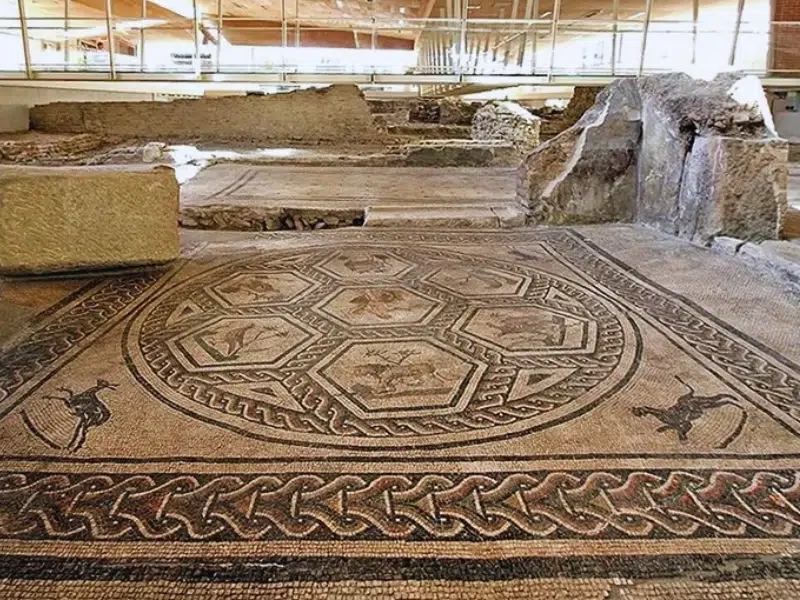
The Domus del Chirurgo (Surgeon's House) is a Roman house uncovered under Piazza Ferrari, a garden square in the historic centre of Rimini. In the 3rd century AD it was the home and surgery of a doctor in Ariminum, as the Romans called the town. When fire destroyed the house it buried his kit: about 150 instruments, the most complete set of Roman surgical tools ever found.
The Domus del Chirurgo at a glance
- Where: Piazza Ferrari in Rimini's historic centre, under a glass-walled building, a short walk from the City Museum (Museo della Città).
- Built: in the second half of the 2nd century AD; destroyed by fire in the mid-to-late 3rd century. Found in July 1989 and opened to visitors in December 2007.
- What it is today: an archaeological site you see from walkways suspended above the floors, in a cover building designed by the architect Alessandro Colombo. The instruments themselves are on display in the City Museum.
- Time needed: about 45 minutes for the house, and another hour if you add the finds in the City Museum.
Found under a garden
In July 1989, during work on the gardens of Piazza Ferrari, workers found fragments of Roman painted plaster caught in the roots of the trees. The digs that followed lasted about ten years and uncovered much more than one house: layers running from Roman times to the early Middle Ages. At their centre was a house built in the second half of the 2nd century AD, which in its last phase served a doctor as home and practice, a taberna medica with rooms to receive, examine and treat patients. A graffito on a wall gives a name, Eutyches, a Greek name. Scholars think he trained in the Greek East and may have served as a military doctor.
In the mid-to-late 3rd century, in years when Germanic raiders reached northern Italy under Emperor Gallienus, a fire destroyed the house. The collapse sealed the rooms, and with them the doctor's tools. Later a large late Roman palace, with mosaics and underfloor heating, rose next to the site on its western side. It was probably ruined in the Gothic War of 535–553, and until the 7th century its floors were used as a small Christian cemetery, with graves cut straight into the mosaics. When the surgeon lived here, his house stood close to the shore; the coastline has since moved far out to sea.
What to look for
- The walkways: each one follows the outline of a building from a different period, so you can read the layers of the site from above.
- The Orpheus mosaic: the floor of the room where most of the instruments lay shows the mythical musician Orpheus.
- The mosaic floors of the house, with geometric patterns and figures, many still in place where they were laid.
- The graves of the early medieval cemetery, cut into the mosaic floors of the late Roman palace.
- The finds in the City Museum: the surgical instruments, a reconstruction of the doctor's consulting room and a glass panel with three fish, probably made in the eastern Mediterranean, a hint of how far the doctor had travelled.
Eutyches, a good man
The instruments, in bronze and iron, date from the 1st to the 3rd century AD. About a third of them were meant for bone surgery, and none for gynaecology, which suggests a doctor who mostly dealt with wounds, fractures and other injuries. Alongside them came tools for preparing and giving medicines. The graffito that gave the doctor his name reads 'Eutyches homo bonus hic habitat': 'Eutyches, a good man, lives here'. Whether he wrote it himself or a grateful patient did, nobody knows.
Tips for your visit
- See both halves of the story: the house on Piazza Ferrari and the instruments in the City Museum, a short walk away.
- A guided visit helps a lot here: the remains of several eras overlap, and a guide shows you which wall belongs to which house.
- Even if you don't go in, walk round the glass walls: from the square you can glimpse the floors inside.
Nearby
- City Museum (Museo della Città): in a former 18th-century Jesuit college, with the surgeon's instruments and much of Roman Rimini.
- Arch of Augustus: the Roman gate of 27 BC that marked the end of the Via Flaminia from Rome, at the top of the Corso d'Augusto.
- Tempio Malatestiano: Rimini's cathedral, remodelled for Sigismondo Malatesta in the 15th century with a façade by Leon Battista Alberti.
- Piazza Tre Martiri: the square on the site of the Roman forum, named after three partisans hanged here in August 1944.
See Rimini with World City Trail
Our Rimini scavenger hunt turns the old town into a game you play on your phone. The route links 10 stops and takes around 2 hours, with about 34 minutes of walking. It includes the Arch of Augustus, the Tempio Malatestiano and Piazza Tre Martiri.
If you prefer a different format, there is also a self-guided walking tour and an outdoor escape game in Rimini.
Play the Rimini scavenger hunt →
Take the self-guided walking tour of Rimini →
Play the outdoor escape game in Rimini →
Facts checked in October 2026.