
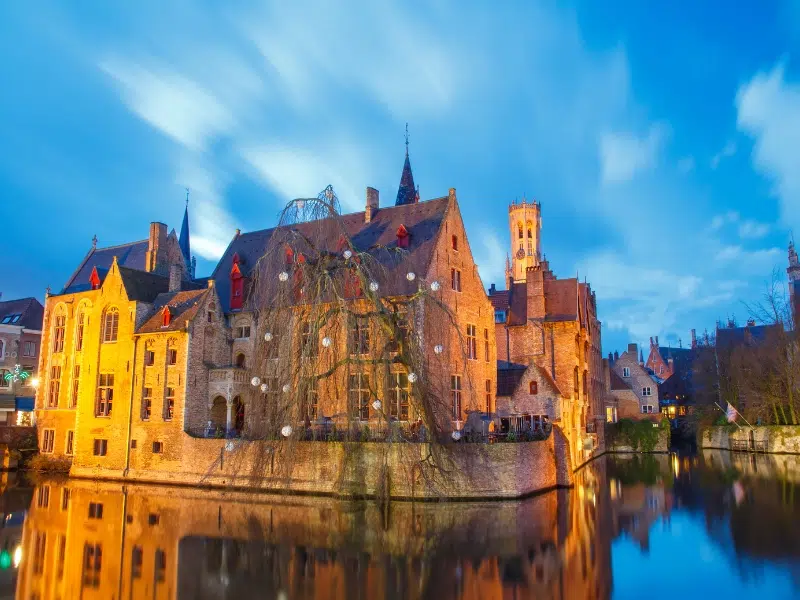
The Rozenhoedkaai, the Quay of the Rosary, is a short stretch of waterfront in the centre of Bruges where the Dijver and the Groenerei canals meet. From its corner you see old brick houses rising straight from the water and, above the rooftops, the tower of the Belfry: probably the most photographed view in the city. In the Middle Ages this was a small harbour for the salt trade, and the quay was known as the Salt Dike before it took its present name.
Rozenhoedkaai at a glance
- Where: on the corner where the Dijver meets the Groenerei, a few minutes' walk south-east of the Markt, next to Huidenvettersplein.
- What it is: a medieval canal-side quay, now a pedestrian viewpoint inside the historic centre of Bruges, a UNESCO World Heritage Site since 2000.
- Known for: the classic view of canal houses, the water and the Belfry tower, by day and when lit up at night.
- Time needed: 10 minutes for the view, longer if you take a canal boat from the area.
From salt harbour to postcard view
After the year 1000, when Bruges was growing into a trading city connected to the sea, this corner of the canals served as a small harbour for salt. Salt was a costly and strategic product, used above all to preserve fish and meat, and boats unloaded it here close to the market. The quay was called the Zoutdijk, or Salt Dike, and the neighbouring squares were full of trades: fishmongers at the Vismarkt and leather tanners at the Huidenvettersplein.
The quay later took the name Rozenhoedkaai, from rozenhoed, an old Dutch word for rosary, which is usually linked to the rosaries sold from stalls here. As the port silted up and Bruges lost its trade, the waterfront became quiet, and the houses that survived are now some of the best-known images of the city. Many have been restored several times, and their stepped gables and turrets are mixtures of medieval work and later rebuilding.
What to look for
- The Belfry tower rising above the rooftops: from the corner of the quay it lines up neatly behind the canal houses.
- The brick façades with stepped gables and small turrets, many with walls that go straight down into the water.
- The meeting of two canals, the Dijver and the Groenerei, with the boats turning under the bridges.
- The reflections: on a still morning the houses and the tower are mirrored in the canal.
Why everyone photographs it
Few places in Bruges combine so many of the city's ingredients in one frame: water, medieval houses, a bridge and the tower of the Belfry, which has watched over the Markt since the Middle Ages. That is why the Rozenhoedkaai appears on so many postcards and in so many films and photo books. It is also small, so at busy times you will be sharing the railing with many other cameras.
Tips for your visit
- Come early in the morning for calm water, soft light and fewer people; the view is also beautiful at dusk when the Belfry is lit.
- Canal boats pass right below the quay; a boat tour is the best way to see the houses from water level.
- Step back from the railing so others can photograph too, and keep an eye on cyclists on the narrow streets around it.
- Walk on along the Dijver towards the museums for quieter views of the same canal.
Nearby
- Belfry and Markt: the medieval bell tower and the main square, a few minutes' walk away.
- Burg: the square with the Gothic City Hall and the Basilica of the Holy Blood, just round the corner.
- Vismarkt and Huidenvettersplein: the colonnaded fish market and the old tanners' square, right next to the quay.
- Groeninge Museum: the Flemish Primitives, including works by Jan van Eyck, along the Dijver.
See Bruges with World City Trail
Our Bruges scavenger hunt turns the old town into a game you play on your phone. The route links 10 stops and takes around two hours, with about 24 minutes of walking. It includes places such as Jan van Eyckplein, the Belfry and Burg square.
If you prefer a different format, Bruges also has a self-guided walking tour and an outdoor escape game.
Play the Bruges scavenger hunt →
Take the self-guided walking tour of Bruges →
Play the outdoor escape game in Bruges →
Facts checked in October 2026.