
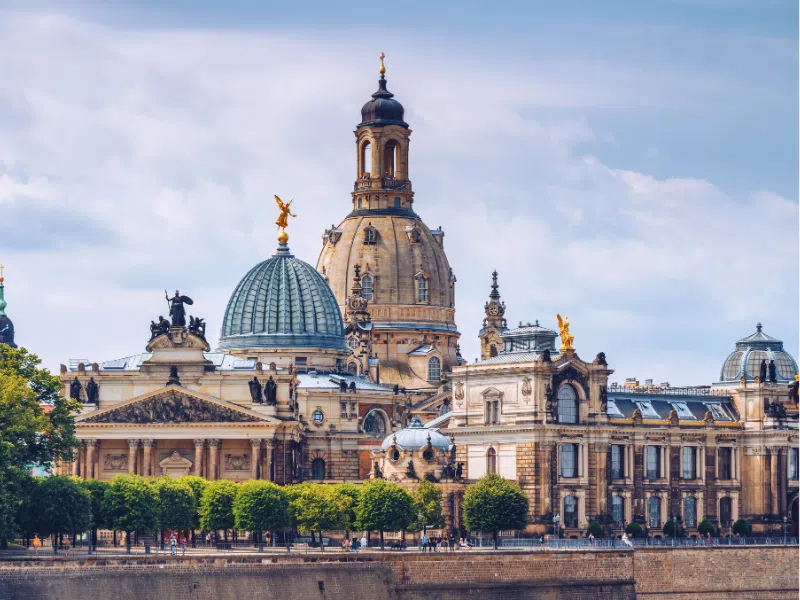
Dresda fu la splendida capitale barocca dei principi elettori di Sassonia, quasi completamente distrutta nel febbraio 1945 e ricostruita con pazienza nei decenni successivi. Camminando oggi lungo l’Elba vedi entrambe le storie insieme: palazzi, chiese e gallerie, e i segni scuri del fuoco sulle loro pietre. Ecco i fatti e le storie che rendono speciale la città.
10 curiosità su Dresda
- Una chiesa ricostruita con le sue macerie: la Frauenkirche, costruita tra il 1726 e il 1743 da George Bähr, crollò il 15 febbraio 1945. Fu ricostruita dopo la riunificazione tedesca e riconsacrata il 30 ottobre 2005.
- Una croce dalla Gran Bretagna: il globo e la croce dorati in cima alla Frauenkirche sono opera dell’orafo britannico Alan Smith, il cui padre aveva partecipato ai bombardamenti su Dresda.
- Un palazzo per le feste: lo Zwinger fu costruito tra il 1710 e il 1728 da Matthäus Daniel Pöppelmann per Augusto il Forte. Oggi ospita la Pinacoteca dei Maestri Antichi.
- The most famous cherubs in art: the gallery's star is Raphael's Sistine Madonna, bought for Dresden in 1754. The two bored-looking angels at the bottom of the painting appear on countless postcards.
- Un teatro dell’opera risorto due volte: la Semperoper, dell’architetto Gottfried Semper, bruciò nel 1869 e fu ricostruita entro il 1878. Distrutta nel 1945, riaprì il 13 febbraio 1985, esattamente 40 anni dopo il bombardamento.
- Where Strauss made history: three of Richard Strauss's operas premiered at the Semperoper: Salome in 1905, Elektra in 1909 and Der Rosenkavalier in 1911.
- Europe's first hard porcelain: in 1708 Johann Friedrich Böttger, working in Dresden for Augustus the Strong, produced the first European hard-paste porcelain. Two years later the Meissen porcelain manufactory was founded.
- A 102-metre parade of princes: the Fürstenzug on Augustusstrasse shows Saxony's rulers on about 23,000 Meissen porcelain tiles. It survived the 1945 bombing with only minimal damage.
- A World Heritage Site lost: the Dresden Elbe Valley was removed from UNESCO's World Heritage List in 2009 because of the new Waldschlösschen Bridge. It was only the second site ever to be delisted.
- One of Germany's oldest Christmas markets: the Striezelmarkt has been held since 1434.
Caduta e rinascita della Frauenkirche
On the night of 13 to 14 February 1945, Allied air raids destroyed Dresden's old town. The Frauenkirche survived the night, but the fires inside had burned it out, and on the morning of 15 February its great stone dome collapsed. For almost half a century the pile of blackened rubble stayed in the middle of the city as a memorial. In 1982 young people gathered there with candles in a silent protest for peace. After reunification, donors around the world paid for the rebuilding. Thousands of original stones were catalogued and set back in place, and you can still spot them as the dark patches in the pale new sandstone.
Augusto il Forte in breve
Federico Augusto I divenne principe elettore di Sassonia nel 1694 e, come Augusto II, re di Polonia nel 1697. Fece di Dresda una vetrina barocca, costruì lo Zwinger e riempì la sua camera del tesoro, la Volta Verde, di gioielli e oro. La leggenda dice che spezzava ferri di cavallo a mani nude e che ebbe più di 300 figli; gli storici ne contano molti meno. Morì nel 1733 e fu sepolto nella Cattedrale del Wawel a Cracovia, mentre il suo cuore fu riportato a Dresda. La sua statua equestre dorata, il Cavaliere d’oro, si trova in Neustädter Markt.
Cosa mangiare a Dresda
- Dresdner Christstollen: the city's famous Christmas fruit bread, a protected geographical indication in the EU since 2010. Genuine loaves carry a golden seal.
- Eierschecke: una torta sassone a tre strati, con base lievitata, ripieno di quark e una copertura dorata di crema all’uovo.
- Quarkkäulchen: piccole frittelle in padella di quark e patate, servite con zucchero alla cannella e purea di mele.
- Sauerbraten: manzo marinato per giorni e brasato, spesso con uvetta in una salsa agrodolce.
- Saxon wine: vineyards line the Elbe around Radebeul and Meissen in one of Germany's smallest wine regions.
Da sapere prima di partire
- L’ingresso alla Frauenkirche è libero al di fuori di funzioni e concerti, ma per salire sulla cupola serve un biglietto.
- La Volta Verde Storica fa entrare i visitatori in piccoli gruppi con biglietti a orario, quindi prenota in anticipo.
- For the classic skyline, walk along Brühl's Terrace, the 'Balcony of Europe', or cross the Augustus Bridge to the north bank of the Elbe.
- Meissen è una facile gita di mezza giornata con la S-Bahn, e le rupi di arenaria della Svizzera sassone, con il ponte della Bastei, valgono un’intera giornata.
Scopri Dresda con World City Trail
Our Dresden scavenger hunt turns these sights into a game you play on your phone. The route links 10 stops and takes around two hours, with about 24 minutes of walking: the Zwinger, the Frauenkirche, the Semperoper and more of the old town's main sights.
A ogni tappa risolvi un enigma e ascolti una breve storia, al tuo ritmo. Puoi iniziare quando vuoi.
Gioca alla caccia al tesoro di Dresda →
Fatti verificati a ottobre 2026.