
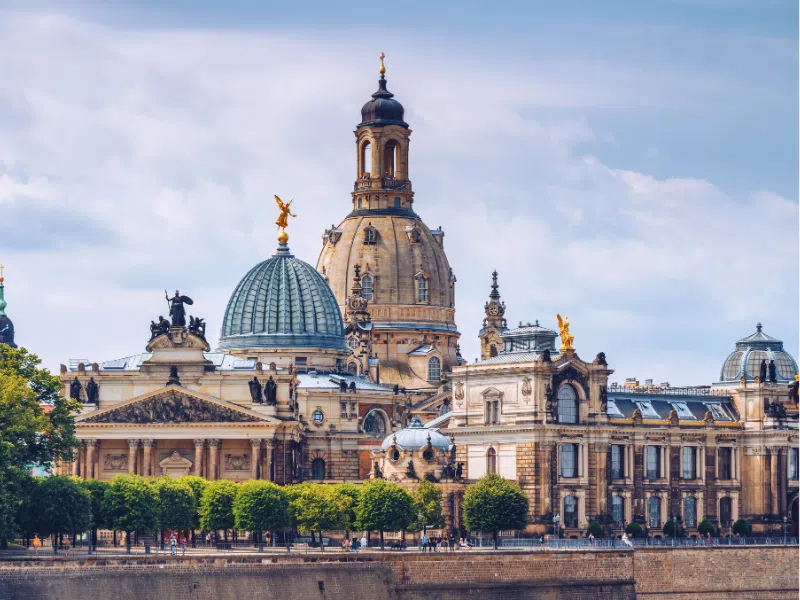
Dresden was the glittering Baroque capital of the Saxon electors, almost entirely destroyed in February 1945 and patiently rebuilt over the following decades. Walking along the Elbe today, you see both stories at once: palaces, churches and galleries, and the dark scorch marks on their stones. Here are the facts and stories that make the city special.
10 fun facts about Dresden
- A church rebuilt from its own rubble: the Frauenkirche, built between 1726 and 1743 by George Bähr, collapsed on 15 February 1945. It was rebuilt after German reunification and consecrated again on 30 October 2005.
- A cross from Britain: the golden orb and cross on top of the Frauenkirche were made by the British goldsmith Alan Smith, whose father had flown in the bombing raids on Dresden.
- A palace built for parties: the Zwinger was built between 1710 and 1728 by Matthäus Daniel Pöppelmann for Augustus the Strong. Today it houses the Old Masters Picture Gallery.
- The most famous cherubs in art: the gallery's star is Raphael's Sistine Madonna, bought for Dresden in 1754. The two bored-looking angels at the bottom of the painting appear on countless postcards.
- An opera house that rose twice: the Semperoper, by the architect Gottfried Semper, burned down in 1869 and was rebuilt by 1878. Destroyed in 1945, it reopened on 13 February 1985, exactly 40 years after the bombing.
- Where Strauss made history: three of Richard Strauss's operas premiered at the Semperoper: Salome in 1905, Elektra in 1909 and Der Rosenkavalier in 1911.
- Europe's first hard porcelain: in 1708 Johann Friedrich Böttger, working in Dresden for Augustus the Strong, produced the first European hard-paste porcelain. Two years later the Meissen porcelain manufactory was founded.
- A 102-metre parade of princes: the Fürstenzug on Augustusstrasse shows Saxony's rulers on about 23,000 Meissen porcelain tiles. It survived the 1945 bombing with only minimal damage.
- A World Heritage Site lost: the Dresden Elbe Valley was removed from UNESCO's World Heritage List in 2009 because of the new Waldschlösschen Bridge. It was only the second site ever to be delisted.
- One of Germany's oldest Christmas markets: the Striezelmarkt has been held since 1434.
The fall and rise of the Frauenkirche
On the night of 13 to 14 February 1945, Allied air raids destroyed Dresden's old town. The Frauenkirche survived the night, but the fires inside had burned it out, and on the morning of 15 February its great stone dome collapsed. For almost half a century the pile of blackened rubble stayed in the middle of the city as a memorial. In 1982 young people gathered there with candles in a silent protest for peace. After reunification, donors around the world paid for the rebuilding. Thousands of original stones were catalogued and set back in place, and you can still spot them as the dark patches in the pale new sandstone.
Augustus the Strong, explained
Frederick Augustus I became Elector of Saxony in 1694 and, as Augustus II, King of Poland in 1697. He turned Dresden into a Baroque showpiece, built the Zwinger and filled his treasure chamber, the Green Vault, with jewels and gold. Legend says he could break horseshoes with his bare hands and fathered more than 300 children; historians count far fewer. He died in 1733 and was buried in Wawel Cathedral in Kraków, while his heart was brought back to Dresden. His gilded equestrian statue, the Golden Rider, stands on Neustädter Markt.
What to eat in Dresden
- Dresdner Christstollen: the city's famous Christmas fruit bread, a protected geographical indication in the EU since 2010. Genuine loaves carry a golden seal.
- Eierschecke: a Saxon cake in three layers, with a yeast base, a quark filling and a golden egg-custard top.
- Quarkkäulchen: small pan-fried cakes of quark and potato, served with cinnamon sugar and apple sauce.
- Sauerbraten: beef marinated for days and braised, often with raisins in a sweet and sour sauce.
- Saxon wine: vineyards line the Elbe around Radebeul and Meissen in one of Germany's smallest wine regions.
Good to know before you go
- Entry to the Frauenkirche is free outside services and concerts, but climbing the dome needs a ticket.
- The Historic Green Vault admits visitors with timed tickets in small numbers, so book ahead.
- For the classic skyline, walk along Brühl's Terrace, the 'Balcony of Europe', or cross the Augustus Bridge to the north bank of the Elbe.
- Meissen is an easy half-day trip by S-Bahn, and the sandstone cliffs of Saxon Switzerland, including the Bastei bridge, make a good day out.
Explore Dresden with World City Trail
Our Dresden scavenger hunt turns these sights into a game you play on your phone. The route links 10 stops and takes around two hours, with about 24 minutes of walking: the Zwinger, the Frauenkirche, the Semperoper and more of the old town's main sights.
At each stop you solve a puzzle and hear a short story, at your own pace. You can start whenever you like.
Play the Dresden scavenger hunt →
Facts checked in October 2026.