
Padua has been a university town since 1222, and students still fill its arcaded streets. It also holds Giotto's greatest frescoes, one of the largest squares in Europe and the tomb of a saint who draws pilgrims from all over the world. Shakespeare chose it as the setting of The Taming of the Shrew. Here are the facts and stories that make the city special.
10 fun facts about Padua
- A chapel painted blue: the Scrovegni Chapel was frescoed by Giotto in the early 1300s for the banker Enrico Scrovegni. Its scenes from the lives of Mary and Christ, under a deep blue vault scattered with stars, are seen as a turning point in Western painting.
- A university since 1222: the University of Padua is one of the oldest in the world. Nicolaus Copernicus studied here, and Galileo Galilei taught mathematics here from 1592 to 1610.
- The first woman with a doctorate: in 1678 Elena Lucrezia Cornaro Piscopia received a degree in philosophy in Padua, the first woman known to have been awarded a doctorate by a university.
- A theatre for anatomy lessons: Palazzo Bo holds an anatomical theatre built in 1594, the oldest surviving permanent one of its kind.
- The oldest university garden still in place: the Orto Botanico was founded in 1545 and still has its original site and layout. A palm planted in 1585 caught the eye of Goethe when he visited in 1786, and it is still known as Goethe's palm.
- A city of painted walls: Padua has two UNESCO World Heritage Sites, the botanical garden (1997) and its fourteenth-century fresco cycles (2021), spread over eight buildings including the Scrovegni Chapel and Palazzo della Ragione.
- A square ringed by statues: Prato della Valle covers about 90,000 square metres, one of the largest squares in Europe. Its central island, Isola Memmia, is surrounded by a small canal lined with 78 statues of people linked to the city.
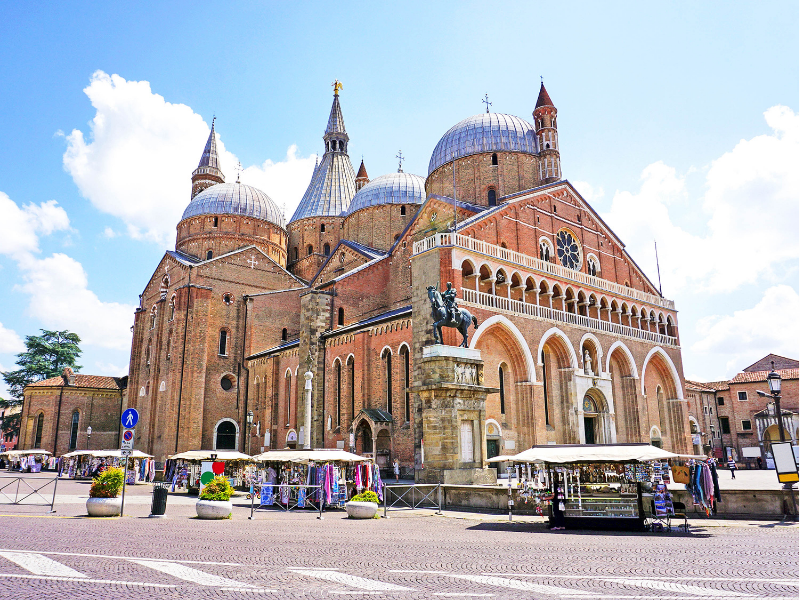
- A saint made in record time: Saint Anthony died near Padua in 1231 and was made a saint less than a year later. His tongue is kept as a relic in the Treasury Chapel of the basilica that holds his tomb.
- Donatello's bronze horseman: in front of the Basilica of Saint Anthony stands Donatello's statue of the mercenary commander Gattamelata, finished in 1453. It is one of the first large bronze equestrian statues made since antiquity.
- A hall like an upturned ship: the medieval Palazzo della Ragione, once the city's law court, has an upper hall more than 80 metres long under a wooden roof shaped like a ship's hull.
The Trojan founder of Padua
Legend says Padua was founded by Antenor, a Trojan prince who escaped the fall of Troy and led his people across the sea to the lagoons of the Veneto. The Roman historian Livy, who was born in Padua, then called Patavium, tells the story in the opening lines of his history of Rome. In the 13th century, workers dug up a large stone coffin, and the scholar Lovato Lovati declared it Antenor's tomb. The city raised it on columns in what is now Piazza Antenore, near the university, and it is still there. Historians agree it has nothing to do with Troy, but Padua has never let go of its Trojan founder.
Padua's three 'withouts'
An old saying sums up Padua through three things that are missing something. The saint without a name is Saint Anthony: his basilica is so central to local life that everyone simply calls it 'il Santo'. The meadow without grass is Prato della Valle, a swampy field until the 18th century, when it was turned into a monumental square. The café without doors is Caffè Pedrocchi, which opened in 1831 and stayed open day and night until 1916.
What to eat in Padua
- Spritz: Aperol was launched in Padua in 1919. Order a spritz in Piazza delle Erbe or Piazza dei Frutti at aperitivo time, when the squares fill up after work.
- Bigoli: thick, rough Venetian pasta, served with duck ragù or with the classic sauce of onions and anchovies.
- Risi e bisi: rice and young peas cooked somewhere between a risotto and a soup, a Venetian spring dish.
- Caffè Pedrocchi: espresso topped with mint cream and cocoa, the signature drink of the café without doors.
- Torta pazientina: Padua's own layered cake of almond pastry, zabaglione and dark chocolate shavings.
Good to know before you go
- The Scrovegni Chapel can only be visited in small groups at booked times, with a short wait in a climate-controlled room before you go in. Book well ahead, especially at weekends.
- The anatomical theatre and the historic halls of Palazzo Bo can only be seen on guided tours run by the university, so check the schedule before your visit.
- Venice is about half an hour away by train, so Padua makes a calmer base for visiting it.
- For a day trip, head to the Euganean Hills south-west of the city. In the village of Arquà Petrarca you can visit the house where the poet Petrarch spent his last years.
Explore Padua with World City Trail
Our Padua scavenger hunt turns these sights into a game you play on your phone. The route links 10 stops and takes around two hours, with about 42 minutes of walking, and passes sights such as the Scrovegni Chapel and Piazza Garibaldi.
At each stop you solve a puzzle and hear a short story, at your own pace. You can start whenever you like.
Play the Padua scavenger hunt →
Facts checked in October 2026.