
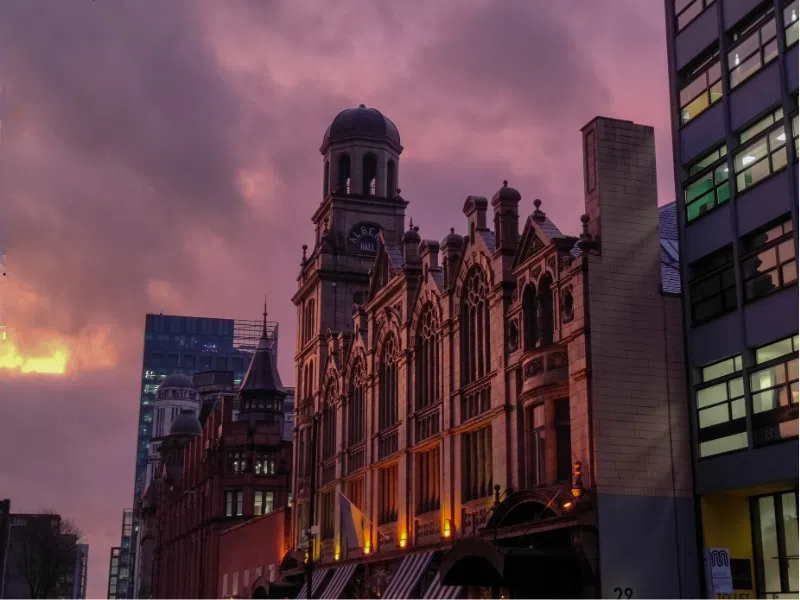
Manchester was the world's first industrial city, and it has been inventing things ever since: railways, computers, new materials and some of the most famous bands and football clubs on earth. Under the new glass towers you still find the warehouses, mills and Victorian halls that cotton paid for. Here are the facts and stories that make Manchester special.
10 fun facts about Manchester
- The first inter-city railway: the Liverpool and Manchester Railway opened in 1830. Its Manchester terminus on Liverpool Road is the world's oldest surviving passenger railway station and is now part of the Science and Industry Museum.
- A canal that started a boom: the Bridgewater Canal, opened in 1761 to bring coal into Manchester, is often called the first canal of the Industrial Revolution.
- A free library since 1653: Chetham's Library is the oldest free public library in the English-speaking world. In 1845 Karl Marx and Friedrich Engels studied together at a table by its window.
- The birthplace of the suffragettes: in 1903 Emmeline Pankhurst founded the Women's Social and Political Union at her home in Manchester. Her statue has stood in St Peter's Square since 2018.
- Splitting the atom: at the University of Manchester, Ernest Rutherford carried out the experiments, from 1917, that are remembered as the first splitting of the atom.
- The first stored-program computer: on 21 June 1948 the Manchester Baby, built at the university, ran the first program stored in a computer's electronic memory.
- A Nobel Prize material: in 2004 Andre Geim and Konstantin Novoselov isolated graphene, a layer of carbon one atom thick, in Manchester. They won the Nobel Prize in Physics for it in 2010.
- Where Rolls met Royce: Charles Rolls and Henry Royce first met at the Midland Hotel in May 1904, the meeting that led to Rolls-Royce.
- The worker bee: a bee has appeared on the city's coat of arms since 1842 as a symbol of industry. After the Manchester Arena attack in 2017 it became a symbol of unity, and you will see it on bollards, bins and tattoos.
- A cathedral of books: the neo-Gothic John Rylands Library opened in 1900, built by Enriqueta Rylands in memory of her husband, the cotton magnate John Rylands.
Peterloo: the day Manchester changed Britain
On 16 August 1819 a crowd of around 60,000 people gathered on St Peter's Field to hear the speaker Henry Hunt demand the vote for ordinary people. Magistrates ordered his arrest, and cavalry charged into the crowd with sabres drawn. About 18 people died and several hundred were injured. A local editor called it the Peterloo Massacre, an ironic nod to the Battle of Waterloo four years earlier. The outrage helped found the Manchester Guardian in 1821, and the fight for the vote went on for decades. In 2019, for the 200th anniversary, a memorial by the artist Jeremy Deller was unveiled near the site.
Cottonopolis and the Royal Exchange, explained
In the 19th century so much of the world's cotton was spun and traded here that Manchester was nicknamed Cottonopolis. Its heart was the Royal Exchange, where merchants met to buy and sell. After an extension finished in 1931, its trading hall was the largest in England. Cotton trading ended in 1968, and in 1976 a theatre opened inside the hall: a seven-sided steel and glass module, described as the largest theatre in the round in the world. In 1996 an IRA bomb exploded nearby and shifted the dome; the theatre reopened in 1998 after repairs.
What to eat in Manchester
- Manchester tart: shortcrust pastry with raspberry jam, custard and coconut, a school-dinner classic.
- Eccles cake: flaky pastry packed with currants, named after the town of Eccles just west of the city.
- Vimto: the purple fruit drink was created in Manchester in 1908 and is still made in the region.
- The Curry Mile: Wilmslow Road in Rusholme is lined with South Asian restaurants and dessert shops, busiest late in the evening.
- Lancashire hotpot: lamb and onions slow-baked under a lid of sliced potatoes, the ultimate rainy-day dish.
Good to know before you go
- Manchester Art Gallery and the John Rylands Library are free to enter, though special exhibitions may charge.
- Chetham's Library is in a medieval building next to the cathedral and can only be visited at certain times, so check before you go.
- For football fans, both Old Trafford and the Etihad Stadium run stadium tours, which are best booked ahead on match weeks.
- The Peak District is about an hour away by train, ideal for a day of hiking.
Explore Manchester with World City Trail
Our Manchester scavenger hunt turns these sights into a game you play on your phone. The route links 10 stops and takes around three hours, with about 58 minutes of walking, and leads you past the National Football Museum, Manchester Cathedral and the Royal Exchange, among other sights.
At each stop you solve a puzzle and hear a short story, at your own pace. You can start whenever you like and play in English, German, French, Italian, Spanish or Dutch.
Play the Manchester scavenger hunt →
Facts checked in October 2026.