
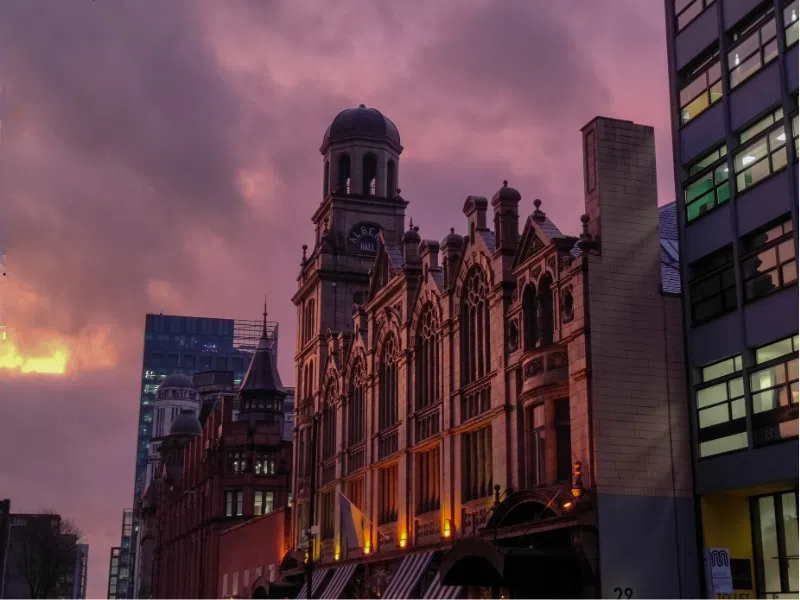
Manchester was the world's first industrial city, and it has been inventing things ever since: railways, computers, new materials and some of the most famous bands and football clubs on earth. Under the new glass towers you still find the warehouses, mills and Victorian halls that cotton paid for. Here are the facts and stories that make Manchester special.
10 anecdotes sur Manchester
- The first inter-city railway: the Liverpool and Manchester Railway opened in 1830. Its Manchester terminus on Liverpool Road is the world's oldest surviving passenger railway station and is now part of the Science and Industry Museum.
- Un canal qui lança un essor : le canal de Bridgewater, ouvert en 1761 pour acheminer le charbon jusqu’à Manchester, est souvent présenté comme le premier canal de la révolution industrielle.
- A free library since 1653: Chetham's Library is the oldest free public library in the English-speaking world. In 1845 Karl Marx and Friedrich Engels studied together at a table by its window.
- The birthplace of the suffragettes: in 1903 Emmeline Pankhurst founded the Women's Social and Political Union at her home in Manchester. Her statue has stood in St Peter's Square since 2018.
- La fission de l’atome : à l’université de Manchester, Ernest Rutherford mena à partir de 1917 les expériences restées dans l’histoire comme la première « division » de l’atome.
- The first stored-program computer: on 21 June 1948 the Manchester Baby, built at the university, ran the first program stored in a computer's electronic memory.
- Un matériau prix Nobel : en 2004, Andre Geim et Konstantin Novoselov isolèrent à Manchester le graphène, une couche de carbone épaisse d’un seul atome. Ils reçurent pour cela le prix Nobel de physique en 2010.
- Là où Rolls rencontra Royce : Charles Rolls et Henry Royce se rencontrèrent pour la première fois au Midland Hotel en mai 1904, rencontre dont naquit Rolls-Royce.
- The worker bee: a bee has appeared on the city's coat of arms since 1842 as a symbol of industry. After the Manchester Arena attack in 2017 it became a symbol of unity, and you will see it on bollards, bins and tattoos.
- Une cathédrale de livres : la John Rylands Library, de style néogothique, a ouvert en 1900. Enriqueta Rylands la fit construire en mémoire de son mari, le magnat du coton John Rylands.
Peterloo : le jour où Manchester changea la Grande-Bretagne
On 16 August 1819 a crowd of around 60,000 people gathered on St Peter's Field to hear the speaker Henry Hunt demand the vote for ordinary people. Magistrates ordered his arrest, and cavalry charged into the crowd with sabres drawn. About 18 people died and several hundred were injured. A local editor called it the Peterloo Massacre, an ironic nod to the Battle of Waterloo four years earlier. The outrage helped found the Manchester Guardian in 1821, and the fight for the vote went on for decades. In 2019, for the 200th anniversary, a memorial by the artist Jeremy Deller was unveiled near the site.
Cottonopolis et le Royal Exchange en quelques mots
In the 19th century so much of the world's cotton was spun and traded here that Manchester was nicknamed Cottonopolis. Its heart was the Royal Exchange, where merchants met to buy and sell. After an extension finished in 1931, its trading hall was the largest in England. Cotton trading ended in 1968, and in 1976 a theatre opened inside the hall: a seven-sided steel and glass module, described as the largest theatre in the round in the world. In 1996 an IRA bomb exploded nearby and shifted the dome; the theatre reopened in 1998 after repairs.
Que manger à Manchester
- Manchester tart : une pâte brisée garnie de confiture de framboises, de crème anglaise épaisse et de noix de coco, un classique des cantines scolaires.
- Eccles cake : une pâte feuilletée garnie de raisins de Corinthe, du nom de la petite ville d’Eccles, juste à l’ouest.
- Vimto : cette boisson violette aux fruits a été créée à Manchester en 1908 et est toujours fabriquée dans la région.
- Le Curry Mile : Wilmslow Road, à Rusholme, est bordée de restaurants sud-asiatiques et de boutiques de desserts, très animés tard le soir.
- Lancashire hotpot : agneau et oignons cuits lentement au four sous une couche de pommes de terre en tranches, le plat parfait par temps de pluie.
Bon à savoir avant de partir
- La Manchester Art Gallery et la John Rylands Library sont gratuites, mais les expositions temporaires peuvent être payantes.
- Chetham's Library is in a medieval building next to the cathedral and can only be visited at certain times, so check before you go.
- Pour les fans de football, Old Trafford et l’Etihad Stadium proposent des visites des stades, à réserver de préférence à l’avance les semaines de match.
- Le Peak District est à environ une heure de train, idéal pour une journée de randonnée.
Découvrir Manchester avec World City Trail
Notre chasse au trésor à Manchester transforme ces lieux en un jeu sur votre téléphone. Le parcours relie 10 étapes et dure environ trois heures, dont environ 58 minutes de marche, et vous fait passer notamment par le National Football Museum, la cathédrale et le Royal Exchange.
À chaque étape, vous résolvez une énigme et écoutez une courte histoire, à votre rythme. Vous pouvez commencer quand vous voulez et jouer en français, anglais, allemand, italien, espagnol ou néerlandais.
Jouer à la chasse au trésor de Manchester →
Faits vérifiés en octobre 2026.