
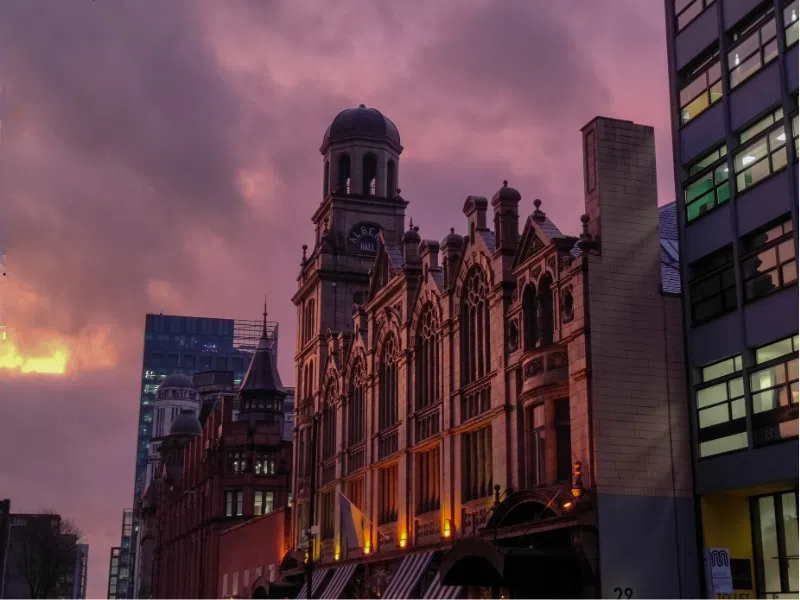
Manchester was the world's first industrial city, and it has been inventing things ever since: railways, computers, new materials and some of the most famous bands and football clubs on earth. Under the new glass towers you still find the warehouses, mills and Victorian halls that cotton paid for. Here are the facts and stories that make Manchester special.
10 curiosità su Manchester
- The first inter-city railway: the Liverpool and Manchester Railway opened in 1830. Its Manchester terminus on Liverpool Road is the world's oldest surviving passenger railway station and is now part of the Science and Industry Museum.
- Un canale che fece da scintilla: il Bridgewater Canal, aperto nel 1761 per portare carbone a Manchester, è spesso definito il primo canale della rivoluzione industriale.
- A free library since 1653: Chetham's Library is the oldest free public library in the English-speaking world. In 1845 Karl Marx and Friedrich Engels studied together at a table by its window.
- The birthplace of the suffragettes: in 1903 Emmeline Pankhurst founded the Women's Social and Political Union at her home in Manchester. Her statue has stood in St Peter's Square since 2018.
- La scissione dell’atomo: all’Università di Manchester, Ernest Rutherford condusse dal 1917 gli esperimenti ricordati come la prima scissione dell’atomo.
- The first stored-program computer: on 21 June 1948 the Manchester Baby, built at the university, ran the first program stored in a computer's electronic memory.
- Un materiale da Nobel: nel 2004 Andre Geim e Konstantin Novoselov isolarono a Manchester il grafene, uno strato di carbonio spesso un solo atomo. Nel 2010 ricevettero per questo il premio Nobel per la fisica.
- Dove Rolls conobbe Royce: Charles Rolls e Henry Royce si incontrarono per la prima volta al Midland Hotel nel maggio 1904, l’incontro da cui nacque la Rolls-Royce.
- The worker bee: a bee has appeared on the city's coat of arms since 1842 as a symbol of industry. After the Manchester Arena attack in 2017 it became a symbol of unity, and you will see it on bollards, bins and tattoos.
- Una cattedrale di libri: la neogotica John Rylands Library aprì nel 1900. La fece costruire Enriqueta Rylands in memoria del marito, il magnate del cotone John Rylands.
Peterloo: il giorno in cui Manchester cambiò la Gran Bretagna
On 16 August 1819 a crowd of around 60,000 people gathered on St Peter's Field to hear the speaker Henry Hunt demand the vote for ordinary people. Magistrates ordered his arrest, and cavalry charged into the crowd with sabres drawn. About 18 people died and several hundred were injured. A local editor called it the Peterloo Massacre, an ironic nod to the Battle of Waterloo four years earlier. The outrage helped found the Manchester Guardian in 1821, and the fight for the vote went on for decades. In 2019, for the 200th anniversary, a memorial by the artist Jeremy Deller was unveiled near the site.
Cottonopolis e il Royal Exchange in breve
In the 19th century so much of the world's cotton was spun and traded here that Manchester was nicknamed Cottonopolis. Its heart was the Royal Exchange, where merchants met to buy and sell. After an extension finished in 1931, its trading hall was the largest in England. Cotton trading ended in 1968, and in 1976 a theatre opened inside the hall: a seven-sided steel and glass module, described as the largest theatre in the round in the world. In 1996 an IRA bomb exploded nearby and shifted the dome; the theatre reopened in 1998 after repairs.
Cosa mangiare a Manchester
- Manchester tart: pasta frolla con marmellata di lamponi, crema pasticcera e cocco, un classico delle mense scolastiche.
- Eccles cake: pasta sfoglia piena di uvetta di Corinto, che prende il nome dalla cittadina di Eccles appena a ovest.
- Vimto: la bibita viola alla frutta fu creata a Manchester nel 1908 ed è ancora prodotta nella zona.
- La Curry Mile: Wilmslow Road, a Rusholme, è fiancheggiata da ristoranti dell’Asia meridionale e pasticcerie, animatissimi la sera tardi.
- Lancashire hotpot: agnello e cipolle cotti a lungo in forno sotto uno strato di patate a fette, il piatto perfetto per i giorni di pioggia.
Da sapere prima di partire
- La Manchester Art Gallery e la John Rylands Library sono a ingresso libero, anche se le mostre temporanee possono essere a pagamento.
- Chetham's Library is in a medieval building next to the cathedral and can only be visited at certain times, so check before you go.
- Per i tifosi, sia l’Old Trafford sia l’Etihad Stadium offrono visite guidate, da prenotare in anticipo nelle settimane di partita.
- Il Peak District dista circa un’ora di treno, ideale per una giornata di escursioni.
Scopri Manchester con World City Trail
La nostra caccia al tesoro a Manchester trasforma questi luoghi in un gioco sul tuo telefono. Il percorso collega 10 tappe e dura circa tre ore, con circa 58 minuti a piedi, e ti porta tra l’altro al National Football Museum, alla cattedrale e al Royal Exchange.
A ogni tappa risolvi un enigma e ascolti una breve storia, al tuo ritmo. Puoi iniziare quando vuoi e giocare in italiano, inglese, tedesco, francese, spagnolo o olandese.
Gioca alla caccia al tesoro di Manchester →
Fatti verificati a ottobre 2026.