
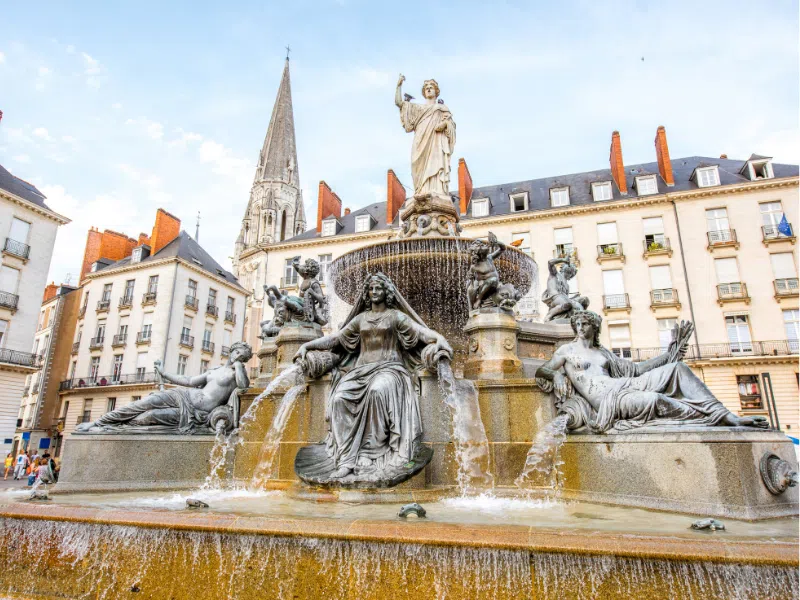
Nantes was the capital of the Dukes of Brittany, then a great Atlantic port, and today it is better known for a 12-metre mechanical elephant than for its ships. Its castle, its white cathedral and its streets of merchants' houses sit on the Loire, a short drive from the ocean. Here are the facts and stories that make the city special.
10 fun facts about Nantes
- An edict that changed France: in 1598 King Henry IV signed the Edict of Nantes, which gave French Protestants freedom of worship and ended decades of religious war. Louis XIV revoked it in 1685.
- A ducal castle in the city centre: the Château des ducs de Bretagne was begun in 1466 by Duke Francis II. Its white walls and moat now hold the city's history museum.
- A cathedral that took 457 years: the first stone of the Cathedral of Saint-Pierre-et-Saint-Paul was laid in 1434, and the building was only completed in 1891.
- Two fires in one lifetime: a roof fire in 1972 led to a long restoration of the cathedral, and on 18 July 2020 an arson attack destroyed its great organ, built in 1621.
- A ducal tomb in white marble: inside the cathedral stands the tomb of Duke Francis II and his wife Marguerite de Foix, made in the early 16th century by the sculptor Michel Colombe.
- Jules Verne was born here: the author of Twenty Thousand Leagues Under the Sea was born in Nantes on 8 February 1828. A museum overlooking the Loire is dedicated to him.
- The home of the Petit Beurre: the biscuit maker LU, short for Lefèvre-Utile, created its famous butter biscuit in Nantes in 1886. Its old factory tower is now the Lieu Unique arts centre.
- A port with a dark past: in the 18th century Nantes was France's leading slave-trading port. In 2012 the city opened the Memorial to the Abolition of Slavery along the Loire quays.
- A shopping arcade on three levels: the Passage Pommeraye, opened in 1843, links two streets at different heights with staircases, galleries and statues under a glass roof.
- Green capital: Nantes was European Green Capital in 2013, and a green line painted on the pavements leads visitors past its artworks and landmarks.
Anne of Brittany, duchess and twice queen
Anne of Brittany was born in the castle in 1477, the daughter of Duke Francis II. She became duchess at eleven, when Brittany was still an independent duchy that France wanted to absorb. To keep the peace she married King Charles VIII of France in 1491, and after his death she married his successor, Louis XII, in 1499, so she was queen of France twice. She fought to keep Brittany's rights and is still a heroine for many Bretons. When she died in 1514, she asked for her heart to be brought back to Nantes; it came in a gold reliquary and was placed with her parents. Brittany was formally united with France in 1532.
Les Machines de l'Île, explained
On the Île de Nantes, in the halls of the city's old shipyards, artists build giant machines inspired by Jules Verne and Leonardo da Vinci. The best known is the Great Elephant, launched in 2007: 12 metres tall and 8 metres wide, made of 45 tonnes of wood and steel, it carries up to 49 passengers on a slow walk, swinging its trunk and spraying water. Nearby, the Carousel of Marine Worlds, opened in 2012, stacks giant squid, crabs and fish on three levels nearly 25 metres high. You can watch the workshop through a gallery and see the next machines being built.
What to eat in Nantes
- Beurre blanc: a sauce of butter, shallots and white wine or vinegar, created in the Nantes area and served with fish from the Loire.
- Muscadet: the dry white wine of the vineyards south-east of the city, the classic match for oysters and seafood.
- Gâteau nantais: a dense almond cake soaked in rum and topped with icing, born of the days when sugar and rum arrived through the port.
- LU biscuits: Petit Beurre and other LU biscuits are sold all over town, and you can see the brand's history in the old factory tower.
- Berlingots nantais: small pyramid-shaped boiled sweets in bright colours, sold in tins as a souvenir.
Good to know before you go
- The courtyard and ramparts of the castle are free to walk around. The history museum inside needs a ticket.
- Take the Navibus river shuttle from the centre across the Loire to Trentemoult, an old fishing village of brightly painted houses.
- In summer, the Voyage à Nantes festival adds temporary artworks along the green line, and the Estuaire art trail follows the Loire down to Saint-Nazaire.
Explore Nantes with World City Trail
Our Nantes scavenger hunt turns these sights into a game you play on your phone. The route links 10 stops and takes around two hours, with about 36 minutes of walking, and its stops include the Cathedral of Saint-Pierre-et-Saint-Paul.
At each stop you solve a puzzle and hear a short story, at your own pace. You can start whenever you like.
Play the Nantes scavenger hunt →
Facts checked in October 2026.