What is the Nantes self-guided walking tour?
The Nantes self-guided walking tour is a walk through the centre of the city with audio narration on your phone in place of a guide. Reckon on about 3 hours: 36 minutes of that is walking, the route covers 2.9 km, and there are 10 stops where you pause to listen. You choose the day and the time, and you stay at each stop for as long as it holds you.
At the cathedral the narration describes the tomb of Duke Francis II, where the figure of Prudence has a young woman's face in front and an old man's behind. At the castle you hear about his daughter Anne of Brittany, twice Queen of France, and on Place Royale the fountain of 1865 shows Nantes standing above the Loire and its tributaries. The theatre owes its name to the financier Graslin, who built up the district around it, and on the Quai de la Fosse a memorial recalls the city's past as France's main slave-trading port in the 18th century.
- Durationabout 3 hours
- Walkingabout 36 min · 2.9 km
- Stops10
- LanguagesEnglish, German, French, Italian, Spanish, Dutch
What you do on the walking tour
Listen
Each stop has its history, its legends and the details that are easy to overlook. If you prefer reading, the same text is on your screen.
Walk on
The way from one stop to the next is shown in Google Maps: 36 minutes on foot over 2.9 km, at whatever pace you like.
Take a break
Stop for a coffee in the Bouffay quarter or spend an hour in a museum, then carry on later the same day or on another one.
Eat and shop
Tips for food and local shops near the route come with the stops, and in the app you can change the first stop and the order.
See the route and attractions →
How it works
- Book online Choose the number of people. Your booking reference arrives by email straight away.
- Get the app Download the World City Trail app from the App Store or Google Play and enter your booking reference.
- Walk when you like Start whenever you are ready, walk at your own pace and pause any time. No guide, no fixed schedule.
Who the walking tour is for
A first visit
One walk joins the medieval lanes, the castle, the 18th-century squares and the Loire quays, and explains what you see.
Anyone who avoids groups
No flag to follow and no fixed departure: stay where something interests you and move on when you want.
Shopping in the centre
Passage Pommeraye and the streets around Place Royale are on the route, so browsing the shops fits naturally into the walk.
Good to know
- Bring a charged smartphone with mobile data; a power bank helps.
- No entry tickets needed: everything happens outside the buildings. Going inside is optional and paid separately.
- Family friendly; children must be accompanied by an adult.
- Not suitable for wheelchair users and difficult with strollers.
- Groups of up to 5 work best; larger groups split up, one ticket per person.
- Every purchase helps support stray cats and dogs in Greece.
The walk stop by stop: Musée d'Arts, the castle, Passage Pommeraye, the Loire
10 stops · about 36 min walking · start: Musée d'Arts de Nantes · finish: Memorial to the Abolition of Slavery
From the Musée d'Arts de Nantes the walk reaches the cathedral within minutes and continues to the moat and walls of the Château des ducs de Bretagne. In the narrow streets of the Bouffay you pass Église Sainte-Croix, then the tall spire of the Basilique Saint-Nicolas leads you on to Place Royale. Passage Pommeraye, with its staircase over three levels, and Théâtre Graslin follow, and after the Natural History Museum the walk ends at the Memorial to the Abolition of Slavery beside the Loire. The app lets you change the start and the order, and no stop asks for a ticket.
Open the route map ↗
1Musée d'Arts de NantesStart
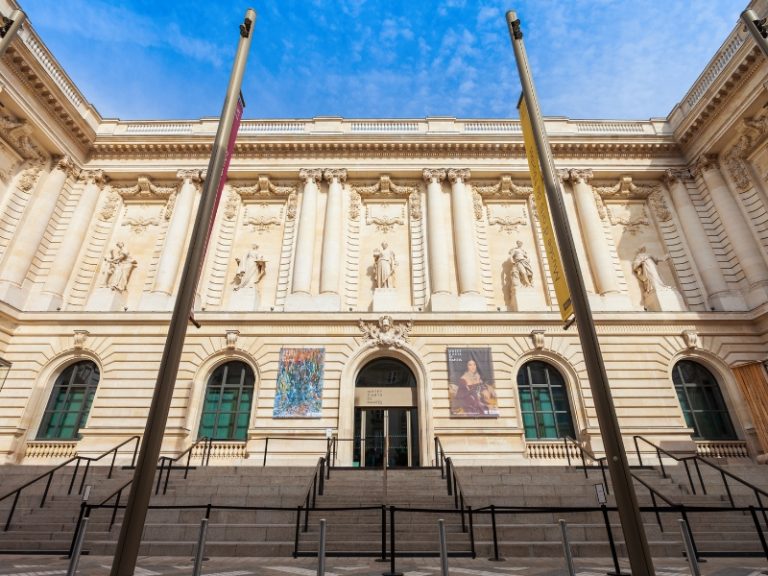
The city's fine arts museum occupies a palace completed around 1900 and reopened in 2017 after a long renovation that added a contemporary wing. Its collections run from the 13th century to the present day, behind a monumental stone façade with tall arched windows.
2Nantes Cathedral
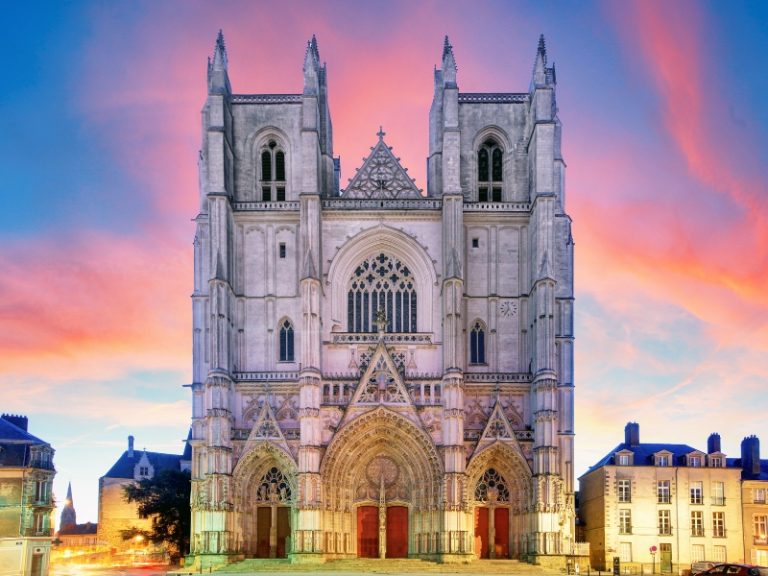
Building of the Cathedral of Saint Peter and Saint Paul began in 1434 and was only completed in 1891, yet it kept a unified Gothic style in pale tufa stone. Inside lies the Renaissance tomb of Duke Francis II of Brittany, carved by Michel Colombe, where the statue of Prudence has two faces: a young woman in front and an old man behind.
3Château des ducs de Bretagne
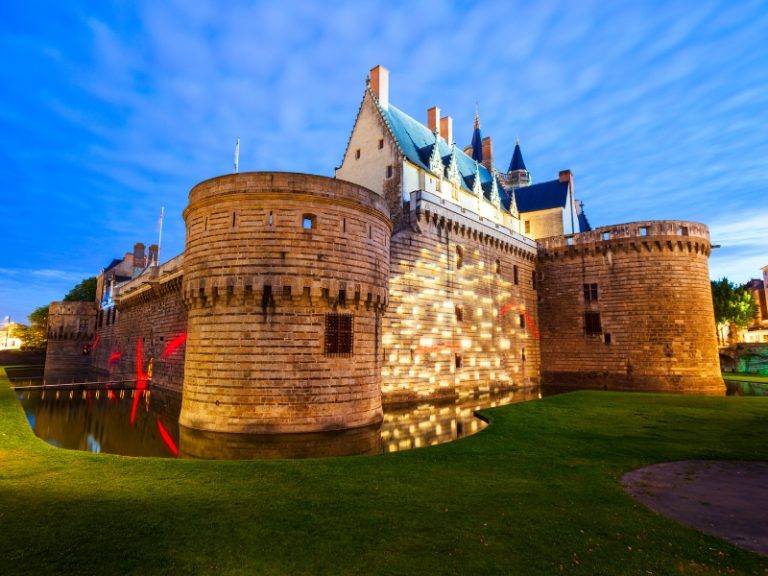
Duke Francis II began rebuilding this castle in 1466, and his daughter Anne of Brittany, twice Queen of France, continued the work. Behind its moat and walls, a fortress encloses an elegant residence of white tufa stone. Today it houses the Nantes History Museum, and you can walk along its ramparts.
4Église Sainte-Croix
This church in the old Bouffay quarter was built mainly in the 17th century. In the 19th century the city's belfry, with its clock and bells, was placed on top of its tower, where angels blowing trumpets still keep watch over the narrow streets around it.
Read the full story →
5Basilique Saint-Nicolas
Built between 1844 and 1869 to designs by Jean-Baptiste Lassus, this basilica is one of the first large neo-Gothic churches in France. Its slender spire rises high above the shopping streets of the centre, and the church was restored after being damaged by bombing in the Second World War.
6Place Royale
The architect Mathurin Crucy designed this elegant square at the end of the 18th century to link the old town with the new districts to the west. Its fountain of 1865 shows a figure of Nantes standing above statues of the Loire and its tributaries. Badly damaged in the Second World War, the square was rebuilt in its original style.
7Passage Pommeraye
Opened in 1843, this covered arcade connects two streets at different heights with a monumental staircase over three levels. Look up at the glass roof, the sculpted figures and the iron railings of its galleries, which make it one of the finest 19th-century arcades in France.
8Théâtre Graslin
Designed by Mathurin Crucy and opened in 1788, the theatre is named after the financier Jean-Joseph-Louis Graslin, who developed the surrounding district. Its neoclassical portico of eight Corinthian columns is crowned by statues of the Muses, and the building is used today as an opera house.
9Natural History Museum
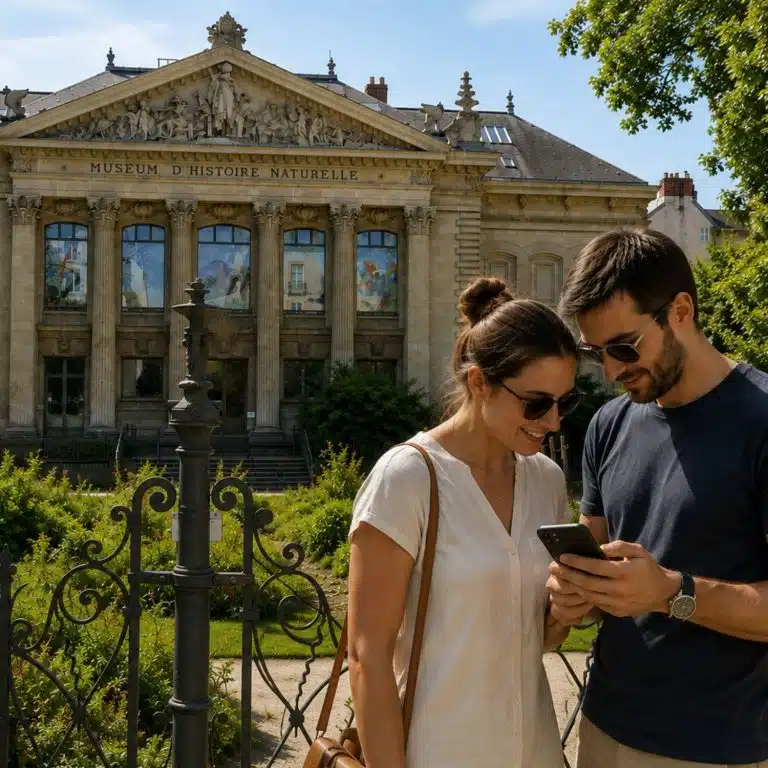
The Muséum d'histoire naturelle de Nantes has occupied the building of the city's former mint since the 1870s. Its collections cover zoology, geology and minerals, and the skeleton of a large whale is one of its best-known exhibits.
10Memorial to the Abolition of SlaveryFinish
Opened in 2012 on the Quai de la Fosse, this memorial recalls that Nantes was France's main slave-trading port in the 18th century. Glass plaques set into the riverside walk carry the names of slave-trading expeditions, and beneath the quay a passage displays the word freedom in many languages.
Only logged in customers who have purchased this product may leave a review.









Baudon Jean– Belgium –
Collected on GetYourGuide
Idéal pour une prise en main de la ville en un temps limite Rien à redire bon rapport prix qualité