
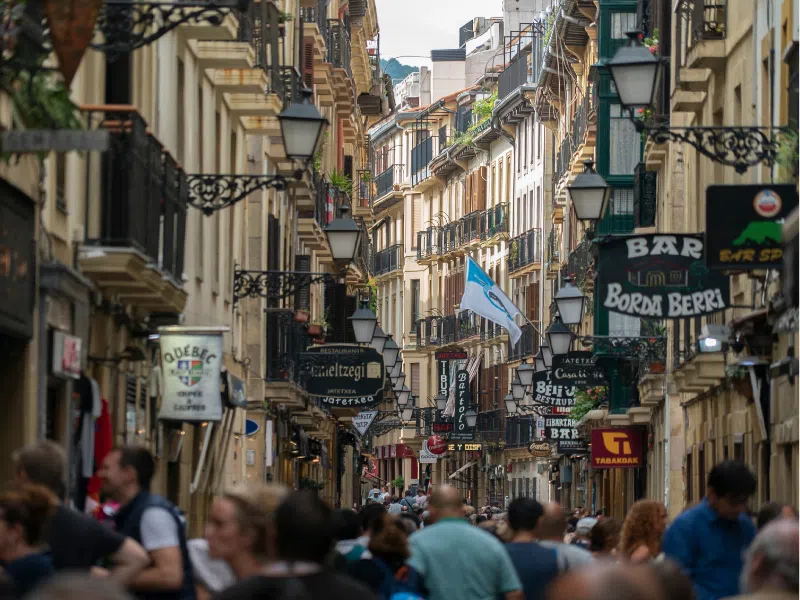
San Sebastián, Donostia in Basque, curls around a shell-shaped bay between two green hills, with a Belle Époque seafront on one side and a tight old town full of pintxo bars on the other. It became a royal summer resort in the 19th century and today is best known for what it puts on a plate. Here are the facts and stories behind the city.
10 fun facts about San Sebastián
- Two names, one saint: the Spanish name San Sebastián and the Basque name Donostia both come from Saint Sebastian. Officially the city uses both, written Donostia / San Sebastián.
- A queen's summer address: from the late 1880s Queen Maria Cristina, regent of Spain, spent her summers here, and the Miramar Palace was built for her above La Concha.
- A town hall that was a casino: the City Hall by the Alderdi Eder gardens opened on 1 July 1887 as the Gran Casino. Gambling was banned in Spain in 1924, and the town council moved in in 1947.
- Obelisks from Paris: the María Cristina Bridge was inaugurated on 20 January 1905, the feast of Saint Sebastian. Its four obelisks, each 18 metres high, are modelled on those of the Pont Alexandre III in Paris.
- A 75-metre spire: the neo-Gothic Good Shepherd Cathedral was consecrated in 1897. It only became a cathedral in 1953, and it is the largest church in Gipuzkoa.
- A square that was a bullring: the balconies around the Plaza de la Constitución still carry painted numbers, a reminder of the days when the square hosted bullfights and the balconies were rented out as seats.
- 24 hours of drumming: at midnight on 20 January, the mayor raises the city flag in the Plaza de la Constitución and the Tamborrada begins. For a whole day, companies of drummers march through the streets playing marches written by Raimundo Sarriegui in 1861.
- Sculptures that comb the wind: the Peine del Viento, three huge steel sculptures by Eduardo Chillida, has been anchored to the rocks at the end of Ondarreta beach since 1977.
- Cooking clubs: the city has dozens of gastronomic societies, private clubs where members cook for each other in shared kitchens.
- A festival since 1953: the San Sebastián International Film Festival has been held every September since 1953, making it one of the oldest film festivals in Europe.
The fire of 1813
In the summer of 1813, during the Peninsular War, French troops held San Sebastián and British and Portuguese forces laid siege to it. On 31 August they stormed the walls. The French retreated to the castle on Monte Urgull, the attackers sacked the town, and fire spread until almost all of it had burned. Only the houses on one street, then called Calle Trinidad, survived, reportedly because officers were quartered there. It has been called Calle 31 de Agosto ever since. Most of the old town you walk through today, including the Plaza de la Constitución, was rebuilt in the years after the fire. Every 31 August, residents switch off the lights and put candles on their balconies.
Pintxos, explained
Pintxos are small bites, often on a slice of bread and held together with a stick. In the bars of the Parte Vieja the counters are lined with cold ones, while hot pintxos are usually made to order from a list on the wall. The classic is the Gilda: an anchovy, a green olive and a pickled guindilla pepper on a skewer. The story goes that it was named after Rita Hayworth's 1946 film because, like her character, it was green, salty and a bit spicy.
What to eat in San Sebastián
- Txuleta: a thick beef rib steak grilled over coals and served rare, usually for two or more to share.
- Bacalao al pil-pil: salt cod cooked gently in olive oil and garlic, swirled until the oil turns into a silky sauce.
- Burnt Basque cheesecake: the creamy cheesecake with a dark, caramelised top was created at La Viña in the old town in 1990.
- Txakoli: a dry, lightly sparkling white wine from the coast nearby, poured from a height to wake up the bubbles.
Good to know before you go
- The funicular up Monte Igueldo has run since 1912. From the top you get the classic view over La Concha, plus an old-fashioned amusement park.
- Monte Urgull, behind the old town, is free to climb. Paths lead up to the castle of La Mota and the large statue of the Sacred Heart.
- Hotels fill up fast for the Tamborrada in January, Semana Grande in August and the film festival in September. The Euskotren line to Hendaye makes France an easy half-day trip.
Explore San Sebastián with World City Trail
Our San Sebastián scavenger hunt turns these sights into a game you play on your phone. The route links 10 stops and takes around three hours, with about 38 minutes of walking, and its stops include the María Cristina Bridge, the Good Shepherd Cathedral and the City Hall.
At each stop you solve a puzzle and hear a short story, at your own pace. You can start whenever you like and play in English, German, French, Italian or Spanish.
Play the San Sebastián scavenger hunt →
Facts checked in October 2026.