
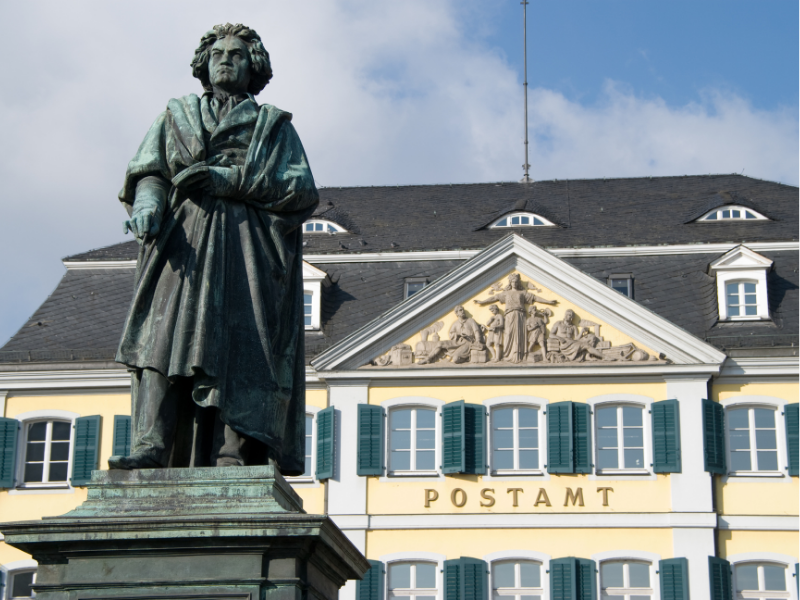
Bonn is a Rhine town of Roman origin that became, almost by accident, the capital of West Germany for four decades. It is also where Beethoven was born and where the gummy bear was invented. Here are the facts and stories that make the city special.
10 fun facts about Bonn
- Beethoven's birthplace: Ludwig van Beethoven was born in December 1770 in the house at Bonngasse 20. Today it is the Beethoven-Haus, a museum with one of the world's largest Beethoven collections.
- A monument paid for partly by Liszt: the bronze Beethoven statue on Münsterplatz was unveiled in 1845, for the 75th anniversary of the composer's birth. Franz Liszt gave a large sum to get it finished.
- Capital by 24 votes: on 3 November 1949 the new Bundestag chose Bonn over Frankfurt as the provisional seat of government, by 200 votes to 176.
- And replaced by 18 votes: on 20 June 1991 the Bundestag voted 338 to 320 to move to Berlin. The parliament and most of the government moved in 1999.
- Still a federal city: under a 1994 law Bonn kept the title Bundesstadt, and several federal ministries still have their main seat here, alongside a campus of United Nations organisations.
- The home of the gummy bear: Haribo stands for Hans Riegel Bonn. The company was registered in December 1920 in a house in the district of Kessenich, and its first gummy bears, then called dancing bears, followed in 1922. Its headquarters moved just outside the city in 2018.
- Older than 2,000 years: Bonn began as a Roman legionary camp on the Rhine and celebrated its 2,000th anniversary in 1989.
- Two Roman soldiers as patron saints: tradition says that Cassius and Florentius, legionaries of the Theban Legion, were beheaded for their faith where Bonn Minster now stands. The Minster, built mainly between the 11th and 13th centuries, is one of the oldest churches in Germany.
- A pink town hall with famous visitors: the Rococo Old Town Hall was built in 1737 and 1738 for Elector Clemens August. While Bonn was the capital, state guests such as John F. Kennedy and Charles de Gaulle stood on its steps to greet the crowds.
- A tunnel of cherry blossom: every April the cherry trees along Heerstraße and Breite Straße in the Altstadt bloom at the same time and turn the streets pink, drawing photographers from all over the world.
How Bonn became the capital
When the Federal Republic was founded in 1949, Frankfurt looked like the obvious choice for its seat of government. It was larger, central and had already hosted the first German parliament in 1848. Bonn's champion was Konrad Adenauer, the first chancellor, who had to deny again and again that he only wanted it because he lived across the Rhine in Rhöndorf. Supporters of Bonn argued that a small town would make it clear the arrangement was temporary until Berlin could be the capital again. On 3 November 1949 the Bundestag confirmed Bonn by 200 votes to 176. The provisional capital then lasted 41 years. The parliamentary high-rise known as the Langer Eugen now houses United Nations organisations.
Beethoven's Bonn, explained
Beethoven came from a family of musicians at the court of the Electors of Cologne, who lived in Bonn. His grandfather, also called Ludwig, was the court's Kapellmeister, and the young Beethoven played the organ and viola in the court orchestra as a teenager. In 1792 he left for Vienna to study with Joseph Haydn and never returned. The city has not forgotten him: the Beethoven-Haus holds manuscripts, letters and his last grand piano, and the Beethovenfest brings concerts to the city every year.
What to eat in Bonn
- Rheinischer Sauerbraten: beef marinated for days in vinegar and spices, served in a sweet-sour sauce with raisins, red cabbage and potato dumplings.
- Reibekuchen: crisp potato fritters, eaten with apple sauce or on dark rye bread, especially at markets and fairs.
- Himmel un Ääd: heaven and earth, a Rhineland classic of mashed potatoes and apple, served with fried black pudding.
- Bönnsch: the city's own cloudy, top-fermented beer, brewed in the old town at the Brauhaus Bönnsch.
- Gummy bears: the Haribo shop in the city centre sells far more varieties than you will find at home.
Good to know before you go
- The cherry blossom usually peaks in early to mid-April and only lasts a week or two. Go early in the morning to avoid the crowds.
- The Museum Mile on Willy-Brandt-Allee includes the Haus der Geschichte, which tells the story of post-war Germany, the Kunstmuseum and the Bundeskunsthalle.
- For views of the Rhine valley, cross to Königswinter and climb, or ride the rack railway, up the Drachenfels in the Siebengebirge hills.
- Cologne is only a short train ride away, so the two cities combine easily in one trip.
Explore Bonn with World City Trail
Our Bonn scavenger hunt turns these sights into a game you play on your phone. The route links 10 stops and takes around two hours, with about 30 minutes of walking, including Bonn Minster and the Old Town Hall.
At each stop you solve a puzzle and hear a short story, at your own pace. You can start whenever you like.
Play the Bonn scavenger hunt →
Facts checked in October 2026.