
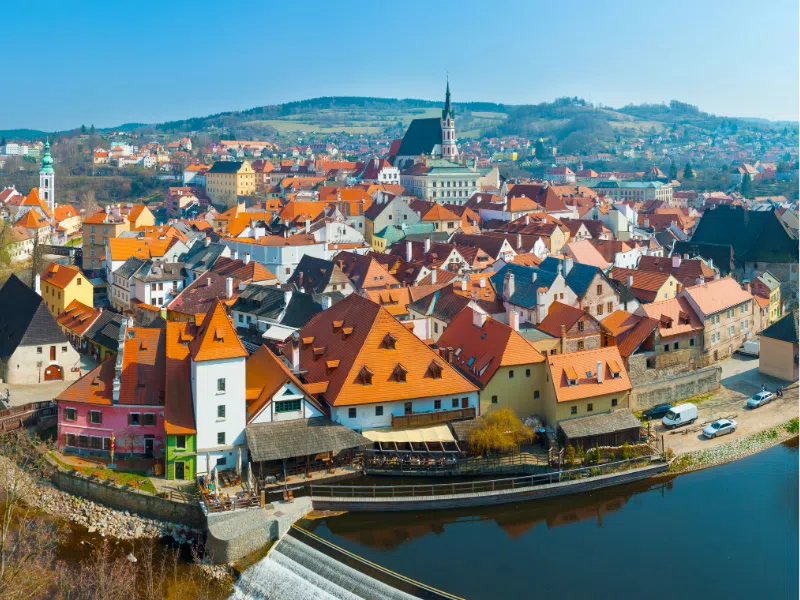
Český Krumlov sits inside a tight loop of the Vltava in South Bohemia, crowned by a castle complex that seems built for a much bigger city. Neglected for decades and restored after 1989, it is one of the best-preserved small historic towns in Central Europe. Here are the facts and stories that make it special.
10 fun facts about Český Krumlov
- A name from a bend in the river: Krumlov is usually traced to the German Krumme Aue, meaning crooked meadow, after the sharp curves of the Vltava.
- The second-largest castle in the country: the castle and chateau complex is the second largest in the Czech Republic after Prague Castle, with more than 40 buildings around five courtyards.
- Bears in the moat: bears have been kept at the castle since the 16th century, and the bear moat is first recorded in 1707. They recall a family legend that the Rosenbergs were related to the Italian Orsini, whose name comes from the word for bear.
- Three centuries of the rose: the Rosenbergs, whose emblem was a red five-petalled rose, ruled the town from 1302 until 1602, when the last of the line, Petr Vok, sold it to Emperor Rudolf II.
- A Baroque theatre with its machinery intact: the castle theatre was rebuilt in 1765–66 and still has its original stage machinery, scenery and costumes. The only comparable theatre is at Drottningholm in Sweden.
- A painted tower: the round Castle Tower, the oldest part of the castle, received its colourful Renaissance paintwork in the late 16th century. You can climb it for a view over the river loop.
- A bridge with several storeys: the Cloak Bridge, or Plášťový most, is a covered bridge on several levels that carries the castle across a deep ravine.
- A painter who had to leave: Egon Schiele, whose mother came from Český Krumlov, moved here in 1911, but locals objected to his way of life and his young models, and he left within months. An art centre in a former brewery now bears his name.
- A double monastery: the monastery founded by the Rosenbergs in the 14th century housed Minorite friars and Poor Clare nuns side by side, an unusual arrangement in Central Europe.
- A UNESCO town since 1992: the historic centre joined the World Heritage List in 1992, as its restoration was getting under way.
The White Lady of the Rosenbergs
The castle's most famous ghost is the White Lady, usually identified as Perchta of Rožmberk, born around 1429. She was married to Jan of Lichtenstein, who treated her badly, and the letters she wrote home about her unhappy marriage still survive. Legend says that after her death she began to appear in the Rosenberg castles, dressed in white. Her gloves tell what is coming: white gloves mean good news, black gloves foretell a death in the family. She is said to walk not only in Český Krumlov but also in other family seats, such as Jindřichův Hradec.
The castle complex, explained
The castle grew from a 13th-century Gothic stronghold on a rock above the Vltava into a sprawling Renaissance and Baroque residence. The Eggenbergs and then the Schwarzenbergs, who owned it from 1719 until 1947, added the theatre, the Cloak Bridge and a large Baroque garden. In the garden stands a revolving open-air auditorium, where the audience turns to face scenes set among the trees, a modern addition that has long been controversial. Today the whole complex belongs to the Czech state.
What to eat in Český Krumlov
- Svíčková: beef sirloin in a creamy root-vegetable sauce, served with bread dumplings, cranberries and whipped cream.
- Trout: fish from South Bohemian waters, often grilled whole with butter and herbs.
- Bramboráky: crisp potato pancakes flavoured with garlic and marjoram.
- Eggenberg beer: brewed in the town's old castle brewery, a short walk from the centre.
- Trdelník: rolled dough baked on a spit and sold on the streets. It is a recent tourist favourite rather than an old Czech tradition.
Good to know before you go
- The castle interiors and the Baroque theatre can be seen only on guided tours, most of which run from spring to autumn. Theatre tours have limited places, so book ahead.
- The Five-Petalled Rose Festival in June fills the old town with Renaissance costumes, music and knightly games.
- In summer you can rent a raft or canoe and float down the Vltava right through the town.
- České Budějovice, home of the Budvar brewery, and the white castle of Hluboká are easy half-day trips.
Explore Český Krumlov with World City Trail
Our Český Krumlov scavenger hunt turns these sights into a game you play on your phone. The route links 10 stops and takes around two hours, with about 25 minutes of walking, and includes the monastery complex, the Castle Tower and the Church of St Vitus.
At each stop you solve a puzzle and hear a short story, at your own pace. You can start whenever you like.
Play the Český Krumlov scavenger hunt →
Facts checked in October 2026.