What is the Dresden self-guided walking tour?
The Dresden self-guided walking tour is an audio walk through the centre of Dresden: you follow the route on your phone and the narration tells you what you are looking at. Plan on about 3 hours, of which 24 minutes are walking, for 2 km and 10 stops. With only 2 km to cover, most of the time belongs to the baroque city, its destruction in 1945 and its rebuilding.
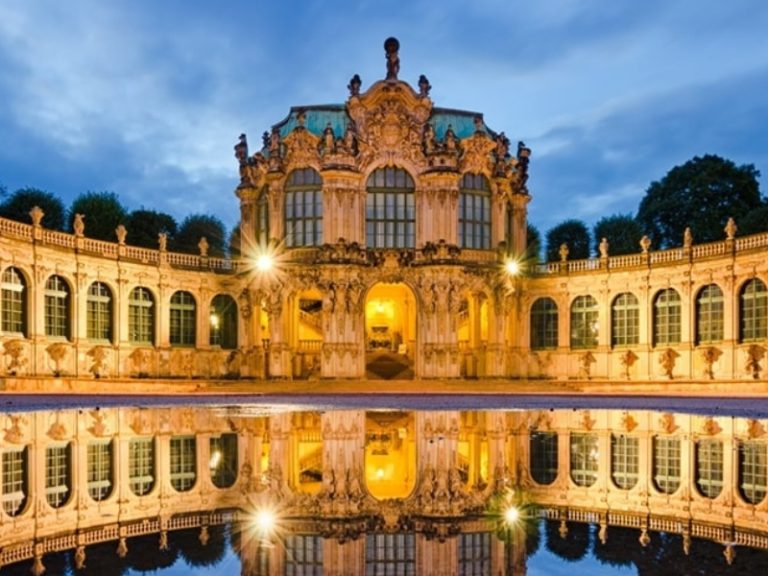
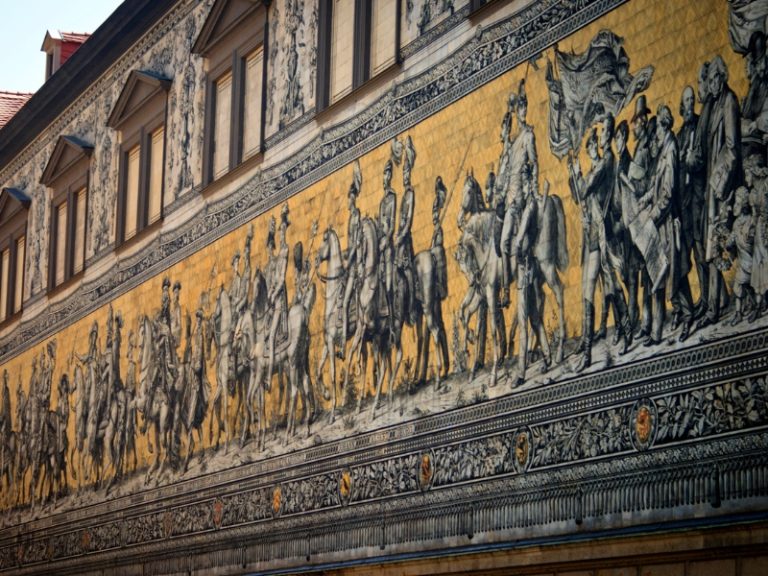
At the Zwinger the narration tells how Augustus the Strong had a baroque festival ground built between 1710 and 1728, and where to spot the gilded Polish crown on the Crown Gate. At the Hofkirche you hear that his heart is kept in the crypt, and at the Fürstenzug how a 102-metre procession of 35 Wettin rulers was moved onto about 23,000 Meissen porcelain tiles that came through the bombing of 1945 almost unharmed. The Frauenkirche brings the collapse of its stone dome two days after the raid and a rebuilding with original stones, still visible as dark patches. Last comes the glass dome that locals call the lemon squeezer.
- Durationabout 3 hours
- Walkingabout 24 min · 2 km
- Stops10
- LanguagesEnglish, German, French, Italian, Spanish, Dutch, Polish
How the walk works
Listen
The narration starts as you reach each stop: the history of the place, the legends told about it and the details most people walk past. Prefer reading? The same text is on screen.
Walk
Between stops you simply follow Google Maps. The whole route is 2 km, roughly 24 minutes on foot, and the speed is yours.
Pause
Stop for lunch, a coffee or a museum and carry on later, the same day or another one.
Eat and shop
The app suggests places to eat and local shops near the route, and that is also where you change the first stop and the order.
See the route and attractions →
How it works
- Book online Choose the number of people. Your booking reference arrives by email straight away.
- Get the app Download the World City Trail app from the App Store or Google Play and enter your booking reference.
- Walk when you like Start whenever you are ready, walk at your own pace and pause any time. No guide, no fixed schedule.
Who will enjoy it
Curious walkers
If you like knowing the story behind a façade or a square, every stop gives you one.
Couples and families
Children hear the legends, adults get the history, and nobody has to keep up with a group.
Return visitors
Even if you know the streets, the stories add history and legends you may not have heard before.
Good to know
- Bring a charged smartphone with mobile data; a power bank helps.
- No entry tickets needed: everything happens outside the buildings. Going inside is optional and paid separately.
- Family friendly; children must be accompanied by an adult.
- Not suitable for wheelchair users and difficult with strollers.
- Groups of up to 5 work best; larger groups split up, one ticket per person.
- Every purchase helps support stray cats and dogs in Greece.
The walk stop by stop: the Zwinger, the Semperoper, the Neumarkt, Brühl's Terrace
10 stops · about 24 min walking · start: Zwinger · finish: Academy of Fine Arts
From the Zwinger the walk crosses to Dresden Castle and the Semperoper, then to the Hofkirche, the Catholic court church whose balustrades carry 78 saints. The Fürstenzug runs along the outer wall of the castle's Stallhof and brings you to the Johanneum, home of the Transport Museum. Reconstructed burghers' houses and a bronze Martin Luther frame the Neumarkt in front of the Frauenkirche, the eighth stop. The Albertinum follows, and the Academy of Fine Arts on Brühl's Terrace is the last stop. Any stop can be your start in the app, and none of them charges an entry fee.
Open the route map ↗
1ZwingerStart
Augustus the Strong had the Zwinger built between 1710 and 1728 as a baroque festival ground, designed by Matthäus Daniel Pöppelmann with sculptures by Balthasar Permoser. Look for the Crown Gate, topped by a gilded Polish crown. Today it houses the Old Masters Picture Gallery with Raphael's Sistine Madonna.
2Dresden Castle
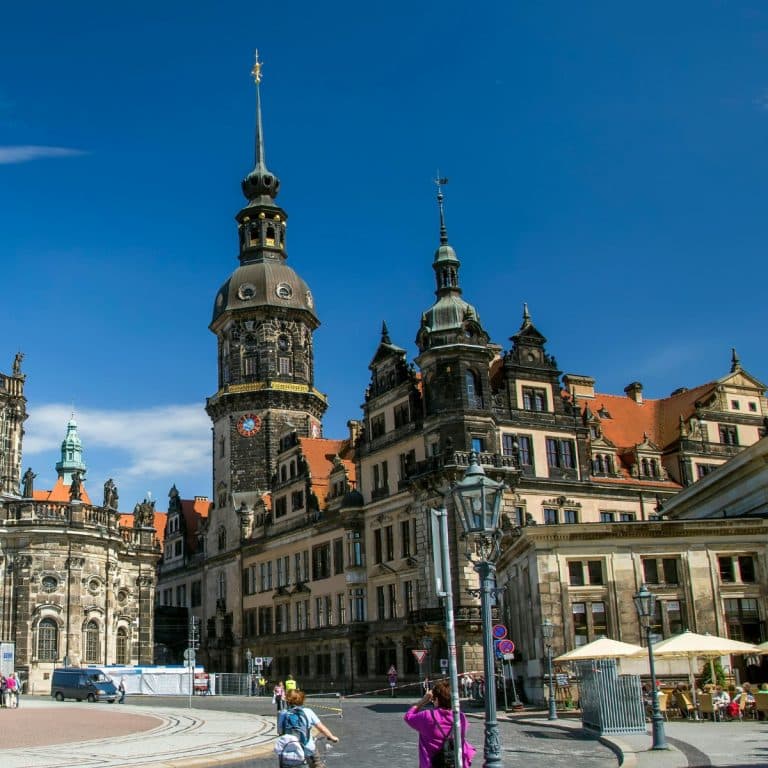
From the late 15th century until 1918 the Residenzschloss was the seat of the Saxon electors and kings. Burnt out in the bombing of 1945, it has been rebuilt in stages since the late 20th century. Today it holds the treasures of the Green Vault and other state collections.
3Semperoper
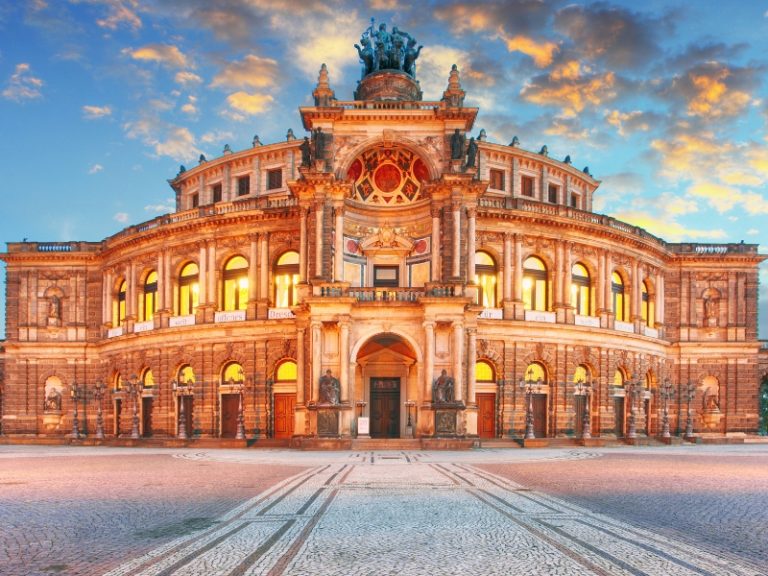
The opera house is named after the architect Gottfried Semper. His first theatre on this square burned down in 1869, and the second one, completed in 1878, was destroyed in 1945 and reopened in 1985. Look up at the bronze panther quadriga with Dionysus and Ariadne above the entrance.
4Hofkirche (Dresden Cathedral)
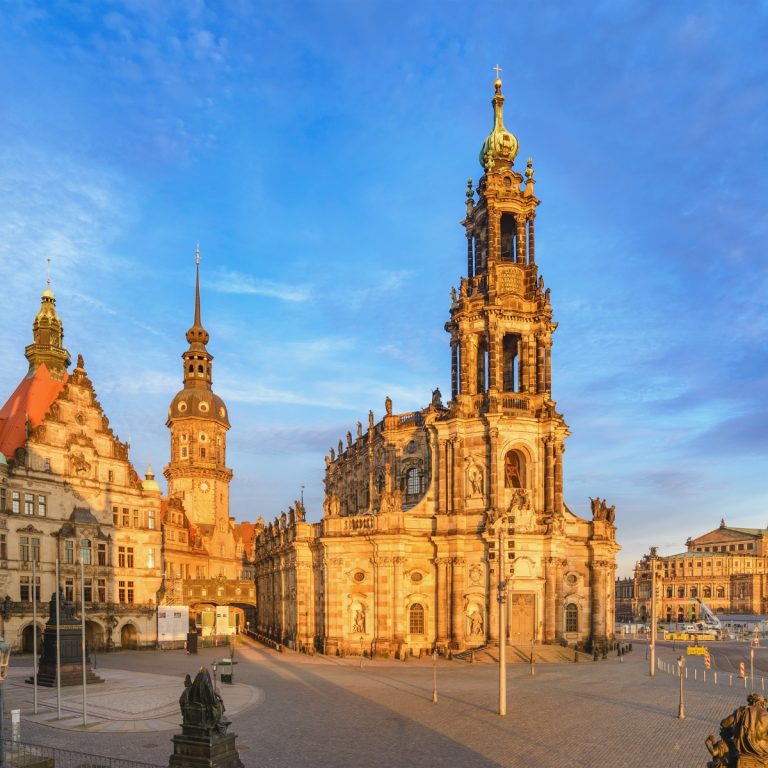
The Catholic court church was built between 1739 and 1755 to plans by the Italian architect Gaetano Chiaveri, after Saxony's rulers had converted to Catholicism. Seventy-eight statues of saints line its balustrades, and it has been the cathedral of the Diocese of Dresden-Meissen since 1980. Augustus the Strong's heart is kept in its crypt.
5Fürstenzug
This 102-metre mural on the outer wall of the castle's Stallhof shows a procession of 35 rulers of the House of Wettin on horseback. Wilhelm Walther first painted it in sgraffito in the 1870s, and between 1904 and 1907 it was transferred onto about 23,000 Meissen porcelain tiles, which survived the bombing of 1945 almost undamaged.
Read the full story →
6Transport Museum (Johanneum)
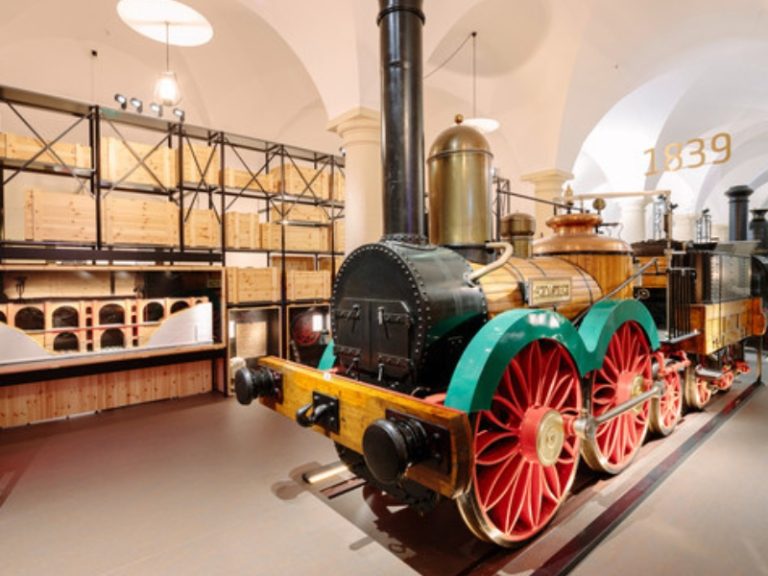
The Dresden Transport Museum is housed in the Johanneum, built in the late 16th century as the electors' stables and later named after King John of Saxony. Its collections cover railways, trams, cars, bicycles, ships and aircraft.
7Neumarkt
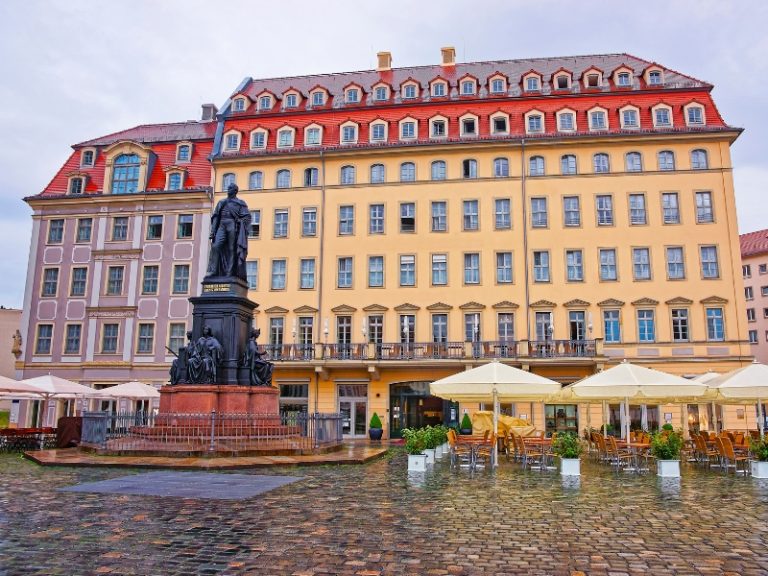
Until the bombing of February 1945 this square around the Frauenkirche was lined with baroque burghers' houses. Since the early 2000s many of their façades have been reconstructed in their historic form. In front of the church stands a bronze statue of Martin Luther from 1885.
8Frauenkirche
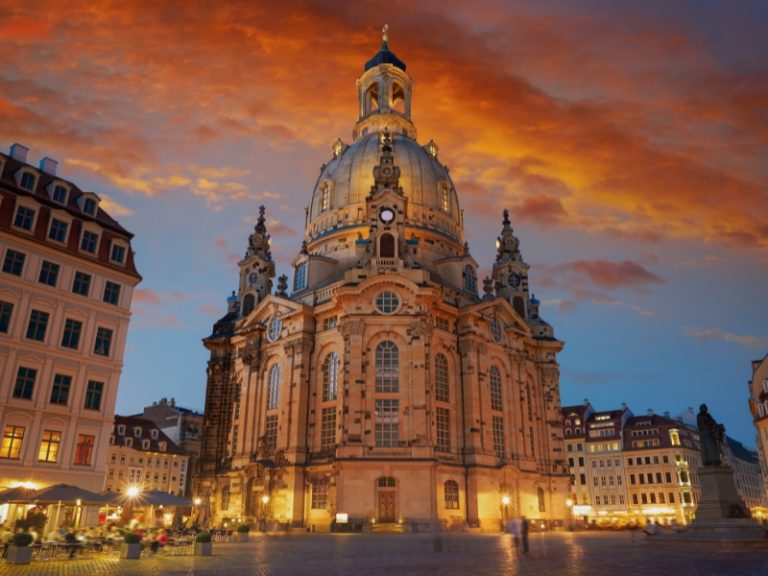
George Bähr built this Lutheran church between 1726 and 1743, crowned by a massive stone dome known as the Stone Bell. It collapsed two days after the bombing of February 1945, remained a ruin for decades and was rebuilt from 1994 to 2005 with many original stones, visible as dark patches in the walls.
9Albertinum
The building began as the electors' arsenal in the 16th century and was converted into a museum in the 1880s, named after King Albert of Saxony. It houses the New Masters Gallery, with paintings from Romanticism to the present including works by Caspar David Friedrich, and the Sculpture Collection.
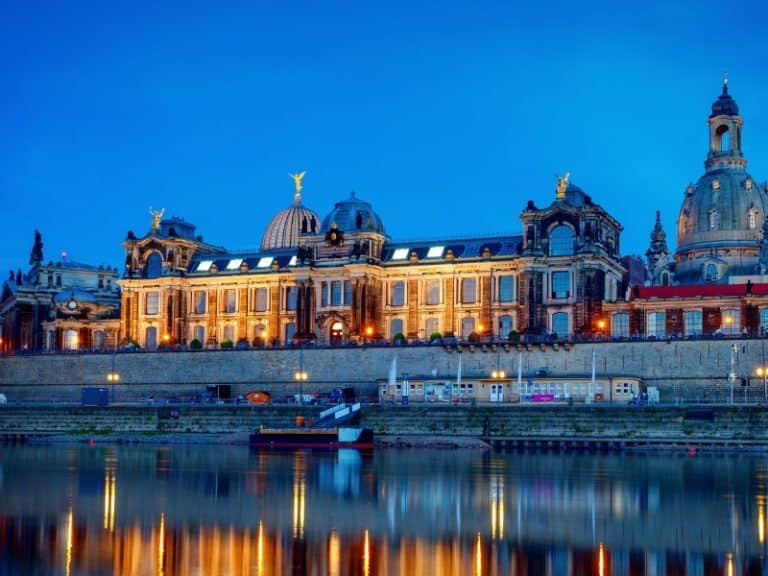
10Academy of Fine ArtsFinish
The Dresden Academy of Fine Arts, founded in 1764, has its main building on Brühl's Terrace, completed in the 1890s to designs by Constantin Lipsius. Its ribbed glass dome, crowned by a golden figure of Fame, is nicknamed the lemon squeezer by locals.
Only logged in customers who have purchased this product may leave a review.





Reviews
There are no reviews yet.