
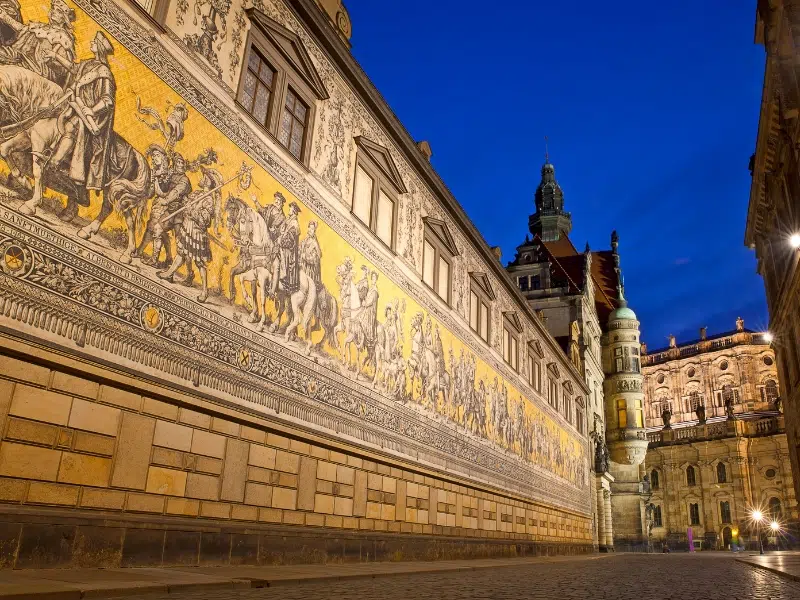
The Fürstenzug, the Procession of Princes, is a mural about 102 metres long on the outer wall of the Stallhof of Dresden Castle, along Augustusstraße. It shows the rulers of Saxony from the House of Wettin riding in procession across eight centuries, and it is made of around 23,000 tiles of Meissen porcelain, which makes it one of the largest porcelain artworks in the world.
The Fürstenzug at a glance
- Where: Augustusstraße in Dresden's old town, between the Georgentor of the castle and the Johanneum, a minute from the Frauenkirche.
- Created: painted as a sgraffito in 1872–1876; transferred to porcelain tiles between 1904 and 1907.
- By: the history painter Wilhelm Walther; the tiles were made by the Meissen porcelain manufactory.
- What it is today: an open-air artwork on a public street, free to see at any time.
- Time needed: 15 to 20 minutes to walk the length of it and find the main figures.
From scratched plaster to porcelain
The wall of the castle's stable courtyard had been decorated as early as 1589, but by the 19th century the old painting had faded. For the 800th anniversary of the Wettin dynasty in 1889, the painter Wilhelm Walther proposed a new design: a festive procession of all of Saxony's rulers. He made full-size drawings and between 1872 and 1876 created the mural in sgraffito, a technique in which layers of coloured plaster are scratched away. Walther studied portraits in the royal collections to make the faces and costumes as accurate as possible.
The black-and-white sgraffito did not cope well with Dresden's weather, and by around 1900 it was badly damaged. The Meissen manufactory was asked to copy it onto porcelain tiles fired at very high temperatures. Painters at Meissen worked from Walther's original cartoons from late 1904 to 1906, every tile was numbered on the back, and between April and August 1907 the tiles were fixed to the wall. In February 1945 the bombing of Dresden destroyed most of the old town around it, but the Fürstenzug came through with only minor damage.
What to look for
- The 35 mounted margraves, electors, dukes and kings, from Konrad the Great, who ruled from 1127, to George, who became king in 1902; each one's name is written below him.
- Augustus the Strong, Elector of Saxony and King of Poland, who did more than anyone to make Dresden a Baroque capital.
- The clothing: every ruler wears the armour and dress of his own time, so the mural is also a history of fashion over 800 years.
- The 59 people on foot who accompany the rulers, among them scholars, artists, craftsmen, farmers and children.
- The group at the end of the procession, where Walther included himself among the artists and scholars.
The king who never joined the procession
While the tiles were being made, King George died, and his son Frederick Augustus III came to the throne in 1904. The idea of adding the new king to the end of the procession was discussed, but with his agreement the mural was left as it was, since it had already become a historical work. So the last king of Saxony, who abdicated in 1918, never got a place on the wall, and the procession ends with George, shown here as a prince.
Tips for your visit
- Start at one end and walk the full length slowly: there is a surprising amount of detail in the horses, banners and faces.
- Step to the far side of Augustusstraße for an overview, then come close to see the individual tiles and their fine joints.
- Come early in the morning or in the evening, when the street is less crowded with tour groups heading to the Frauenkirche.
- Look through the gateway into the Stallhof courtyard behind the wall, where tournaments were held and where a Christmas market sets up in winter.
Nearby
- Frauenkirche: Dresden's great domed Lutheran church, destroyed in 1945 and rebuilt by 2005, a minute's walk away.
- Residenzschloss: the royal castle with the Green Vault treasury, right behind the Fürstenzug.
- Brühl's Terrace: the raised promenade above the Elbe, known as the Balcony of Europe, a few minutes' walk.
- Semperoper and the Zwinger: the opera house and the Baroque palace complex on the other side of the castle, a few minutes' walk.
See Dresden with World City Trail
Our Dresden scavenger hunt turns the old town into a game you play on your phone. The route links 10 stops and takes around 2 hours, with about 24 minutes of walking. It includes the Zwinger, the Frauenkirche and the Semperoper, and at each stop you solve a puzzle and hear a story about the city.
If you prefer a different format, there is also a self-guided walking tour of Dresden and an outdoor escape game.
Play the Dresden scavenger hunt →
Take the self-guided walking tour of Dresden →
Play the outdoor escape game in Dresden →
Facts checked in October 2026.