What is the Florence outdoor escape game?
The Florence outdoor escape game is an escape room that moves out onto the streets: you play on your smartphone, and at each of the 10 stops a puzzle waits that you crack by studying the surroundings and thinking it through logically. The route runs 5 km, takes around 2 hours in total and includes 62 minutes on foot.
Each puzzle is tied to a landmark such as the Duomo, the Uffizi Gallery or Ponte Vecchio, and stands on its own, so you never need a storyline to move forward. Stuck? Help is dosed out in three stages, never more, whenever a riddle refuses to give way. The historic centre suits this format because the monuments sit close enough together that the game feels like one long walk.
- Durationabout 2 hours
- Walkingabout 62 min · 5 km
- Stops10
- LanguagesEnglish, German, French, Italian, Spanish, Dutch, Portuguese, Chinese
What you do on the escape game
Solve
Crack the puzzle at every stop by observing the surroundings and reasoning it out. No prior knowledge is needed.
Look closer
The clues sit in the details around each landmark, from the façades to the features of the square itself.
Walk
Follow Google Maps from one stop to the next: about 62 minutes of walking across roughly 5 km.
Take your time
There is no countdown. Use hints when you need them, pause for a coffee and come back later or another day.
See the route and attractions →
How it works
- Book online Choose the number of players. Your booking reference arrives by email straight away.
- Get the app Download the World City Trail app from the App Store or Google Play and enter your booking reference.
- Play when you like Start whenever you are ready, walk at your own pace and pause any time. No guide, no fixed schedule.
Who it suits
Friends on a day out
The puzzles give everyone something to debate at the next landmark, and nobody has to know the city beforehand.
Couples
A shared challenge that keeps you talking as you move between landmarks, with no clock ticking in the background.
Team building
Teams of up to 5 play on their own phones, which makes it a practical choice for colleagues.
Good to know
- Bring a charged smartphone with mobile data; a power bank helps.
- Best started in daylight, so you can see the details the puzzles ask about.
- No entry tickets needed: everything happens outside the buildings. Going inside is optional and paid separately.
- Family friendly; children must be accompanied by an adult.
- Not suitable for wheelchair users and difficult with strollers.
- Teams of up to 5 work best; bigger groups split into several teams, one ticket per player.
- Every purchase helps support stray cats and dogs in Greece.
Puzzle route: from Santa Maria Novella to Piazza della Repubblica
10 stops · about 62 min walking · start: Basilica of Santa Maria Novella · finish: Piazza della Repubblica
The first puzzle waits at the Basilica of Santa Maria Novella and the last one on Piazza della Repubblica, with eight landmarks in between: the Basilica of San Marco, the Basilica of San Lorenzo, the Duomo, Piazza della Signoria, the Basilica of Santa Croce, the Uffizi Gallery, Ponte Vecchio and Ponte Santa Trinita. Daylight makes the best start, because the puzzles are solved outdoors and rain or wind slow everything down. Google Maps guides you between stops, the app lets you reorder them, and the puzzles need no entry tickets.
Open the route map ↗
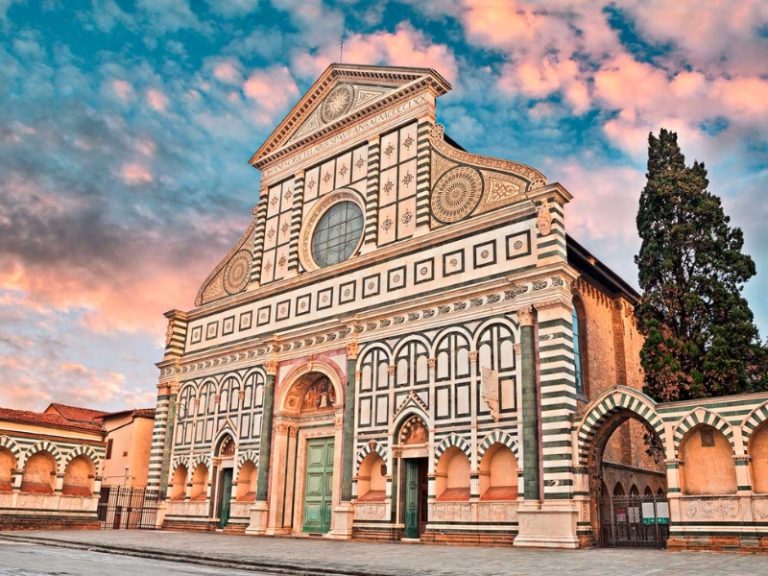
1Basilica of Santa Maria NovellaStart
The Dominican basilica beside the main railway station has a green-and-white marble façade completed by Leon Battista Alberti around 1470. Inside is Masaccio's Holy Trinity fresco, one of the first paintings to use linear perspective.
2Basilica of San Marco
The church and convent of San Marco were rebuilt for the Dominicans with money from Cosimo de' Medici in the 1430s and 1440s. The friar-painter Fra Angelico decorated the convent, and the preacher Girolamo Savonarola was its prior before his fall in 1498.
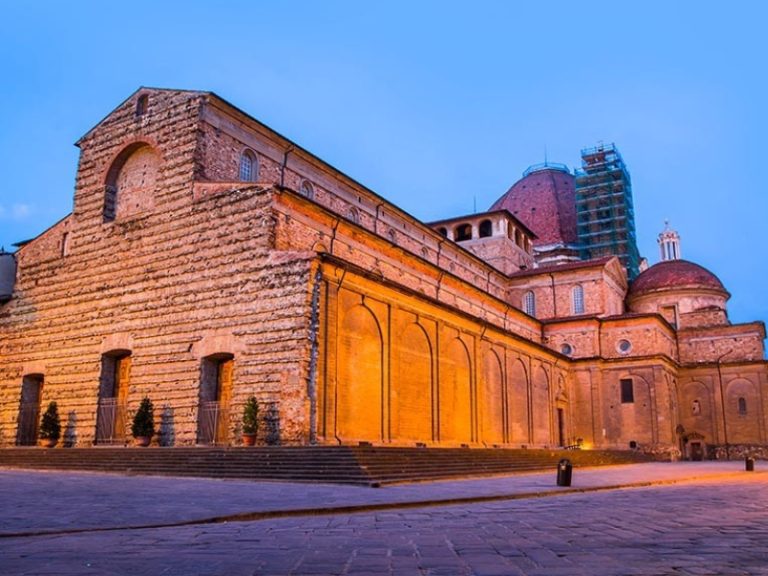
3Basilica of San Lorenzo
San Lorenzo was the parish church of the Medici, rebuilt from the 1420s to designs by Filippo Brunelleschi. Its rough brick front was never finished: Michelangelo designed a marble façade that was never built, and the Medici Chapels lie behind the church.
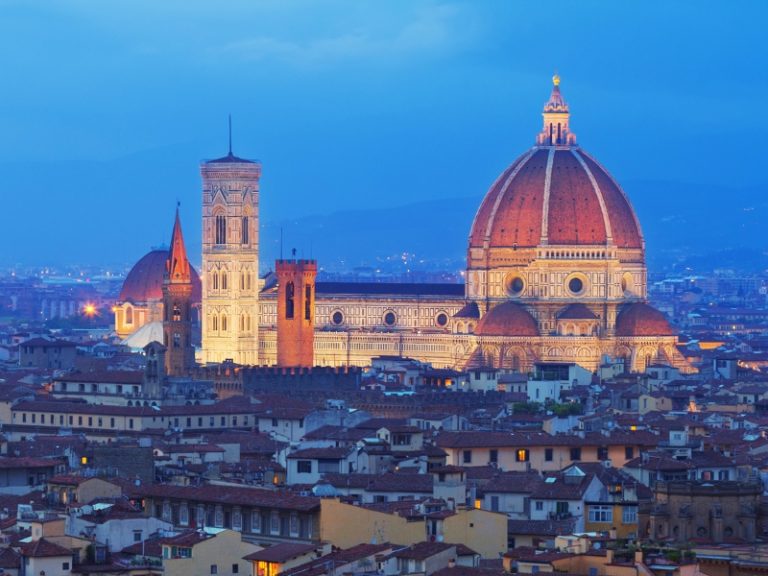
4Duomo (Santa Maria del Fiore)
Florence Cathedral was begun in 1296, and Brunelleschi's dome, completed in 1436, is still the largest brick dome ever built. Beside it stand Giotto's bell tower and the Baptistery, whose gilded east doors by Ghiberti Michelangelo is said to have called the Gates of Paradise.
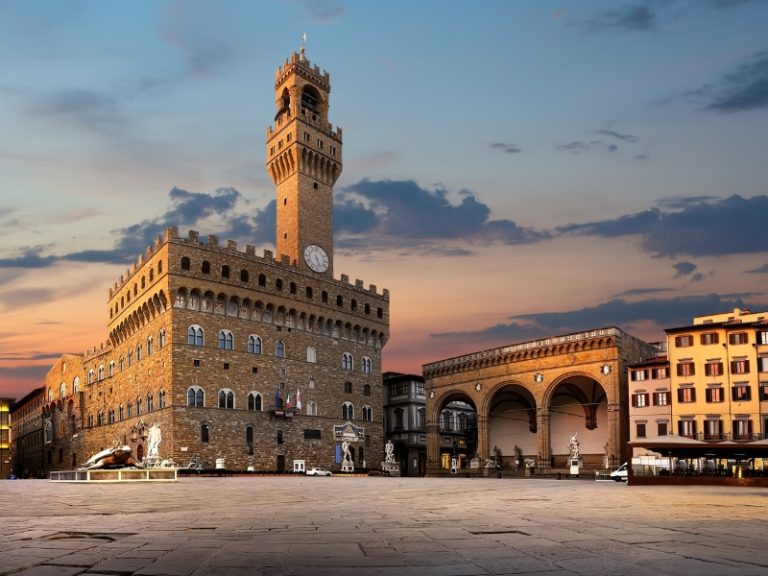
5Piazza della Signoria
Florence's political square is overlooked by Palazzo Vecchio, the town hall since the 14th century. A copy of Michelangelo's David stands where the original stood until 1873, next to Ammannati's Neptune Fountain and the statues of the Loggia dei Lanzi, and a plaque in the paving marks where Savonarola was executed in 1498.
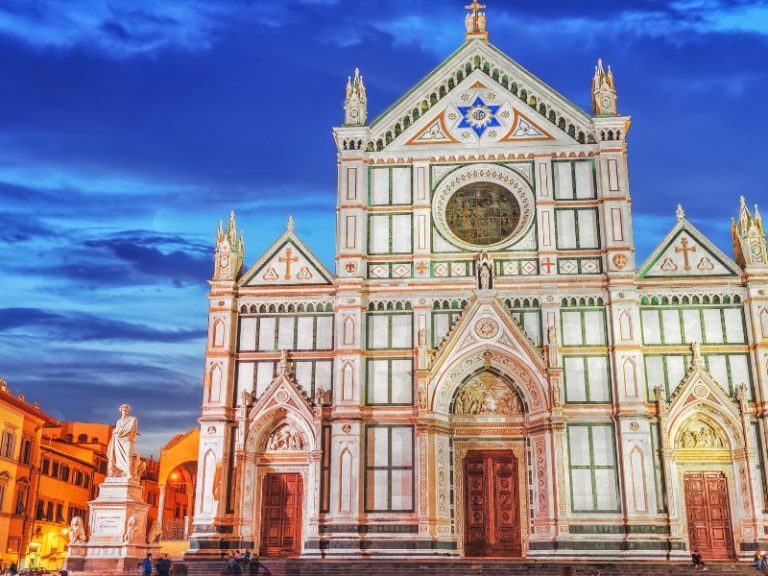
6Basilica of Santa Croce
Santa Croce is one of the largest Franciscan churches in the world and holds the tombs of Michelangelo, Galileo, Machiavelli and Rossini, plus a memorial to Dante, who is buried in Ravenna. Its marble façade was only added in the 19th century.
Read the full story →
7Uffizi Gallery
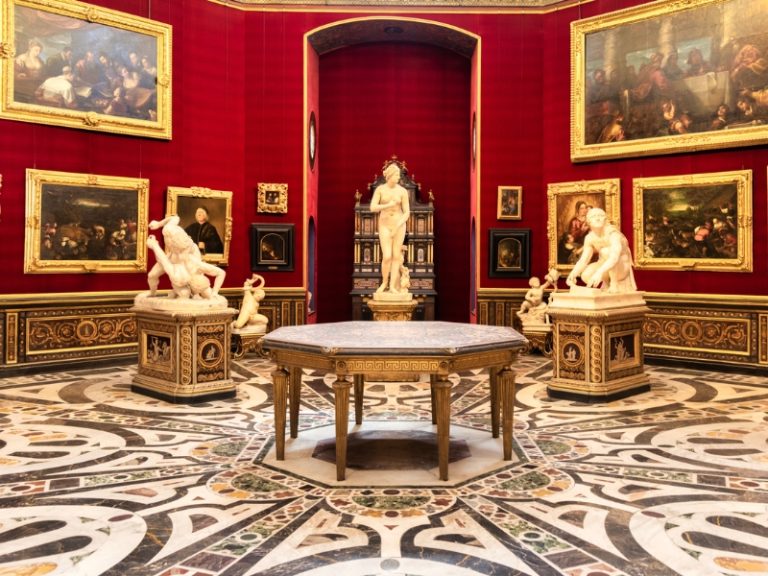
Giorgio Vasari designed the Uffizi from 1560 as offices (uffizi) for Duke Cosimo I de' Medici's administration. Today it is one of the world's great art museums, home to Botticelli's Birth of Venus, and statues of famous Tuscans line its long courtyard.
8Ponte Vecchio
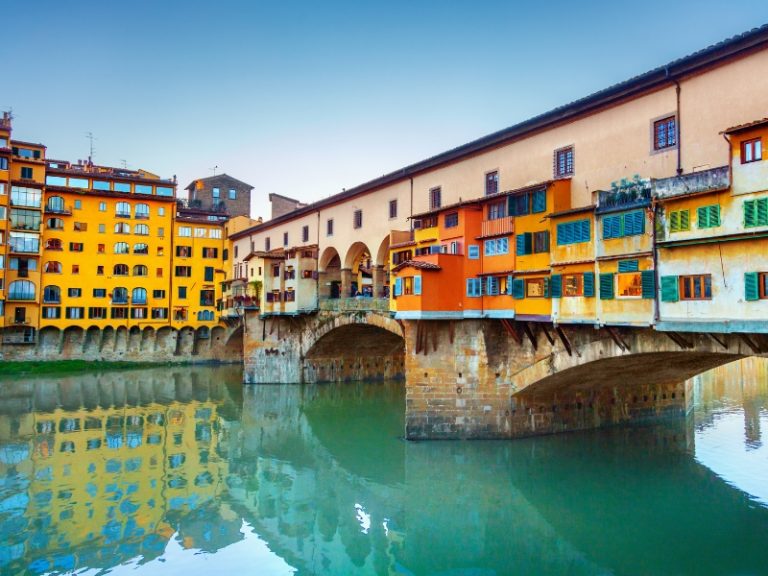
The Old Bridge was rebuilt in stone in 1345 after a flood, and in 1593 Grand Duke Ferdinando I replaced its butchers with goldsmiths, who are still there. The Vasari Corridor runs along its top, and it was the only Florence bridge the retreating German army did not blow up in 1944.
9Ponte Santa Trinita
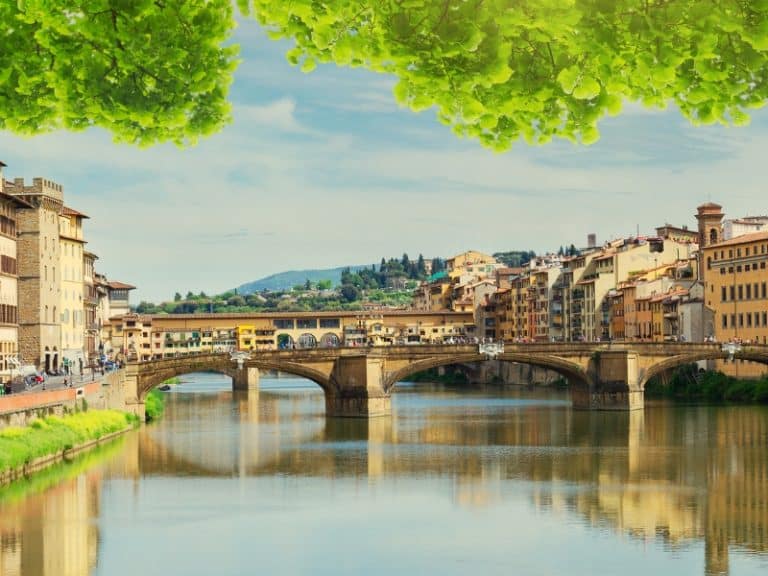
Bartolomeo Ammannati built this bridge in 1567–1569 with three graceful elliptical arches, and statues of the Four Seasons stand at its ends. Blown up in 1944, it was rebuilt by 1958 with stones recovered from the Arno; the head of the Spring statue was only found in the river in 1961.
10Piazza della RepubblicaFinish
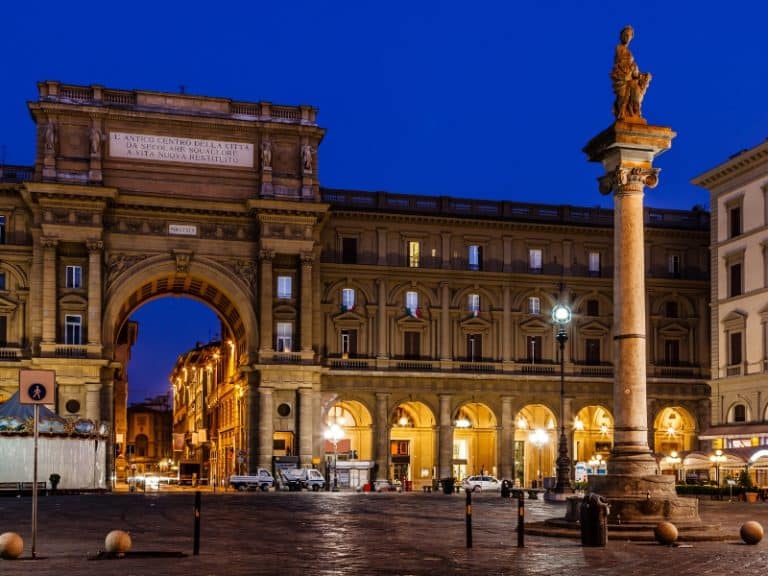
The square lies on the site of the forum of Roman Florentia, and a column topped by a statue of Abundance marks the old centre. Its present look, with the large arch and the historic cafés, dates from the late 19th century, when the old market and the Jewish ghetto were demolished.
Only logged in customers who have purchased this product may leave a review.







Norway –
Collected on GetYourGuide
Interesting and good exercise