What is the Quebec City self-guided walking tour?
The Quebec City self-guided walking tour is an audio walk through Old Quebec, from the Upper Town on the cliff down to the streets by the river, narrated on your phone instead of by a guide. Plan on about 3 hours: 35 minutes of walking over 3 km, with 10 stops where you stand still and listen. Start on any day, at any time that suits you.
At the Notre-Dame de Québec Basilica-Cathedral you hear how the church was destroyed in the siege of 1759 and by fire in 1922, and why its Holy Door of 2013 was the first outside Europe. At the Château Frontenac the narration recalls the Quebec Conferences of 1943 and 1944, when Churchill and Roosevelt met there to discuss the war. On Dufferin Terrace you learn what lies under the boardwalk, the remains of the governors' Château Saint-Louis, and on Place Royale you stand where Samuel de Champlain built his Habitation in 1608.
- Durationabout 3 hours
- Walkingabout 35 min · 3 km
- Stops10
- LanguagesEnglish, German, French, Italian, Spanish, Dutch
What you do on the walking tour
Listen
At every stop the audio covers the history of the place, its legends and the details that are easy to overlook. The same text is on screen if you prefer to read.
Walk on
Between stops, Google Maps shows the way, stairs and slopes included: 35 minutes on foot over 3 km.
Take a break
Pause for a coffee or an hour in a museum, then pick the walk up again later that day or on another day.
Eat and shop
Tips for food and local shops near the route come with the stops, and the app lets you change the first stop and the order.
See the route and attractions →
How it works
- Book online Choose the number of people. Your booking reference arrives by email straight away.
- Get the app Download the World City Trail app from the App Store or Google Play and enter your booking reference.
- Walk when you like Start whenever you are ready, walk at your own pace and pause any time. No guide, no fixed schedule.
Who the walking tour is for
A first visit
One walk links the squares of the Upper Town with Place Royale and the Petit-Champlain quarter below and explains what you are looking at.
Views and history together
Dufferin Terrace and Montmorency Park look out over the St Lawrence River, and each view comes with the story of the place you are standing on.
Anyone who avoids groups
No flag to follow and no fixed departure: stay where something catches your interest and move on when you want.
Good to know
- Bring a charged smartphone with mobile data; a power bank helps.
- No entry tickets needed: everything happens outside the buildings. Going inside is optional and paid separately.
- Family friendly; children must be accompanied by an adult.
- Not suitable for wheelchair users and difficult with strollers.
- Groups of up to 5 work best; larger groups split up, one ticket per person.
- Every purchase helps support stray cats and dogs in Greece.
The walk stop by stop: City Hall, Château Frontenac, Place Royale, Petit-Champlain
10 stops · about 35 min walking · start: Quebec City Hall · finish: Fresque du Petit-Champlain
You begin at Quebec City Hall, behind its small public garden, and walk to the Notre-Dame de Québec Basilica-Cathedral and Place d'Armes. Next comes the Château Frontenac, then the boardwalk of Dufferin Terrace and Montmorency Park at the edge of the cliff. From there the route drops to the Lower Town for the Fresque des Québécois and Place Royale, reaches the Breakneck Stairs and ends at the Fresque du Petit-Champlain. Expect stairs and slopes between the two levels. In the app you can pick another first stop or change the order, and no stop needs a ticket.
Open the route map ↗
1Quebec City HallStart
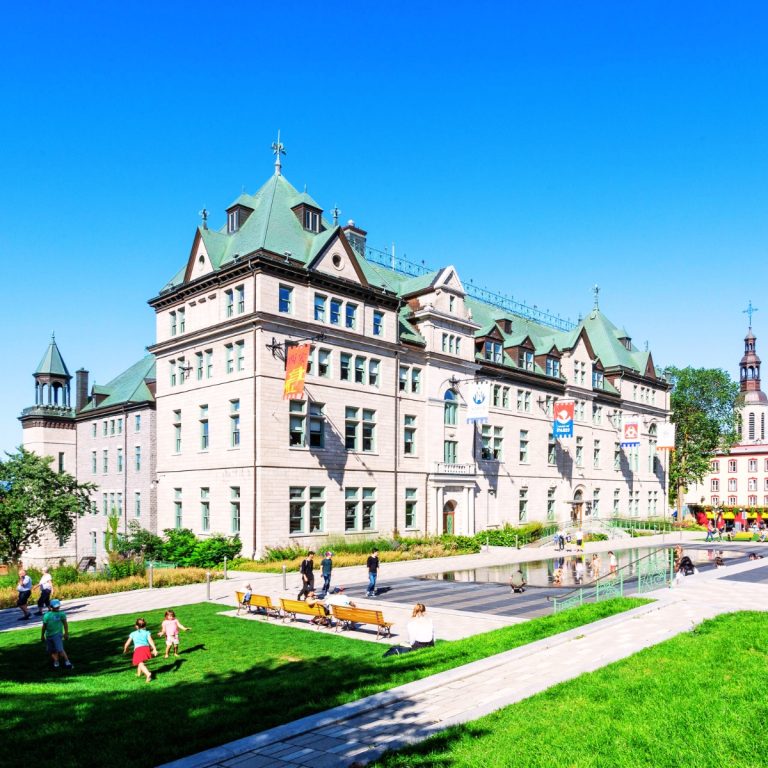
Quebec City Hall opened in 1896 on the site of the former Jesuit college, to designs by the architect Georges-Émile Tanguay. Its towers rise above the Jardin de l'Hôtel-de-Ville, a small public garden in front of the building.
2Notre-Dame de Québec Basilica-Cathedral
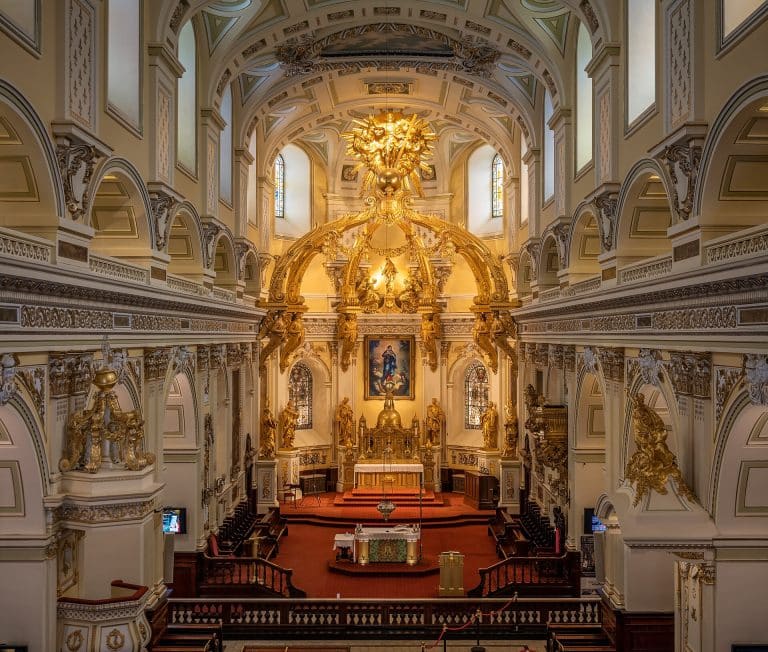
This is the mother church of the first Catholic diocese in North America north of Mexico, created in 1674 with François de Laval as its bishop. Destroyed during the siege of 1759 and again by fire in 1922, it was rebuilt both times. In 2013 it received a Holy Door, the first outside Europe.
3Place d'Armes
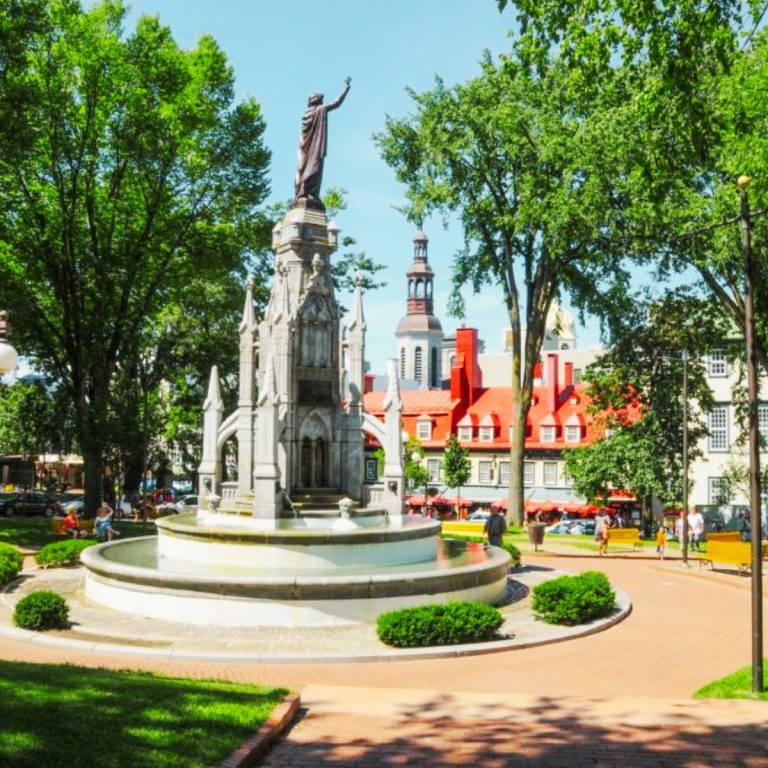
This square was the parade ground of the French garrison in the days of New France, next to the governor's residence. In its centre stands the Monument to the Faith, unveiled in 1916 for the 300th anniversary of the arrival of the Récollet friars in 1615.
4Château Frontenac
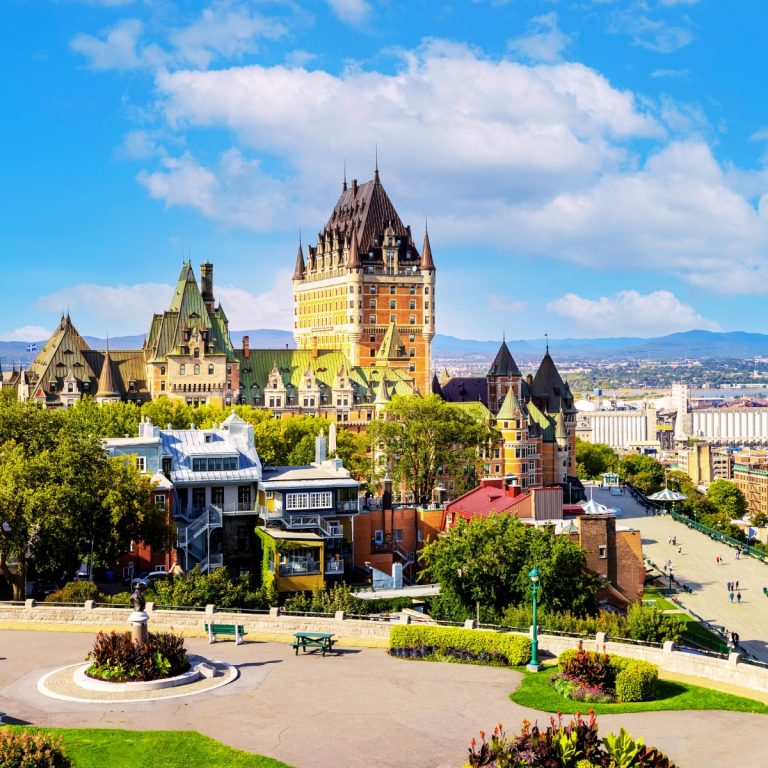
The Château Frontenac opened in 1893 as a railway hotel of the Canadian Pacific Railway, designed by the American architect Bruce Price. It is named after the Count of Frontenac, governor of New France, and in 1943 and 1944 it hosted the Quebec Conferences, where Churchill and Roosevelt discussed the conduct of the Second World War.
5Dufferin Terrace
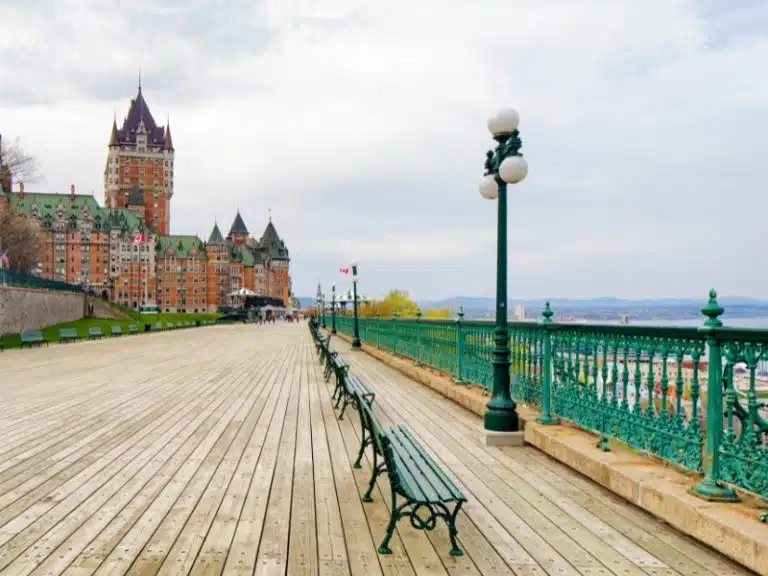
This wide wooden boardwalk along the clifftop opened in 1879 and is named after Lord Dufferin, Governor General of Canada, who pushed for the preservation of the city walls. It looks over the St Lawrence River and the Lower Town, and beneath it lie the remains of the Château Saint-Louis, the residence of the governors of New France.
6Montmorency Park
This park on the edge of the cliff is named after François de Montmorency-Laval, the first bishop of Quebec, whose palace once stood here. Later the parliament of Lower Canada met on this site. Old cannons line its edge, and a statue of George-Étienne Cartier, one of the Fathers of Confederation, looks out over the river.
7Fresque des Québécois
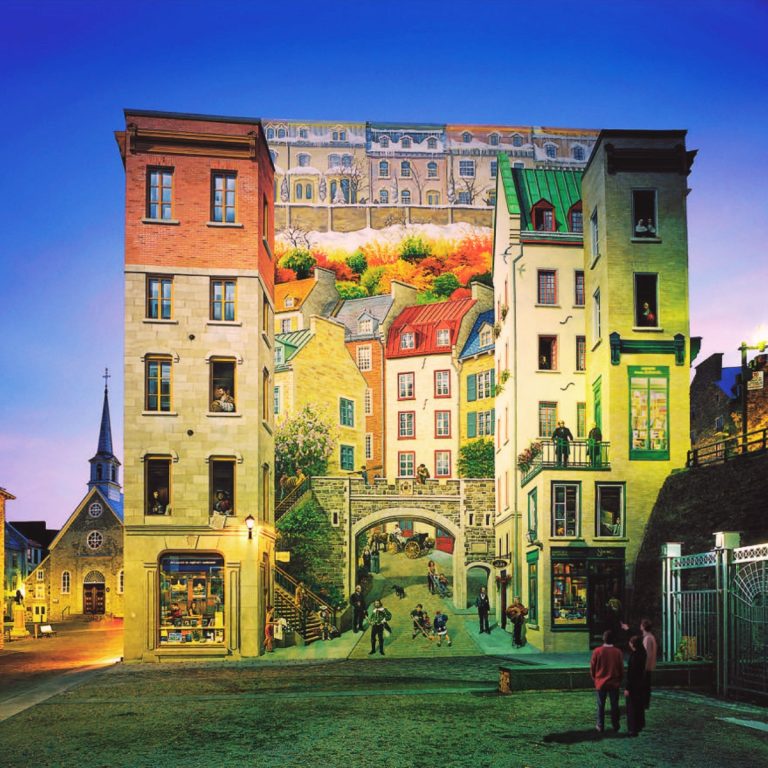
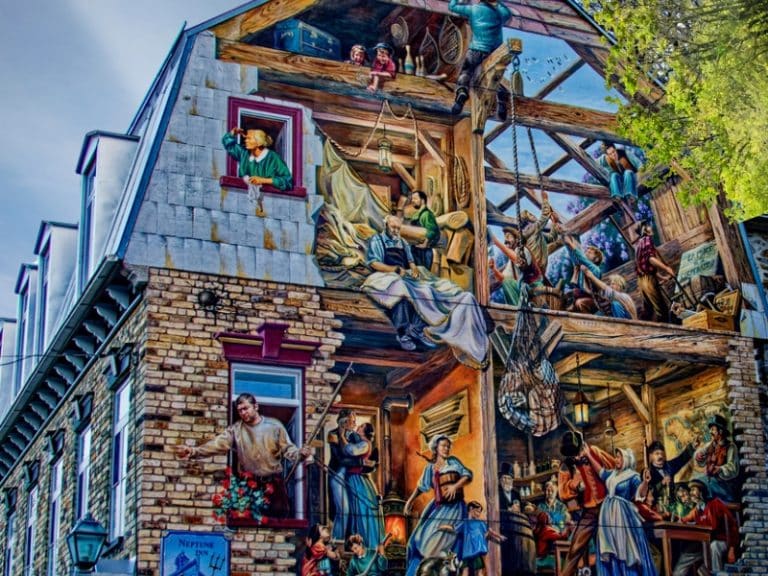
This trompe-l'oeil mural in the Lower Town covers a whole building wall of more than 400 square metres. Painted in 1999 by Quebec and French artists, it shows about 15 figures from four centuries of local history, among them Samuel de Champlain and Bishop Laval, alongside scenes of everyday life.
8Place Royale
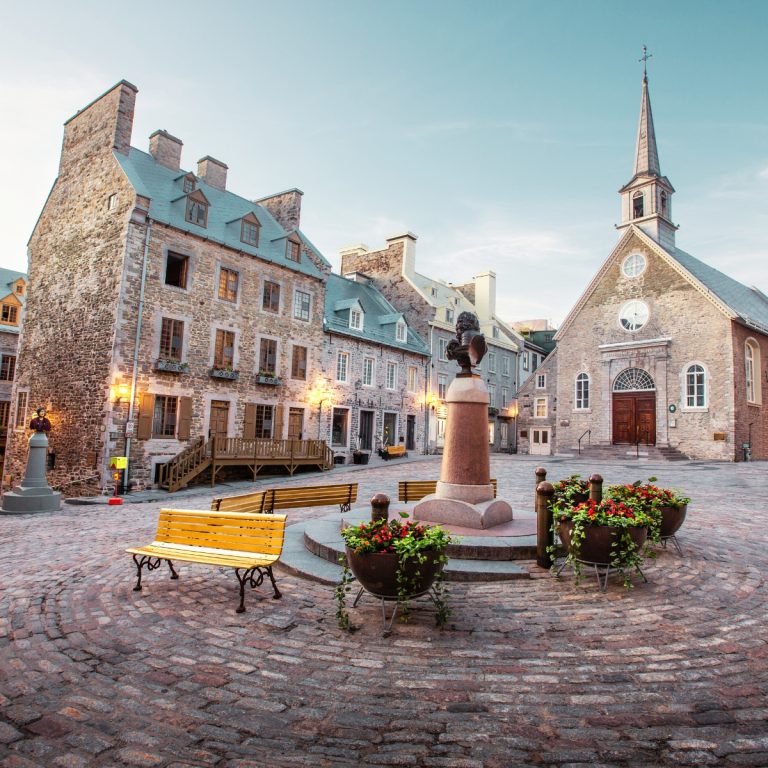
Place Royale is where Samuel de Champlain built his Habitation in 1608, the start of the French settlement. The stone church of Notre-Dame-des-Victoires, begun in 1688, is named after French successes against the English in 1690 and 1711, and a bust of Louis XIV recalls the square's royal name.
9Breakneck Stairs (Escalier Casse-Cou)
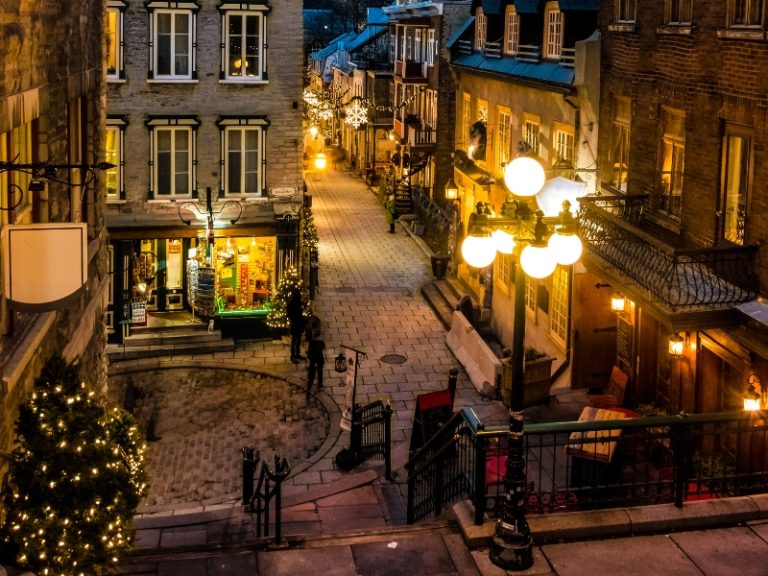
The Breakneck Stairs link the Côte de la Montagne in the Upper Town with Rue du Petit-Champlain below, and a stairway has stood here since the 17th century. Their steep flights explain the name, and from the top you look straight down the narrow street of the Petit-Champlain quarter, often called one of the oldest commercial streets in North America.
10Fresque du Petit-ChamplainFinish
This trompe-l'oeil mural covers the end wall of a house in the Petit-Champlain quarter and portrays the history of the neighbourhood and its residents over the centuries. Its painted building fronts and figures blend into the real street, so look closely to see where the house ends and the painting begins.
Only logged in customers who have purchased this product may leave a review.






Reviews
There are no reviews yet.