
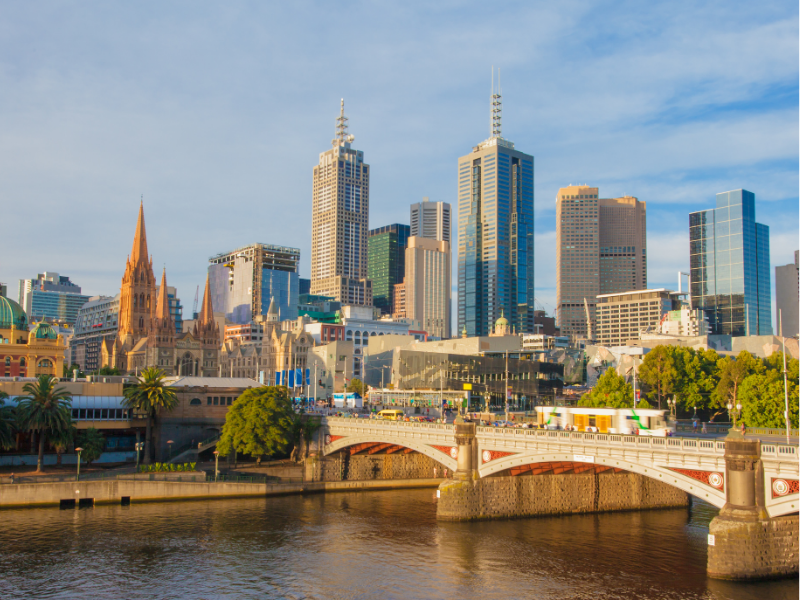
Melbourne was built on gold-rush money, and its Victorian streets still show how rich it became in the 1850s. Today it is known for trams, laneway cafés and an obsession with sport, from cricket at the MCG to the horse race that stops a nation. Here are the facts and stories behind the city.
10 fun facts about Melbourne
- Named after a prime minister: the settlement was founded in 1835 and named Melbourne in 1837, after the British prime minister Lord Melbourne.
- Australia's first capital: when the colonies federated in 1901, the national parliament sat in Melbourne, and it stayed until Canberra was ready in 1927.
- A plan from 1837: the city centre still follows the Hoddle Grid, the rectangle of wide streets laid out by the surveyor Robert Hoddle in 1837.
- The largest tram network in the world: Melbourne's trams run on around 250 kilometres of double track, more than any other city. Rides within the central Free Tram Zone cost nothing.
- Australia's first World Heritage building: the Royal Exhibition Building, built for the 1880 International Exhibition, became the first building in Australia on the UNESCO list in 2004. The first federal parliament opened there in 1901.
- A horse race with a public holiday: the Melbourne Cup has been run since 1861 on the first Tuesday in November, and the day is a public holiday in Melbourne.
- A giant of a stadium: the Melbourne Cricket Ground holds about 100,000 people. It hosted the first ever Test match in 1877 and the main events of the 1956 Olympic Games.
- An architect who never came: St Paul's Cathedral was designed in England by William Butterfield, who never travelled to Australia. It was consecrated in 1891, and its spires, to a different design, were only added from 1926.
- Victoria's oldest Catholic church: St Francis' Church was begun in 1841 and completed in the 1840s, and today it is one of the busiest churches in Australia.
- The Beatles on the balcony: on 16 June 1964, the Beatles waved to a huge crowd from the balcony of Melbourne Town Hall, which opened in 1870 on the corner of Swanston and Collins Streets.
Ned Kelly's last day
Ned Kelly, a bushranger from north-east Victoria, became Australia's most famous outlaw. In June 1880, Kelly and his gang made a last stand against police at Glenrowan, wearing home-made armour forged from ploughshares. Kelly was shot in the legs, captured and taken to Melbourne for trial. He was found guilty of murdering a police officer and hanged at the Old Melbourne Gaol on 11 November 1880, aged 25. His last words are said to have been 'Such is life'. Today you can visit the gaol, and the State Library Victoria displays his armour.
The laneways and arcades, explained
Behind the wide streets of the Hoddle Grid runs a network of narrow lanes, first used for deliveries and rubbish carts. Since the 1990s many have filled with small cafés, bars and street art. Degraves Street and Centre Place are packed with coffee shops, while Hosier Lane is covered in murals that change constantly. The Victorian arcades are older: the Royal Arcade opened in 1869 and is one of the oldest in Australia, and the Block Arcade, with its mosaic floor and glass roof, was built in the early 1890s.
What to eat in Melbourne
- Coffee: Melbourne takes its espresso seriously. Order a flat white or a long black at a laneway café.
- Dim sims: large Chinese-style dumplings, steamed or fried, that Melbourne claims as its own. Try them at the South Melbourne Market.
- Souvlaki: Melbourne has one of the largest Greek communities outside Greece, and Lonsdale Street is the centre of Greek food in the city.
- Chicken parma: chicken schnitzel topped with tomato sauce, ham and cheese, the classic pub meal, usually with chips and salad.
- Queen Victoria Market: open since 1878, this huge market is the place for fresh produce, hot doughnuts and food stalls.
Good to know before you go
- Pack layers: Melbourne's weather can change from warm sunshine to cold rain within hours, so locals talk of four seasons in one day.
- Use the Free Tram Zone in the centre to hop between sights. You still need a myki card for trips beyond it.
- The Great Ocean Road and the Phillip Island penguin parade each make a full-day trip; book tours or plan your drive in advance.
- For a free view over the city, climb to the balcony of the Shrine of Remembrance in the Kings Domain gardens.
Explore Melbourne with World City Trail
Our Melbourne scavenger hunt turns these sights into a game you play on your phone. The route links 10 stops and takes around three hours, with about 64 minutes of walking, and includes St Paul's Cathedral, Melbourne Town Hall and St Francis' Church.
At each stop you solve a puzzle and hear a short story, at your own pace. You can start whenever you like.
Play the Melbourne scavenger hunt →
Facts checked in October 2026.