
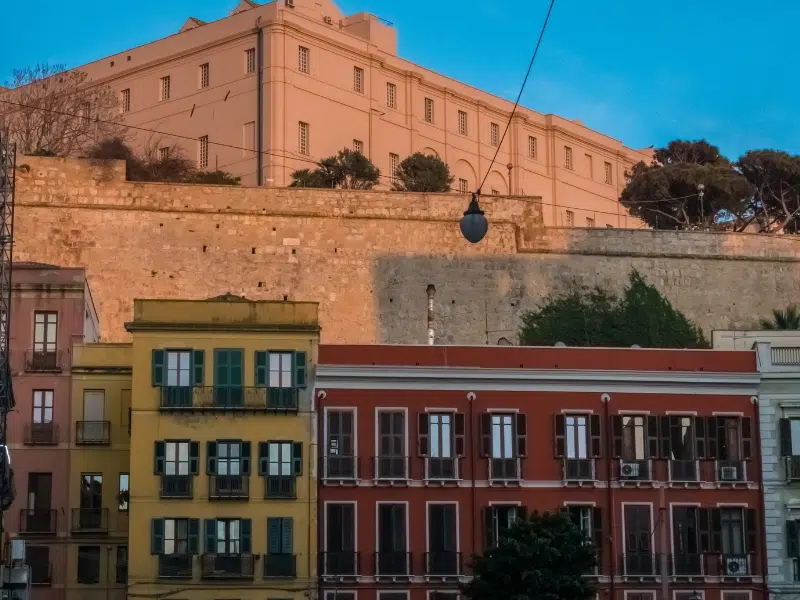
Piazza Yenne is the small square at the top of Largo Carlo Felice in Cagliari, where the Stampace and Marina districts meet and Corso Vittorio Emanuele II begins. It is the city's favourite meeting point, full of café tables from morning to late evening. It is also, officially, where the main road across Sardinia starts: a milestone column here marks the beginning of the royal road to the north, and a bronze king in a Roman toga stands guard over it.
Piazza Yenne at a glance
- Where: at the upper end of Largo Carlo Felice, between the Stampace and Marina districts, at the start of Corso Vittorio Emanuele II and Via Manno.
- Created: the milestone column was placed in 1822; the statue of King Carlo Felice was set up in 1860.
- By: the statue was modelled by the Sassari sculptor Andrea Galassi; its base was designed by the architect Gaetano Cima.
- What it is today: a pedestrian square with bars and cafés, the usual place to meet friends before an aperitivo or a walk.
- Time needed: 10–15 minutes to look around, or an evening if you sit down for a drink.
A viceroy's milestone and a king in a toga
The square takes its name from the Marquis Ettore Veuillet d'Yenne, viceroy of Sardinia for the House of Savoy. In 1822 he placed a milestone column here to mark the starting point of a new royal road linking Cagliari with Sassari and Porto Torres in the north. The road was built in the 1820s on the orders of King Carlo Felice, who had himself governed the island as viceroy before taking the throne in 1821. Today it is the SS131, still known across Sardinia simply as the Carlo Felice.
In 1827 the Stamenti, the estates of the Sardinian parliament, commissioned a monument to the king. Andrea Galassi made the model, the statue was cast in bronze at the arsenal in Cagliari, and it was finally set up in 1860 on a base designed by Gaetano Cima, with inscriptions written by the Cagliari historian Pietro Martini. The king is shown as a Roman commander, with helmet, breastplate and toga. Not everyone in Sardinia remembers the Savoy rulers fondly, and calls to remove the statue resurface from time to time; for now, Carlo Felice still points over the square.
What to look for
- The statue of Carlo Felice: about four metres of bronze, the king in Roman armour with a helmet, his arm stretched out.
- The milestone column from 1822, a few metres from the statue: the official starting point of the road that crosses the island.
- The stone base by Gaetano Cima with its inscriptions honouring the king, written by Pietro Martini.
- The view down Largo Carlo Felice, the broad, sloping avenue that runs from the square down to the port and Via Roma.
- The start of Corso Vittorio Emanuele II, the pedestrian street of Stampace lined with bars and small restaurants.
The arm that points the wrong way
A popular story in Cagliari says the king's outstretched arm was meant to point along his new road towards Sassari, but that the statue was mounted the wrong way round and points in the opposite direction. Whether it was really a mistake or simply how the statue was designed to face the square is hard to prove; treat it as a local legend, and check for yourself which way he is pointing.
Tips for your visit
- Come in the early evening, when the square fills up for the aperitivo and the light on Largo Carlo Felice is soft.
- Stand at the bottom of the statue's base and look up for the best view of the helmet and armour; for a photo with the whole avenue, walk a little way down Largo Carlo Felice and turn round.
- Use Piazza Yenne as a starting point: walk up Via Manno to the Bastione di Saint Remy and the Castello district, or west along Corso Vittorio Emanuele II into Stampace.
Nearby
- Bastione di Saint Remy: the monumental terrace on the old city walls with wide views over Cagliari, reached by walking up Via Manno.
- Remains of San Francesco di Stampace: a plaque on Corso Vittorio Emanuele II marks the site of the medieval Franciscan church, and its cloister survives just off Via Mameli.
- Church of Sant'Anna: the large church of Stampace, begun in 1785, badly damaged in the Second World War and rebuilt afterwards.
- Torre dell'Elefante: the medieval Pisan tower at the entrance to the Castello district, named after the small marble elephant on its wall.
See Cagliari with World City Trail
Our Cagliari scavenger hunt turns the old town into a game you play on your phone. The route links 10 stops and takes around 3 hours, with about 45 minutes of walking. It includes places such as the Bastione di Saint Remy and Cagliari Cathedral.
If you prefer a different format, there is also a self-guided walking tour and an outdoor escape game in Cagliari.
Play the Cagliari scavenger hunt →
Take the self-guided walking tour of Cagliari →
Play the outdoor escape game in Cagliari →
Facts checked in October 2026.