
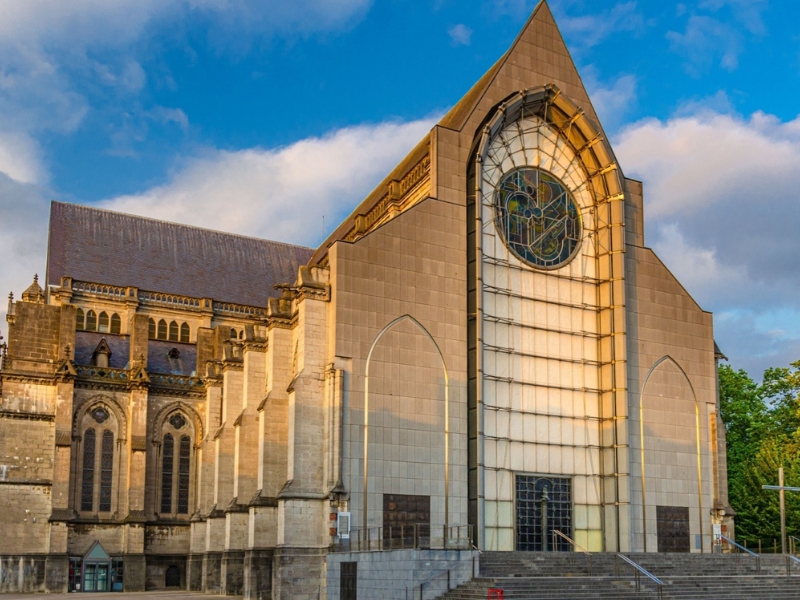
Notre-Dame-de-la-Treille is the cathedral of Lille, a neo-Gothic church in the old town that took about 145 years to finish. Its first stone was laid in 1854, but the main facade was only completed in 1999, and it is a modern wall of thin white marble that glows from inside when the lights are on.
Notre-Dame-de-la-Treille at a glance
- Where: in Vieux-Lille, the old town, a few minutes north of the Grand Place, on the site of the town's former castle mound.
- Built: 1854 to 1999, in several campaigns; the west facade dates from 1999.
- By: Charles Leroy (original design); Pierre-Louis Carlier with the engineer Peter Rice (facade).
- What it is today: the cathedral of the Archdiocese of Lille and a minor basilica, open for worship and visits, with a centre for sacred art in the crypt.
- Time needed: 30 to 45 minutes for the church and the facade, more if you visit the crypt.
A cathedral built across three centuries
The church was built to house a medieval statue of the Virgin, Our Lady of the Treille, venerated in Lille since the 13th century in the collegiate church of Saint-Pierre, which was destroyed after the French Revolution. In 1854 an international competition for a church in the style of early 13th-century Gothic drew 41 entries. The two winning designs were English, and the idea of handing a church of the Virgin to Anglican architects caused an outcry, so the job went to the Lille architect Charles Leroy. The first stone was laid on 1 July 1854.
Money ran short, wars intervened and building went on in fits and starts. The church became a minor basilica in 1904 and a cathedral in 1913, when the diocese of Lille was created. In 1975 it was declared finished, but with a temporary facade of bare concrete. A final campaign in the 1990s gave it the present west front by Pierre-Louis Carlier and Peter Rice, inaugurated in 1999.
What to look for
- The west facade: a tall pointed arch filled with thin panels of white marble. From outside by day it looks pale grey; from inside, and from the square after dark when the church is lit, the marble glows.
- The rose window in the facade by the painter Ladislas Kijno, about 6.5 metres across, on the theme of the Resurrection, in strong modern colours.
- The central portal by the sculptor Georges Jeanclos, with sleeping figures caught in a trellis of vine, a reference to the name Treille, which means trellis.
- The statue of Our Lady of the Treille itself, a small medieval stone Virgin with the Christ Child on her knee, venerated inside the cathedral.
- The contrast from the east side: the neo-Gothic apse and chapels look as if they belong to a different building from the 1999 facade.
The legend of the trellis
The origin of the name Treille is not certain. One traditional explanation is that the statue once stood behind a gilded iron trellis that protected it; historians think it more likely comes from Treola, an old place name in Lille. Many stories of miracles are linked to the statue, and in 1667 Louis XIV is said to have sworn before it to respect the freedoms of Lille after taking the city.
Tips for your visit
- Look at the facade twice: once in daylight, then again after dark when the light inside shines through the marble.
- Walk around the outside of the building to see how the neo-Gothic east end and the modern facade meet.
- It is a working cathedral, so keep your voice down and avoid walking around during Mass.
- Combine it with the cobbled streets of Vieux-Lille, especially rue de la Monnaie just next to it.
Nearby
- Hospice Comtesse: a hospital founded in the 13th century by Countess Joan of Flanders, now a museum, just around the corner on rue de la Monnaie.
- Vieille Bourse: Lille's 17th-century Flemish Renaissance exchange, with a courtyard full of second-hand book stalls, a short walk south.
- Grand Place: the main square with the column of the Goddess, a few minutes' walk away.
See Lille with World City Trail
Our Lille scavenger hunt turns the old town into a game you play on your phone. The route links 10 stops and takes around 2 hours, with about 38 minutes of walking. It includes the Grand Place, the Vieille Bourse and the Belfry.
If you prefer a different format, Lille also has a self-guided walking tour and an outdoor escape game.
Play the Lille scavenger hunt →
Take the self-guided walking tour of Lille →
Play the outdoor escape game in Lille →
Facts checked in October 2026.