What is the Lille outdoor escape game?
The Lille outdoor escape game takes the escape room idea into the city centre: on your phone you solve a puzzle at each of 10 stops by looking closely at what surrounds you and reasoning it through. Allow about 2 hours, including 38 minutes on foot over 3 km.
Each puzzle hangs off a landmark such as the town hall belfry, the Porte de Paris or the Grand'Place, and stands on its own, so there is no storyline to follow. Stuck? Three levels of hints are on hand. The centre of Lille is small enough to cover on foot, so the puzzles follow one another without long transfers.
- Durationabout 2 hours
- Walkingabout 38 min · 3 km
- Stops10
- LanguagesEnglish, German, French, Italian, Spanish, Dutch
What the escape game asks of you
Observe
Puzzles are solved on the spot, using façades, statues and the layout of each square. No prior knowledge is needed.
Navigate
Google Maps leads you from stop to stop, over about 3 km and 38 minutes of walking.
Hint when stuck
Up to three levels of hints help you move on without losing the thread.
Pause freely
No countdown runs. Stop for lunch or a coffee, then pick up at the same stop later or on another day.
See the route and attractions →
How it works
- Book online Choose the number of players. Your booking reference arrives by email straight away.
- Get the app Download the World City Trail app from the App Store or Google Play and enter your booking reference.
- Play when you like Start whenever you are ready, walk at your own pace and pause any time. No guide, no fixed schedule.
Who it is for
Friends
The puzzles give everyone something to argue over at the next landmark, and nobody has to know the city first.
Couples
A shared challenge that keeps you talking as you cross the centre, with no clock ticking.
Teams
Colleagues play on their own phones, which makes it a simple outing for a team day.
Good to know
- Bring a charged smartphone with mobile data; a power bank helps.
- Best started in daylight, so you can see the details the puzzles ask about.
- No entry tickets needed: everything happens outside the buildings. Going inside is optional and paid separately.
- Family friendly; children must be accompanied by an adult.
- Not suitable for wheelchair users and difficult with strollers.
- Teams of up to 5 work best; bigger groups split into several teams, one ticket per player.
- Every purchase helps support stray cats and dogs in Greece.
Puzzle route: from the town hall belfry to Notre-Dame-de-la-Treille
10 stops · about 38 min walking · start: Lille Town Hall Belfry · finish: Notre-Dame-de-la-Treille Cathedral
The puzzles run from the Lille Town Hall Belfry to the Notre-Dame-de-la-Treille Cathedral, with eight stops in between: the Porte de Paris, the Palais des Beaux-Arts, Place de la République, Saint-Maurice Church, the War Memorial, the Grand'Place, the Vieille Bourse and the Chamber of Commerce Belfry. Plan for daylight, because you play outdoors and rain or wind slow everything down. The app lets you reorder the stops, and the puzzles need no entry tickets.
Open the route map ↗
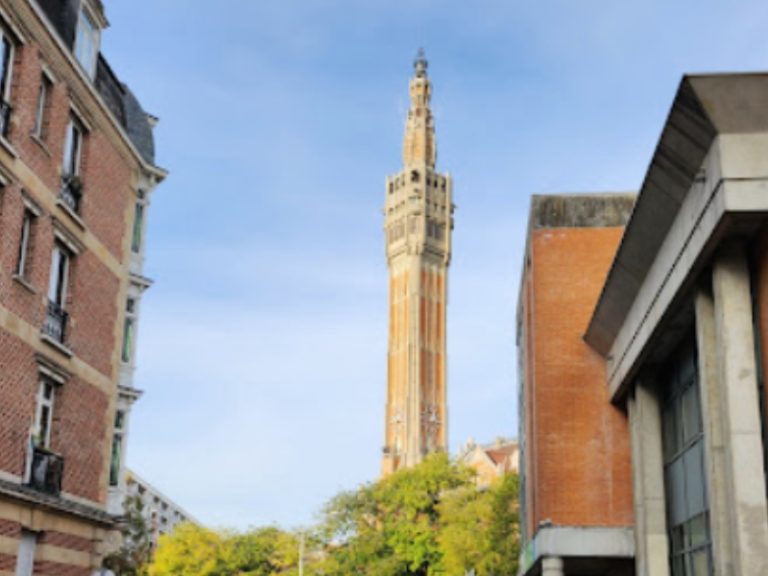
1Lille Town Hall BelfryStart
The 104-metre belfry of the town hall was designed by Émile Dubuisson and inaugurated in 1932, when Lille was rebuilding after the First World War. At its foot stand concrete statues of Lydéric and Phinaert, the giants of the city's founding legend, and since 2005 it has been part of the UNESCO-listed Belfries of Belgium and France.
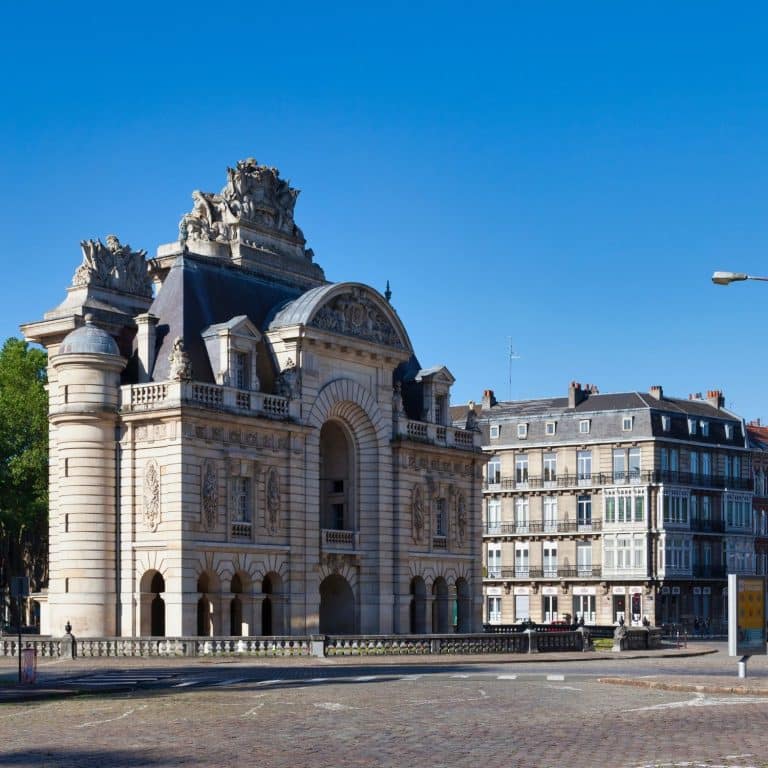
2Porte de Paris
This triumphal arch was built between 1685 and 1692 by Simon Vollant, an engineer who had worked with Vauban on Lille's citadel, to celebrate Louis XIV's capture of the city in 1667. Look for Hercules with his club and Mars, god of war, in the niches, and two trumpeting angels on top.
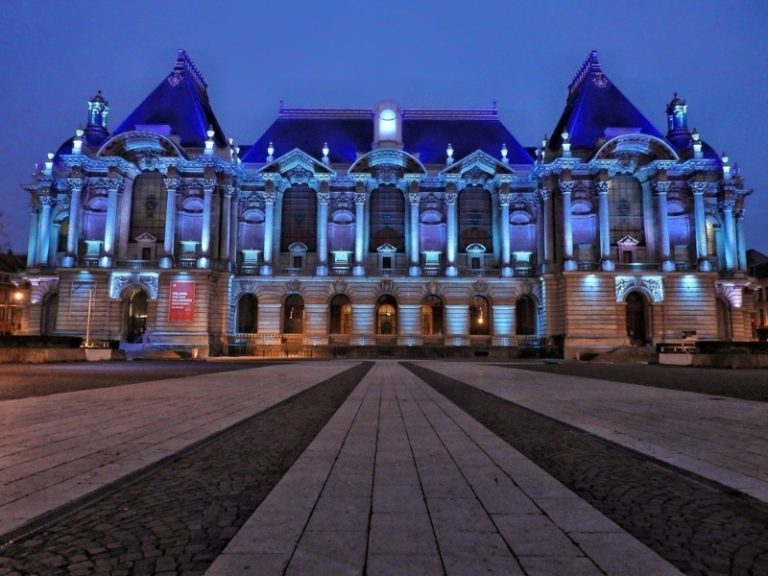
3Palais des Beaux-Arts
Built between 1885 and 1892 to designs by the Paris architects Édouard Bérard and Fernand Delmas, this palace houses one of the largest art museums in France. Its collection runs from Raphael and Rubens to Goya and Delacroix, and includes relief models of fortified towns from the age of Vauban.
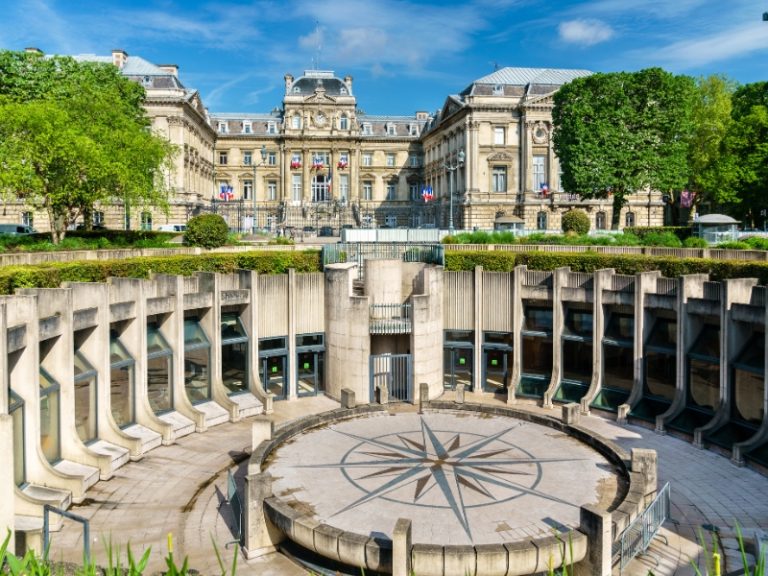
4Place de la République
The square is framed by two grand 19th-century buildings facing each other: the Palais des Beaux-Arts and the Prefecture of the Nord department, begun in 1865 to designs by Charles Marteau. It is one of the city's main meeting points, with its own metro station, République–Beaux-Arts.
5Saint-Maurice Church
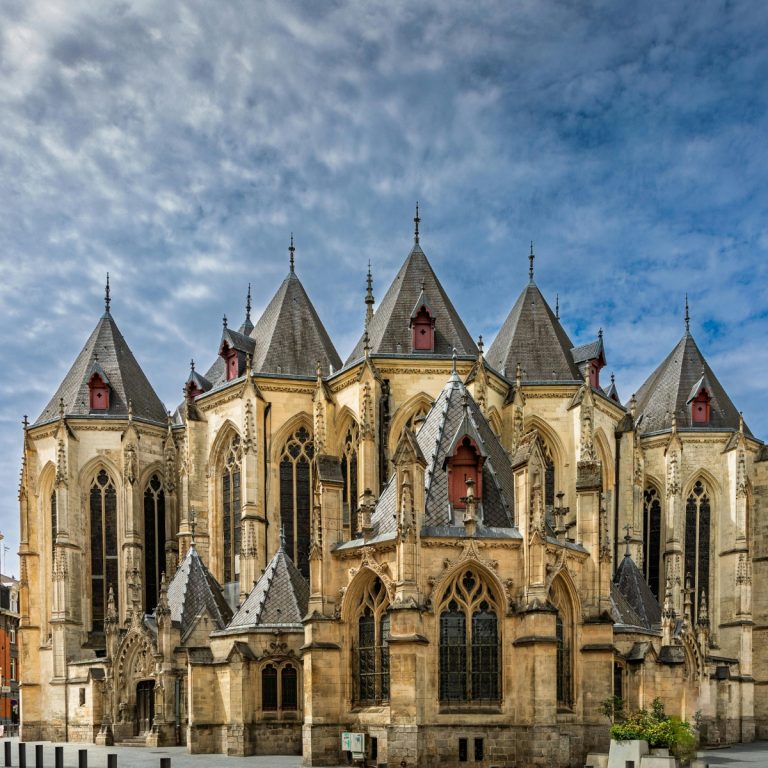
Saint-Maurice is a Gothic hall church: its nave and the double aisles on each side all rise to the same height. Building began in the late 14th century, the western bays and steeple were only completed in the 1870s, and the church was listed as a historic monument in 1840.
Read the full story →
6War Memorial (Monument aux Morts)
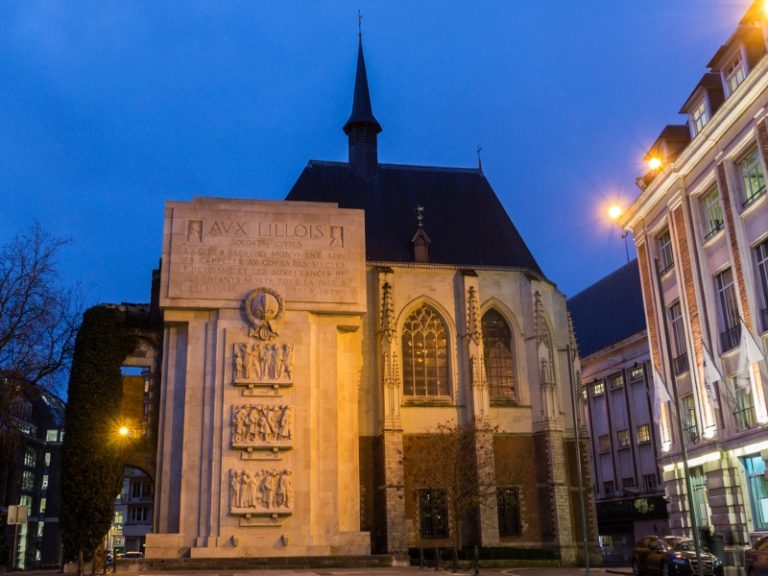
Lille's war memorial on Place Rihour was inaugurated in 1927 against the walls of the Palais Rihour, the 15th-century palace of the Dukes of Burgundy. Designed by sculptor Edgar Boutry and architect Jacques Alleman, it honours soldiers and civilians alike, with scenes of peace, the city's liberation in 1918 and civilians taken away during the German occupation.
7Grand'Place (Place du Général-de-Gaulle)
The main square was renamed after Charles de Gaulle, who was born in Lille in 1890, in September 1944, but locals still call it the Grand'Place. In the centre stands the Column of the Goddess, finished in 1845 in memory of the city's resistance to the Austrian siege of 1792.
8Vieille Bourse
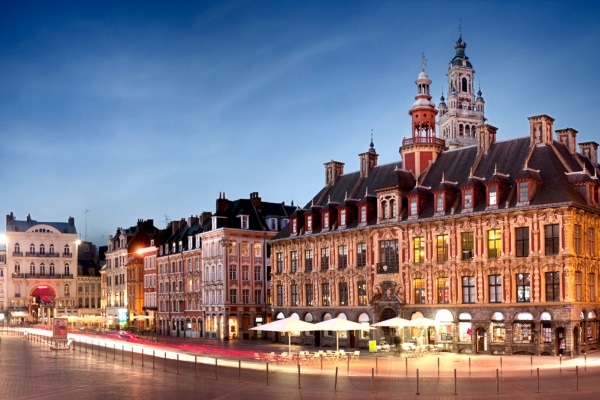
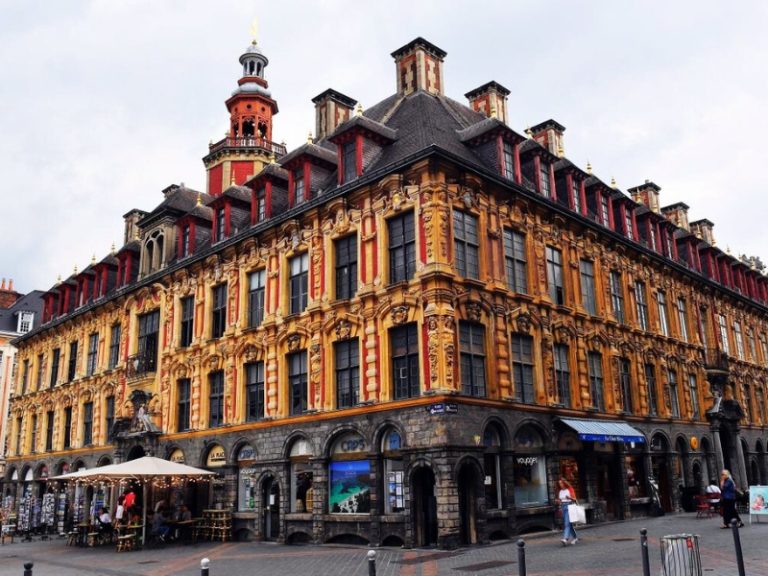
The Old Stock Exchange was built in 1652 and 1653 under the direction of Julien Destrée: 24 identical houses in Flemish Renaissance style around an arcaded courtyard. A statue of Mercury, god of commerce, crowns its bell tower, and today the courtyard belongs to second-hand booksellers and chess players.
Read the full story →
9Chamber of Commerce Belfry
The Chamber of Commerce building on Place du Théâtre was designed by Louis-Marie Cordonnier and built from 1910 to 1921 in neo-Flemish style. Its 76-metre belfry rises right next to the Vieille Bourse and the Opera and is one of the landmarks of the Lille skyline.
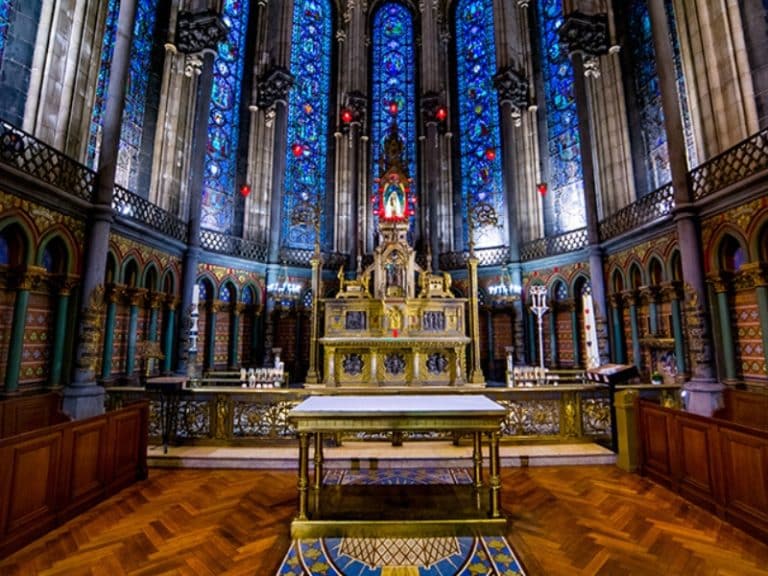
10Notre-Dame-de-la-Treille CathedralFinish
The foundation stone of this Gothic Revival church was laid in 1854, and building went on in stages for more than a century. It became a cathedral when the Diocese of Lille was created in 1913, and its modern façade by architect Pierre-Louis Carlier and engineer Peter Rice was only installed in 1999.
Read the full story →
Only logged in customers who have purchased this product may leave a review.






Reviews
There are no reviews yet.