
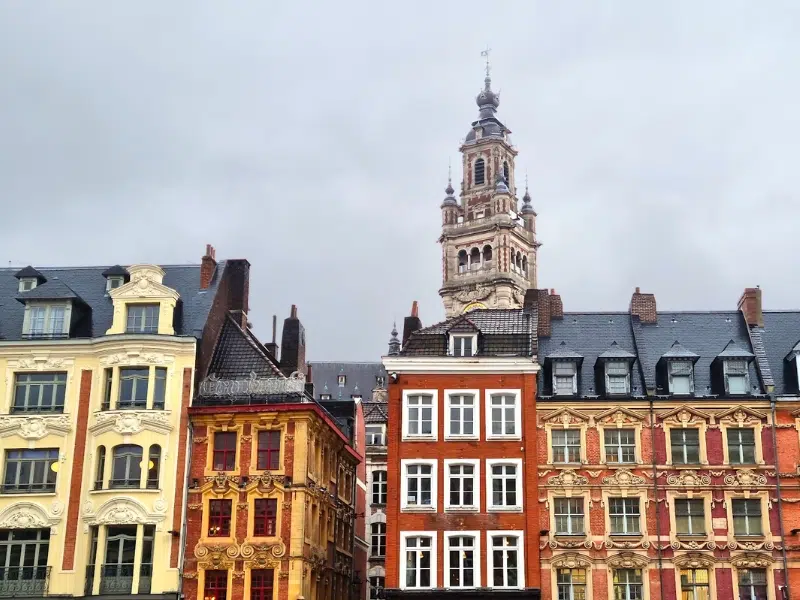
The Vieille Bourse, Lille's Old Stock Exchange, is a square of 24 identical Flemish houses built around an arcaded courtyard between the Grand Place and the Place du Théâtre. Merchants once traded here; today the courtyard belongs to second-hand booksellers and chess players, and it is one of the best places in the city to slow down for half an hour.
Vieille Bourse at a glance
- Where: between the Grand Place (Place du Général-de-Gaulle) and the Place du Théâtre, in the centre of Lille; the nearest metro station is Rihour.
- Built: 1652 to 1653, when Lille belonged to the Spanish Netherlands.
- By: Julien Destrée, an architect who was also a wood carver.
- What it is today: a listed historic monument whose courtyard is open to the public, with booksellers, flower sellers and chess tables under the arcades.
- Time needed: 20 minutes to look, much longer if you start browsing books.
A merchants' exchange for a Spanish king's city
In 1651 the city obtained permission from King Philip IV of Spain to build an exchange for merchants, to be enclosed by 24 houses. The city sold 24 plots on the market square to traders, who had to build their houses at the same time and to the same height, symmetry and design, while the city paid for the galleries, the paving and the four entrances. Destrée built the whole thing between spring 1652 and autumn 1653, taking the Antwerp exchange as his model. The new building cut the old market square in two, which is why Lille now has both a Grand Place and a Place du Théâtre.
The courtyard was originally private, reserved for merchants. In 1853 the Chamber of Commerce received Napoleon III here, and a restoration of the gates and galleries followed. A real stock exchange opened in the building in 1861. When the new Chamber of Commerce, across the Place du Théâtre, opened in the early 1920s, the merchants moved out and the building became the Vieille Bourse, the old exchange. It was listed as a historic monument in 1921 and restored again between 1989 and 1998.
What to look for
- Mercury on the tower: the god of commerce, the emblem of the exchange, stands at the very top of the bell tower, holding his staff.
- The carved pilasters: caryatids, lions, garlands of fruit and horns of plenty crowd the facades, typical of 17th-century Flemish Renaissance decoration.
- The coats of arms: above the upper windows, cartouches carry the arms of the regional companies that supported the restoration.
- The scientists' plaques: in the courtyard galleries, look for the panels honouring scientists and inventors that were added in the 1850s.
- The booksellers: stalls of second-hand books, old maps, prints and posters line the arcades around the courtyard.
- The chess tables: under the arcades, locals settle in for games; watching is welcome, interrupting is not.
Tango in the courtyard
On summer Sunday evenings, the courtyard of the Vieille Bourse becomes an open-air dance floor where couples dance the Argentine tango. Anyone can stop and watch from under the arcades. It is a fine example of how the building, designed for money, ended up as one of Lille's favourite public spaces.
Tips for your visit
- Come in the afternoon, when the booksellers are set up and the courtyard is at its liveliest.
- Walk all the way around the outside too: the facades on the Grand Place and Place du Théâtre are as richly carved as the courtyard.
- Carry some cash for the bookstalls, where small purchases are common.
- Combine the visit with the Grand Place, the Opera and the Chamber of Commerce belfry, all within a couple of minutes.
Nearby
- Grand Place: Lille's main square, with the Déesse column commemorating the 1792 siege; right next door.
- Opéra de Lille: the early 20th-century opera house on the Place du Théâtre, facing the old exchange.
- Chamber of Commerce: the neo-Flemish building with its tall belfry, also on the Place du Théâtre.
- Vieux-Lille: the old quarter just north, with cobbled streets, brick-and-stone houses and the Notre-Dame-de-la-Treille cathedral.
See Lille with World City Trail
Our Lille scavenger hunt turns the old town into a game you play on your phone. The route links 10 stops and takes around 2 hours, with about 38 minutes of walking. The Vieille Bourse is one of the stops, along with the Grand Place and the Belfry.
If you prefer a different format, there is also a self-guided walking tour of Lille and an outdoor escape game in the city.
Play the Lille scavenger hunt →
Take the self-guided walking tour of Lille →
Play the outdoor escape game in Lille →
Facts checked in October 2026.