
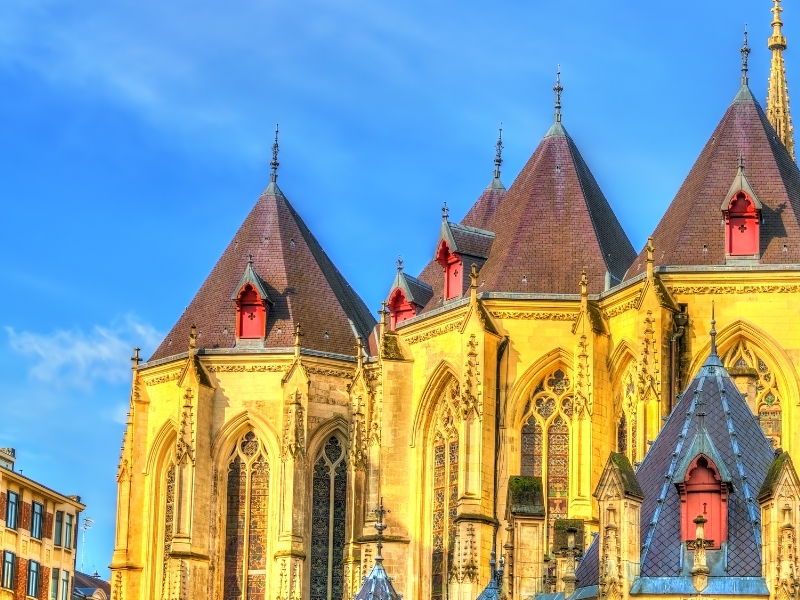
The Église Saint-Maurice is a large Gothic church on Rue Pierre-Mauroy, the street that leads from Lille-Flandres station towards the Grand Place. It is a hall church, a type common in Flanders but rare in France: its five naves rise to almost the same height, so the interior feels like one wide, bright hall. Building it took from the late 14th century to the late 19th century.
Saint-Maurice Church at a glance
- Where: Parvis Saint-Maurice, on Rue Pierre-Mauroy, a few minutes' walk from Lille-Flandres station.
- Built: from the late 14th century to 1877, when the west front and bell tower were completed.
- By: generations of unknown medieval builders; the 19th-century extension and restoration were led by the city architect Philippe Cannissié.
- What it is today: a working Catholic parish church and a protected historic monument, on France's first list of monuments historiques in 1840.
- Time needed: 20–30 minutes.
Five centuries on one building site
A charter of 1066 is the first written mention of Saint-Maurice, then a church belonging to the village of Fins outside Lille. The oldest parts of the present building, two bays of the nave and the central part of the transept, date from the end of the 14th century. The choir with its ambulatory and radiating chapels followed between about 1421 and 1431, side chapels were added in the 16th and 17th centuries, and the stone vaults, planned from the start, were only built between 1615 and 1623.
The church owes its unified look to Philippe Cannissié, Lille's city architect, who restored it in the 19th century. He added the sacristies (1859–1863) and, between 1867 and 1877, three more bays of the nave and the present bell tower, partly because Saint-Maurice was expected to become Lille's cathedral. The houses that pressed against the church were cleared to open up the square in front. After an arson fire in the south sacristy in 2001, a long restoration campaign renewed the roofs, the east end and the side facades.
What to look for
- The west front: its statues were added in 1874–1875 by three Lille sculptors, Henri Biebuyck, Félix Huidiez and Jules-Victor Heyde.
- The tower, which ends in an openwork stone spire, built in the 1870s to replace a medieval tower demolished in the early 19th century.
- The hall interior: stand at the back and notice that the central nave and the four aisles share almost the same height, with no upper windows above arcades as in French cathedrals.
- The columns: their capitals are carved with two rows of curly cabbage leaves, a typical late Gothic motif.
- The east end: the ambulatory and the radiating chapels sit under a single vault, with the back wall opened up like a screen, an unusual plan modelled on Lille's lost collegiate church of Saint-Pierre.
A temple of Mars and a cathedral that never was
A traditional explanation, never proven, holds that the church stands on the ruins of a sanctuary to Mars. Its supporters point to its slightly unusual orientation, to its dedication to Saint Maurice, a soldier saint, which was unique in the old diocese of Tournai, and to the name Fins, from the Latin fines, "border". The cathedral plan was more real: in the 19th century Saint-Maurice was enlarged in expectation of becoming Lille's cathedral, but the role went to the new Notre-Dame-de-la-Treille instead.
Tips for your visit
- It is an active parish, so keep your voice down and avoid walking around during services.
- Come back after dark: since the square was redesigned in 2019–2020, the facade and the tower are lit up at night.
- It makes an easy first stop if you arrive by train at Lille-Flandres, on the way to the Grand Place.
- For the best view of the tower, step back to the far side of the square in front of the west front.
Nearby
- Lille-Flandres station: its facade is the original front of the first Gare du Nord in Paris, moved here in the 1860s.
- Grand Place (Place du Général de Gaulle): Lille's main square, lined with Flemish-style houses.
- Vieille Bourse: the richly decorated 17th-century exchange beside the Grand Place, with a small book market in its courtyard.
- Opéra de Lille: the early 20th-century opera house, with the belfry of the Chamber of Commerce next to it.
See Lille with World City Trail
Our Lille scavenger hunt turns the old town into a game you play on your phone. The route links 10 stops and takes around 2 hours, with about 38 minutes of walking. It includes the Grand Place, the Vieille Bourse and the Belfry.
If you prefer a different format, there is also a self-guided walking tour and an outdoor escape game in Lille.
Play the Lille scavenger hunt →
Take the self-guided walking tour of Lille →
Play the outdoor escape game in Lille →
Facts checked in October 2026.