
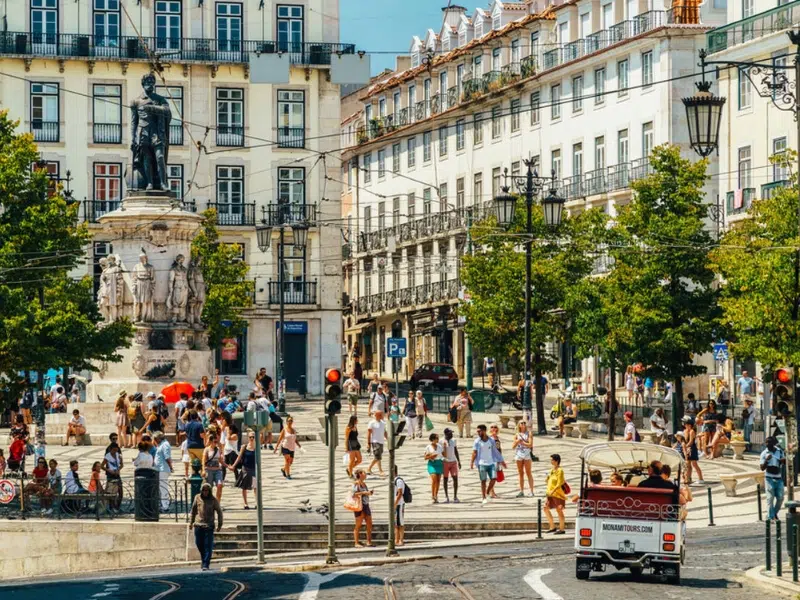
Praça Luís de Camões, usually just called Largo de Camões, is the square where Lisbon's Chiado meets the Bairro Alto. In the middle stands a bronze statue of Luís de Camões, the author of the epic The Lusiads and Portugal's national poet, raised on a tall pedestal and surrounded by eight smaller stone figures of Portuguese writers and scholars. It is one of the city's favourite meeting points and a stop on the famous tram 28 line.
Praça Luís de Camões at a glance
- Where: at the top of Rua do Loreto and Rua Garrett, between Chiado and Bairro Alto.
- Created: the monument was unveiled on 9 October 1867; the square took its present name when the monument was planned.
- By: the sculptor Victor Bastos, whose design was accepted in 1859.
- What it is today: a busy square with the Camões monument, café terraces, two churches and tram stops.
- Time needed: 10–15 minutes; longer if you sit at a café or wait for the tram.
From palace ruins to a poet's square
In the 17th century this site was occupied by the palace of the Marquesses of Marialva. The 1755 earthquake left it in ruins, the owners never rebuilt it, and the remains were taken over by poor families, so the area became known as the huts of Loreto. In the 19th century the ruins were finally cleared and the open space was called Praça do Loreto, after the Italian church of Our Lady of Loreto on its eastern side. During work on an underground car park in 1999, archaeologists found remains of the old palace below the square.
The idea of a national monument to Camões grew through the 19th century. Victor Bastos, a sculptor who taught at Lisbon's Academy of Fine Arts, submitted his design in 1859; King Luís I laid the foundation stone on 28 June 1862 and unveiled the finished monument on 9 October 1867. The square was renamed in the poet's honour. Camões himself died in Lisbon on 10 June 1580, and that date is now Portugal's national day, when the monument becomes a focus for celebrations.
What to look for
- The bronze Camões, about 4 metres tall, on a pedestal of lioz limestone about 7.5 metres high.
- The eight stone figures around the base, among them the chronicler Fernão Lopes, the mathematician Pedro Nunes and the historian João de Barros.
- The black and white Portuguese pavement, the calçada portuguesa, laid in patterns around the monument.
- The Church of Our Lady of Loreto, the church of Lisbon's Italian community, and the Church of Our Lady of the Incarnation, facing each other across the street on the eastern side.
- The yellow trams of line 28 climbing past the square on their way between Chiado and the Estrela district.
The poet who lost an eye
Much of Camões's life is uncertain, but a few episodes are documented. He served as a soldier in Ceuta, where he lost his right eye in battle, and after wounding a palace official in a Lisbon street fight he spent time in prison before sailing to India in 1553. Legend adds that he saved the manuscript of The Lusiads by swimming ashore from a shipwreck off the coast of what is now Cambodia.
Tips for your visit
- Come in the morning for a quiet look at the monument, or in the evening when the square fills up before people head into the Bairro Alto bars.
- Walk round the pedestal and read the names on the eight figures; each is labelled.
- Watch your bags on the tram and in the crowds: tram 28 and Chiado are favourite spots for pickpockets.
- Combine the square with a coffee on Rua Garrett and a walk up to the São Pedro de Alcântara viewpoint.
Nearby
- Café A Brasileira: the historic café on Rua Garrett, with a bronze statue of the poet Fernando Pessoa outside, a couple of minutes down the hill.
- Bairro Alto: the grid of steep, narrow streets just uphill, quiet by day and lively at night.
- Miradouro de São Pedro de Alcântara: a terraced viewpoint over the Baixa and the castle, about ten minutes uphill.
- Rossio Square: the city's great central square, downhill through Chiado.
See Lisbon with World City Trail
Our Lisbon scavenger hunt turns the old town into a game you play on your phone. The route links 10 stops and takes around 2 hours, with about 49 minutes of walking. It includes Rossio Square and the Foz Palace. You can play in English, German, French, Italian, Spanish, Dutch or Portuguese.
If you prefer a different format, there is also a self-guided walking tour and an outdoor escape game in Lisbon.
Play the Lisbon scavenger hunt →
Take the self-guided walking tour of Lisbon →
Play the outdoor escape game in Lisbon →
Facts checked in October 2026.