
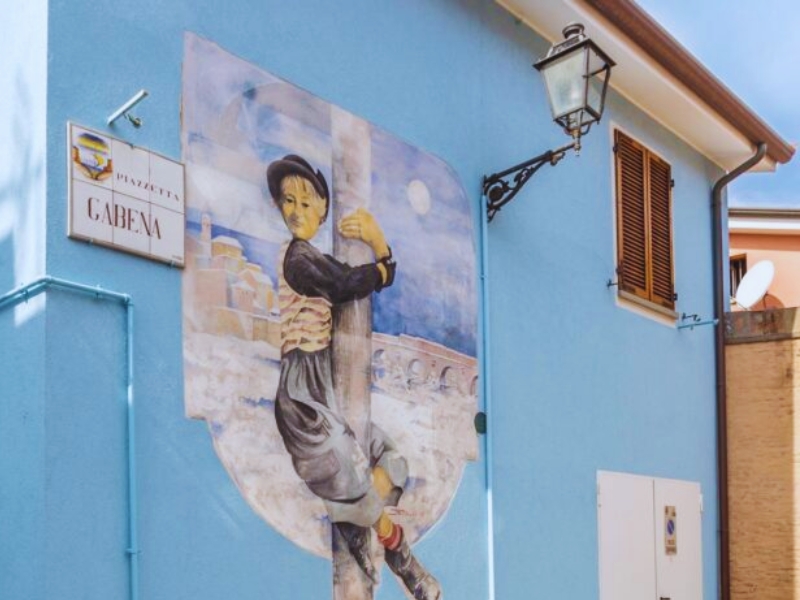
Borgo San Giuliano is the old fishermen's quarter of Rimini, just across the Roman Tiberius Bridge from the historic centre. Its low, brightly painted houses are covered in murals, and many of them show scenes and characters from the films of Federico Fellini, who was born in Rimini in 1920. Walking its lanes is like flicking through a sketchbook of his films, painted on the walls of people's homes.
Borgo San Giuliano at a glance
- Where: on the north bank of the Marecchia canal, at the far end of the Tiberius Bridge from Corso d'Augusto, in central Rimini.
- Created: the quarter dates back centuries; most of the murals have been painted since the 1990s, many for the neighbourhood's street festival.
- What it is today: a lived-in residential quarter with small squares, restaurants and osterie, and an open-air gallery of murals.
- Time needed: 30–45 minutes to wander the lanes and find the main murals.
From fishermen's quarter to open-air gallery
The borgo grew up outside the city walls, beside the river crossing on the Via Emilia, and for centuries it was home to fishermen, sailors and working families. It takes its name from the church of San Giuliano, whose patron, the martyr Saint Julian, has been venerated here since the Middle Ages. The houses are small and close together, built along narrow lanes that open into little squares, and they were never grand: this was the poorer side of the bridge.
In the second half of the 20th century the quarter fell into decline, and residents began to organise to bring it back to life. A neighbourhood street festival, the Festa de' Borg, became the focus, and from the 1990s, after Fellini's death in 1993, residents and artists started painting murals on the walls in his honour. More have been added over the years, and the borgo is now one of the most photographed corners of Rimini, while still being a place where people live, hang out washing and sit outside their front doors.
What to look for
- Fellini's characters: look for Gelsomina, the clown-like heroine of La Strada played by Giulietta Masina, Fellini's wife, and figures from Amarcord, his film about growing up in 1930s Rimini.
- Portraits of Fellini himself: the director appears on several walls, sometimes with Giulietta Masina, sometimes with a camera or megaphone.
- Everyday Romagna: not every mural is about cinema. Others show fishing boats, local characters and scenes of life in the borgo, some with lines in the Romagnol dialect.
- The colours of the houses: even without murals, the facades are painted in strong ochres, pinks and blues, with flower pots on window sills and doorsteps.
- The church of San Giuliano Martire: the quarter's church near the bridge, which holds an altarpiece by Paolo Veronese showing the saint's martyrdom.
The Festa de' Borg
The quarter's festival, held every two years in late summer, fills the lanes with music, food stalls and theatre, and has given the borgo much of its identity. Each edition has a theme, and new murals have often been painted for it, so the open-air gallery keeps growing. If you are in Rimini when it is on, expect crowds in the evening and a very different, livelier borgo than on an ordinary weekday.
Tips for your visit
- Come in the morning or late afternoon, when the light is soft on the painted walls and the lanes are quieter.
- Remember that people live here: keep your voice down, do not sit on doorsteps and do not photograph residents without asking.
- There is no fixed route, so wander slowly and look up and around corners; some of the best murals are in the side lanes rather than on the main street.
- Stay for dinner: the borgo has several traditional trattorias and osterie serving Romagna food such as piadina and fish dishes.
Nearby
- Tiberius Bridge: the Roman bridge of white Istrian stone that links the borgo to the centre, finished under the emperor Tiberius in the 1st century AD, and still in use.
- Parco XXV Aprile: the long park in the former bed of the Marecchia river, right next to the borgo, good for a walk or a run.
- Corso d'Augusto: the main street of the historic centre, which follows the old Roman road from the bridge to the Arch of Augustus.
- Fellini Museum: the museum dedicated to the director, opened in 2021 and spread across Castel Sismondo, the Fulgor cinema building and Piazza Malatesta, about 10 minutes' walk away.
See Rimini with World City Trail
Our Rimini scavenger hunt turns the old town into a game you play on your phone. The route links 10 stops and takes around 2 hours, with just over 30 minutes of walking. It includes the Arch of Augustus, the Tempio Malatestiano and Piazza Tre Martiri.
If you prefer a different format, there is also a self-guided walking tour and an outdoor escape game in Rimini.
Play the Rimini scavenger hunt →
Take the self-guided walking tour of Rimini →
Play the outdoor escape game in Rimini →
Facts checked in October 2026.