
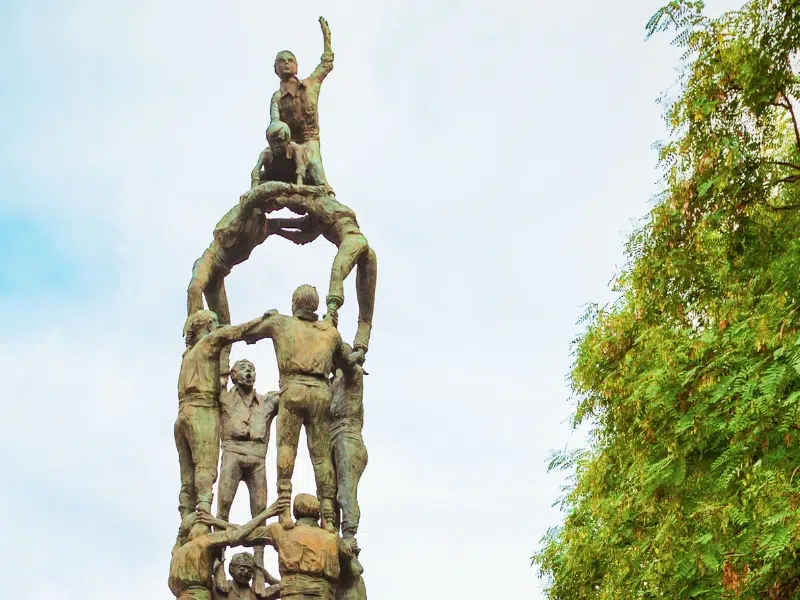
The Monument als Castellers is a bronze human tower in the middle of the Rambla Nova, Tarragona's main boulevard. Unveiled in 1999 and about 11 metres tall, it shows a complete castell, the Catalan human tower, at full scale: from the crowd pressing in at the base to the child at the very top. Walk all the way round it and you will see that every figure has a job.
The Monument als Castellers at a glance
- Where: the central walkway of the Rambla Nova, between Carrer Enginyer Cabestany and Carrer Pare Palau, a few minutes' walk from the Balcó del Mediterrani.
- Created: unveiled on 29 May 1999.
- By: Francesc Anglès i Crespo, a sculptor born in Terrassa in 1938.
- What it is today: the city's tribute to its castellers, the people who build human towers, and a favourite photo stop on the Rambla.
- Time needed: 10–15 minutes.
Why Tarragona built a tower of bronze
Castells, human towers built by teams called colles, grew up in the Camp de Tarragona area around the 18th century, with the nearby town of Valls usually named as their cradle. Tarragona has hosted the Concurs de Castells, the great human tower competition, since 1932. Today it is held every even-numbered year in early October in the Tarraco Arena Plaça, the city's former bullring, which was refurbished and given a roof. In 2010 UNESCO added castells to its list of the Intangible Cultural Heritage of Humanity.
The monument shows a 4 de 8: a tower eight levels high with four people on each of the lower levels, narrowing towards the top. The figures are cast in bronze around an internal steel structure, and the pinya, the base, is about six metres across. The sculptor gave several of the figures the faces of real people, so the monument is also a portrait of the castellers of the time.
What to look for
- The pinya: the dense crowd at the bottom, with arms raised and shoulders pressed together. In a real castell this is where most of the team stands, supporting the climbers and cushioning any fall.
- The levels of the tower: count them up from the pinya to the top, and see how the people on each level stand on the shoulders of the level below.
- The enxaneta: the child at the very top with one hand raised. In a real castell, that gesture marks the moment the tower is complete.
- The faixa: the long sash wrapped tightly around each casteller's waist. It supports the lower back, and climbers use it as a foothold and a handhold on the way up.
- The faces: look closely, especially around the base. Several figures are portraits of real people.
Strength, balance, courage and good sense
The castellers' motto is 'Força, equilibri, valor i seny': strength, balance, courage and good sense. A tower only counts as fully achieved when it is loaded, when the enxaneta reaches the top and raises a hand, and then unloaded, when everyone climbs back down without it falling. The monument captures that brief moment at the top, when the whole team is holding still.
Tips for your visit
- To see real castells, come for Santa Tecla, Tarragona's big festival in September, when colles build towers in the old town, or for the Concurs de Castells in early October in even-numbered years.
- For a photo of the whole tower, step back along the central walkway of the Rambla. For details, go right up to the pinya and look up through the figures.
- The Rambla is a busy promenade with benches and cafés: combine the monument with a walk down to the sea end of the boulevard.
Nearby
- Balcó del Mediterrani: the lookout at the sea end of the Rambla Nova. Locals touch its iron railing for good luck, a custom known as 'tocar ferro'.
- Monument to Roger de Llúria: the 1889 bronze statue of the medieval admiral on a tall pedestal, right in front of the Balcó.
- Mercat Central: Tarragona's Modernista covered market, a short walk away, with food stalls and places to eat inside.
- Roman amphitheatre: the arena by the sea below the Balcó, part of the Roman city of Tarraco, a UNESCO World Heritage site.
See Tarragona with World City Trail
Our Tarragona scavenger hunt turns the old town into a game you play on your phone. The route links 10 stops and takes around 2 hours, with about 32 minutes of walking. The Monument als Castellers is one of the stops, along with the Mercat Central. You can play in English, German, French, Italian, Spanish and Dutch.
If you prefer a different format, there is also a self-guided walking tour and an outdoor escape game in Tarragona.
Play the Tarragona scavenger hunt →
Take the self-guided walking tour of Tarragona →
Play the outdoor escape game in Tarragona →
Facts checked in October 2026.