
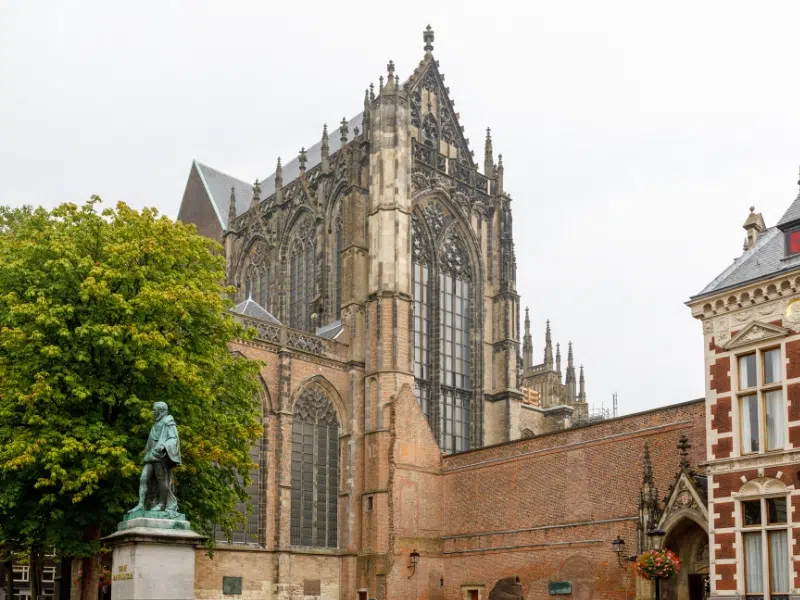
St Martin's Cathedral, the Domkerk, is the great Gothic church at the centre of Utrecht, and it is missing its middle. On 1 August 1674 a violent storm brought down the unfinished nave, and it was never rebuilt. Today the choir and transept stand on one side of the Domplein, the 112-metre Dom Tower on the other, and an open square with trees fills the space where the nave once stood.
St Martin's Cathedral at a glance
- Where: on the Domplein in the old centre of Utrecht, opposite the Dom Tower.
- Built: from 1254 into the 16th century; the tower was built between 1321 and 1382.
- By: begun under Bishop Henry of Vianen after a fire destroyed the Romanesque cathedral in 1253.
- What it is today: a Protestant church since 1580, open to visitors, and part of the UNESCO World Heritage listing of the Lower Germanic Limes for the Roman remains beneath the square.
- Time needed: 30–45 minutes for the church and cloister garden, plus an hour if you climb the tower.
From Roman fort to broken cathedral
The Dom stands inside the site of the Roman fort of Traiectum, from which Utrecht grew. Frankish missionaries built a first chapel here around 630, and around 695 the Anglo-Saxon monk Willibrord founded a church dedicated to St Martin, making Utrecht the base for spreading Christianity in the northern Low Countries. A Romanesque cathedral was consecrated in 1023, but most of it burned in 1253. The next year work began on the present Gothic church, in a style closer to French cathedrals than any other church in the Netherlands.
Money ran short after 1515 and the nave was never properly finished. In 1566 iconoclasts smashed many of its statues, and in 1580 the church passed to Protestant worship. On 1 August 1674 a storm, now described as a derecho, hit the weakly supported nave, which collapsed and left the tower standing on its own. The rubble was cleared, the gap became a square, and the surviving choir was restored in the 19th and early 20th centuries. The Dom Tower's own long restoration was completed in 2024.
What to look for
- The coloured paving on the Domplein that traces the outline of the vanished nave, columns and all.
- Inside, the high Gothic choir with its tall windows and the 14th-century tomb of Bishop Guy of Avesnes, the one major medieval tomb to survive fairly intact.
- The keizerssteentjes, small stones in the choir floor marking where the hearts and bowels of the emperors Conrad II and Henry V, who died in Utrecht, were buried.
- The cenotaph of the 16th-century bishop George van Egmond, which once held his heart.
- The cloister and its garden, the Pandhof, which lead to the chapter house where the Union of Utrecht was signed in 1579; the hall is now the main auditorium of Utrecht University.
The storm of 1674
On the evening of 1 August 1674 a short, extremely violent storm swept across the Dutch Republic. In Utrecht it struck a building that had been left unfinished and under-supported for over a century. The nave fell, and its wreckage lay in the square for years before it was cleared. The result is a cathedral split in two, which is unusual anywhere in Europe. Standing on the Domplein between tower and choir, you are standing inside the church that used to be there.
Tips for your visit
- Walk the outline of the old nave on the Domplein first, then enter the church: the scale makes more sense that way.
- Visit on a weekday morning for a quiet church; on Saturdays there are often concerts and events.
- Book the Dom Tower climb in advance: it is by guided tour only and popular at weekends.
- Sit for a while in the Pandhof, the cloister garden, one of the quietest places in central Utrecht.
Nearby
- Dom Tower: the tallest church tower in the Netherlands, climbed by guided tour for wide views over the city.
- DOMunder: an underground visit beneath the Domplein to see the remains of the Roman fort and earlier churches.
- Museum Speelklok: a museum of self-playing musical instruments in a medieval church, a few minutes' walk away.
- Oudegracht: the main canal with its unusual wharf cellars at water level, just west of the square.
See Utrecht with World City Trail
Our Utrecht scavenger hunt turns the old town into a game you play on your phone. The route links 10 stops and takes around 3 hours, with about 46 minutes of walking. It includes Museum Speelklok, close to the Dom.
If you prefer a different format, there is also a self-guided walking tour and an outdoor escape game in Utrecht.
Play the Utrecht scavenger hunt →
Take the self-guided walking tour of Utrecht →
Play the outdoor escape game in Utrecht →
Facts checked in October 2026.