
Nestled in the heart of downtown Boston, adjacent to the historic Park Street Church and steps away from Boston Common, lies the Granary Burying Ground. This hallowed ground is not merely a cemetery; it is an outdoor museum of early American history, the final resting place for an extraordinary number of figures who shaped the very foundations of the United States. As one of the most visited sites on Boston’s Freedom Trail, it offers a tangible connection to the Revolutionary era, inviting visitors to walk among the gravestones of patriots, statesmen, and everyday citizens who lived through formative moments in American history.
Origins and Evolution of a Sacred Space
The Granary Burying Ground was established in 1660. As Boston’s population grew rapidly, the town officials realized that King’s Chapel Burying Ground, the city’s first cemetery (established in 1630), was becoming overcrowded. To alleviate this, they set aside a section of what was then part of Boston Common for new burials. Initially known as the “South Burying Ground,” it acquired its enduring name in 1737 when a granary (a building used to store grain) was moved to the site now occupied by the Park Street Church, directly adjacent to the burial ground.
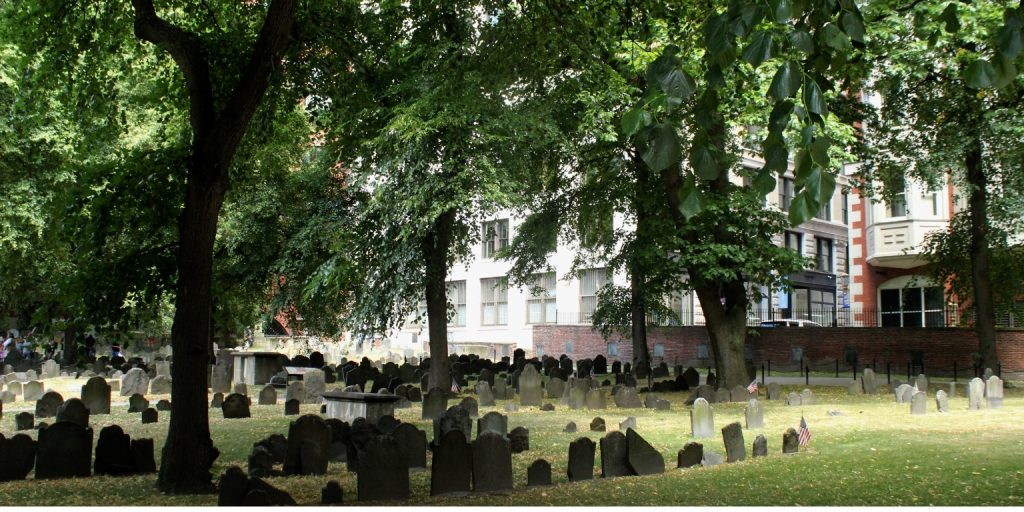
Over its active centuries, the cemetery saw thousands of interments. By the 18th century, it was so crowded that gravediggers complained they were often burying bodies “four deep.” While burials largely ceased after 1856, some interments continued until 1880. In the mid-19th century, the cemetery underwent significant landscaping projects, transforming it from a somewhat haphazard arrangement of graves into a more organized, park-like space with pedestrian walkways, shade trees, and shrubbery. The distinctive Egyptian Revival gate and cast-iron fence, designed by architect Solomon Willard (who also designed the Bunker Hill Monument), were added in 1840, giving the cemetery its iconic Tremont Street entrance.
A Pantheon of Patriots and Pioneers
The true allure of the Granary Burying Ground lies in the remarkable array of historical figures interred within its solemn confines. It is often referred to as the “Westminster Abbey” of Boston due to the sheer concentration of American Revolutionary War heroes and early American notables:
- Three Signers of the Declaration of Independence:
- John Hancock (1737–1793): Famous for his bold, flamboyant signature on the Declaration, his grave is easily recognizable near the monument to the Boston Massacre victims.
- Samuel Adams (1722–1803): A fiery orator and key leader of the American Revolution, his grave is a prominent stop for visitors.
- Robert Treat Paine (1731–1814): A lesser-known but equally vital signer and legal mind.
- Paul Revere (1734–1818): The legendary silversmith and patriot, celebrated for his “Midnight Ride,” is buried here. His grave is marked by a modest original slate stone and a later, larger memorial.
- Victims of the Boston Massacre: The five victims of the tragic Boston Massacre (March 5, 1770), including Crispus Attucks (considered by many the first casualty of the American Revolution), are interred in a common grave marked by a substantial obelisk.
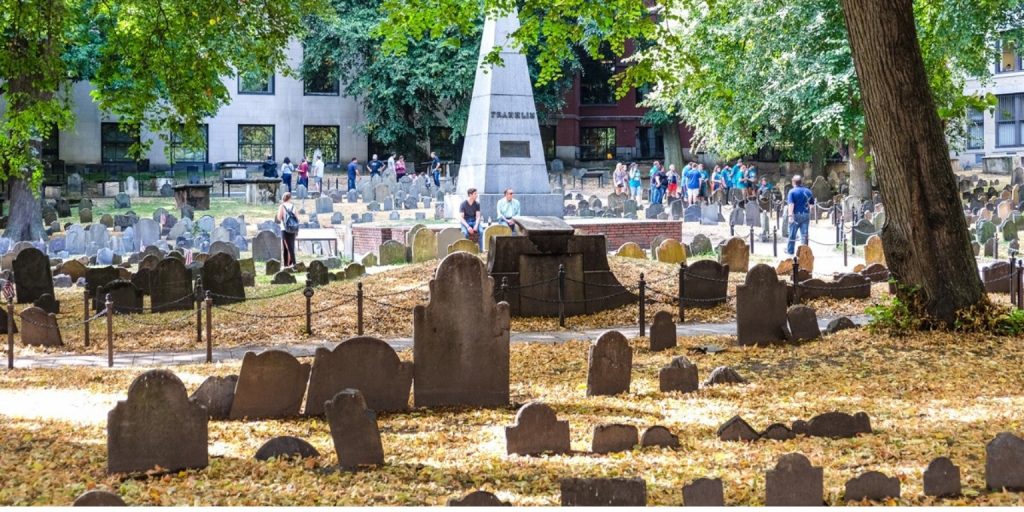
- Benjamin Franklin’s Parents: While Benjamin Franklin himself is buried in Philadelphia, his parents, Josiah and Abiah Franklin, are laid to rest here. Their graves are marked by a tall 25-foot granite obelisk, leading many to mistakenly believe Franklin himself is buried in Boston.
- Peter Faneuil (1700–1743): The wealthy merchant who donated Faneuil Hall to the city, a pivotal site for revolutionary meetings.
- James Otis Jr. (1725–1783): A brilliant lawyer and early advocate for colonial rights, famously associated with the phrase “Taxation without representation is tyranny.”
- Samuel Sewall (1652–1730): A prominent judge during the Salem Witch Trials who later publicly repented his role, representing a crucial shift in colonial thought.
Gravestone Art and Enduring Legacy
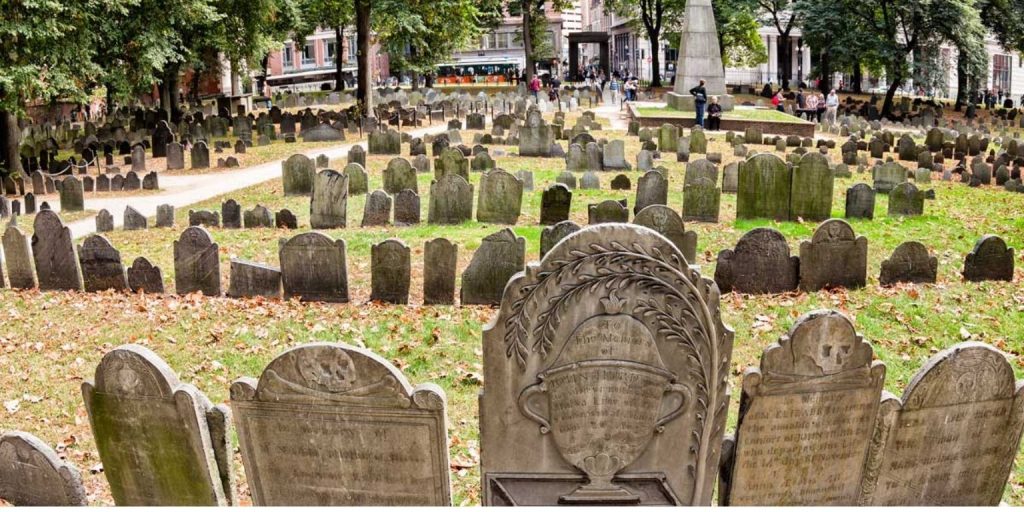
Beyond the famous names, the Granary Burying Ground is a fascinating study in early American funerary art. Its headstones, some dating back to 1667 (the oldest known marker belongs to John Wakefield), showcase the evolving iconography of death and remembrance. Early Puritan gravestones often feature “death’s heads” (winged skulls), stark reminders of mortality. As the 18th century progressed, these gave way to “soul effigies” (winged cherubs), symbolizing the hope of salvation, and later, to more classical urn and willow motifs.
Today, the Granary Burying Ground in Boston, established in 1660, continues to draw over a million visitors annually. It serves as a powerful historical record, a tranquil space for contemplation, and an essential educational site that brings the stories of America’s founders to life, cementing its status as an invaluable national treasure.