
In the verdant expanse of Boston Common, for over two centuries, stood a monumental American elm known simply as “The Great Elm in Boston.” This colossal tree, a natural landmark that predated the very founding of the city, was far more than just a magnificent specimen of nature; it was a living monument, a silent, leafy witness to pivotal moments in the city’s, and indeed the nation’s, history. From colonial justice to revolutionary fervor, its mighty branches once arched over a transforming landscape, embedding itself deeply into Boston’s collective memory.
An Ancient Giant’s Early Life
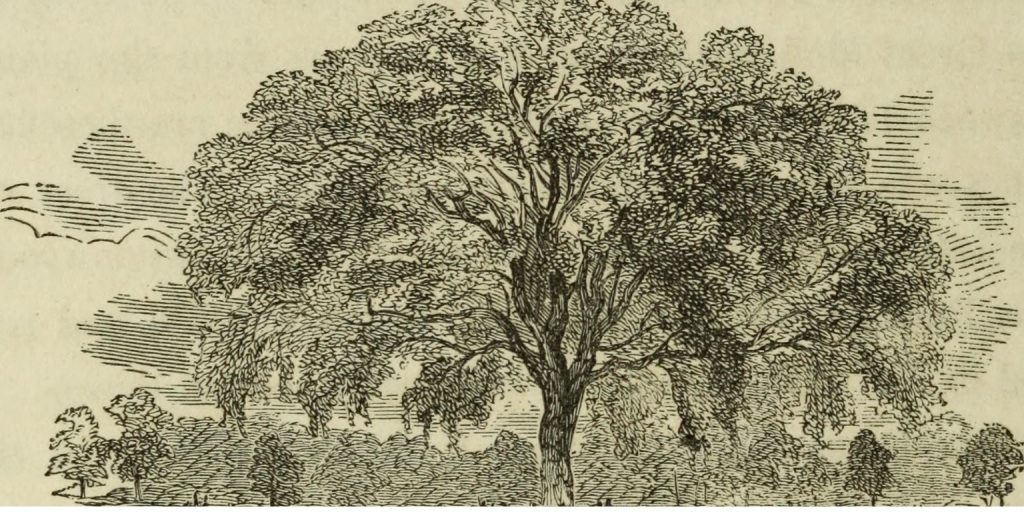
The exact date of The Great Elm’s sprouting remains unknown, but it was considered ancient even in the early 18th century. Estimates suggest it was already a mature tree when the first English settlers arrived in the 1620s and 1630s. Early maps of Boston Common, such as John Bonner’s 1722 engraving, notably depicted The Great Elm in Boston as a prominent feature, significantly larger than any other tree in the vicinity. Its immense size became legendary; by 1825, it reportedly stood 65 feet high with a circumference of 21 feet 8 inches, and its branches spread an astonishing 86 feet wide. By 1855, it had grown even taller, reaching 72.5 feet in height.
Located centrally on Boston Common, near what is now the intersection of Charles Street and Beacon Street, its imposing presence made it a natural gathering point and a beacon in the undeveloped landscape that was initially used as a cow pasture.
A Stage for Punishment and Protest
In its earliest centuries, The Great Elm in Boston served a rather grim, yet historically significant, purpose: it was Boston’s unofficial gallows. Puritan justice, often harsh and public, was dispensed from its lower branches. It is widely believed that numerous individuals, including alleged witches, murderers, pirates, and religious dissenters such as Quakers William Robinson, Marmaduke Stevenson, and Mary Dyer, met their end hanging from this very tree during the 17th century. This macabre function earned it the grim moniker of “the hanging elm.” Public executions continued on or near the Common until 1817, though by the late 18th century, scaffolding was often used instead of the tree itself for hangings due to its age and size.
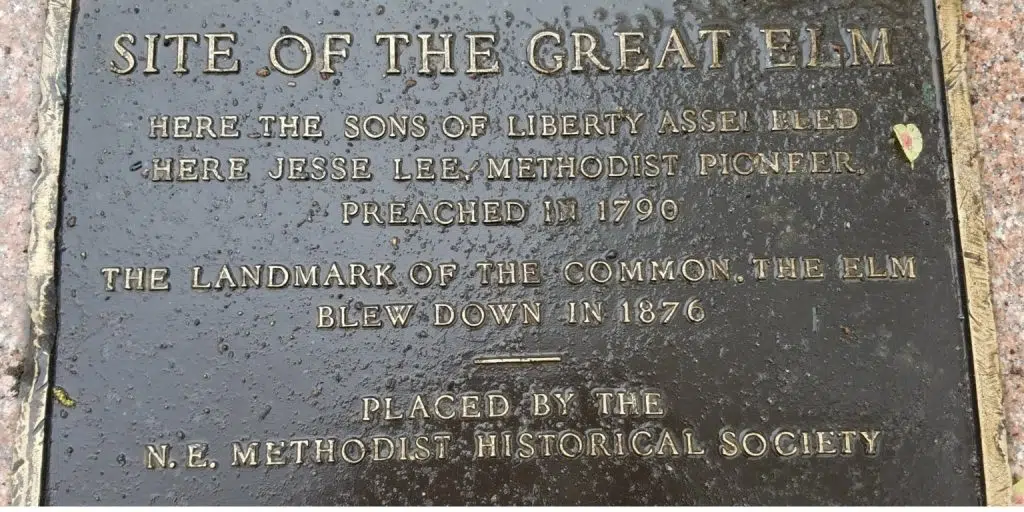
As the American Revolution simmered, The Great Elm transformed from a site of punishment into a symbol of burgeoning liberty. While the more famous “Liberty Tree” (a different elm) stood elsewhere, The Great Elm on the Common also became a favored meeting spot for the Sons of Liberty. Patriots would gather beneath its shade to plot resistance against British rule, discuss grievances, and reportedly even hang lanterns from its branches as a sign of unity or for public display of effigies. British soldiers themselves encamped on Boston Common during the occupation of Boston in the 1770s, undoubtedly aware of the grand tree that stood as a silent witness to their presence.

A Beloved Landmark and Its End
In the decades following the Revolution, The Great Elm’s role shifted once more, becoming a beloved civic landmark and a symbol of Boston itself. It attracted visitors for its sheer grandeur and age. Mayor Jerome V.C. Smith even had an iron enclosure built around its base in the mid-19th century to protect it from damage by eager souvenir hunters.
However, even giants must eventually succumb to time. After weathering countless storms, including a particularly damaging one in 1860, Great Elm in Boston finally met its demise during a strong gale. On February 15, 1876, a powerful storm toppled the ancient tree, bringing down a piece of living history. The event was met with widespread public mourning; thousands of Bostonians, including the mayor, flocked to the Common to witness its fall and collect pieces of its wood as mementos. Many fragments were fashioned into furniture, keepsakes, and even a chair now housed in the Boston Public Library.
Today, while the original Great Elm in Boston no longer stands, its legacy endures. In 2019, a new American Elm of the same species was planted in its approximate location on Boston Common by the city’s Parks and Recreation Department. This new tree serves as a living tribute to its legendary predecessor, reminding current and future generations of the mighty arboreal sentinel that silently observed over two centuries of Boston’s profound and pivotal history.