
It is a significant historical and architectural landmark in downtown Denver. Located at 931 14th Street, the Mountain States Telephone Building stands as a testament to the early 20th-century growth of telecommunications and its impact on urban landscapes. Often considered one of the last of the “Bell System Palaces,” it combines striking architectural grandeur with a rich history of technological innovation, making it a pivotal piece of Denver’s heritage.

A Grand Vision for a Connected Era
The origins of the Mountain States Telephone Building trace back to the rapid expansion of telephone services in the Rocky Mountain region in the early 20th century. The Mountain States Telephone and Telegraph Company (later known as Mountain Bell, and now part of CenturyLink) was formed in 1911 as a result of mergers and reorganizations within AT&T, covering a vast territory from Montana to New Mexico. As the demand for telephone service boomed, tripling by 1930, the company quickly outgrew its existing facilities.
To accommodate its burgeoning staff and cutting-edge switching equipment, Mountain States embarked on building a large, custom-designed headquarters in Denver. Design work began in 1926, with construction commencing in March 1927. The building was largely a product of Colorado, utilizing materials sourced locally, including steel from Pueblo, bricks and terra cotta from Denver and Golden, and granite and travertine from the nearby Rocky Mountains. The grand structure, costing $3 million (plus an additional $2 million for furnishings and equipment), was completed in 1929, coinciding with the 50th anniversary of telephone service in Denver.
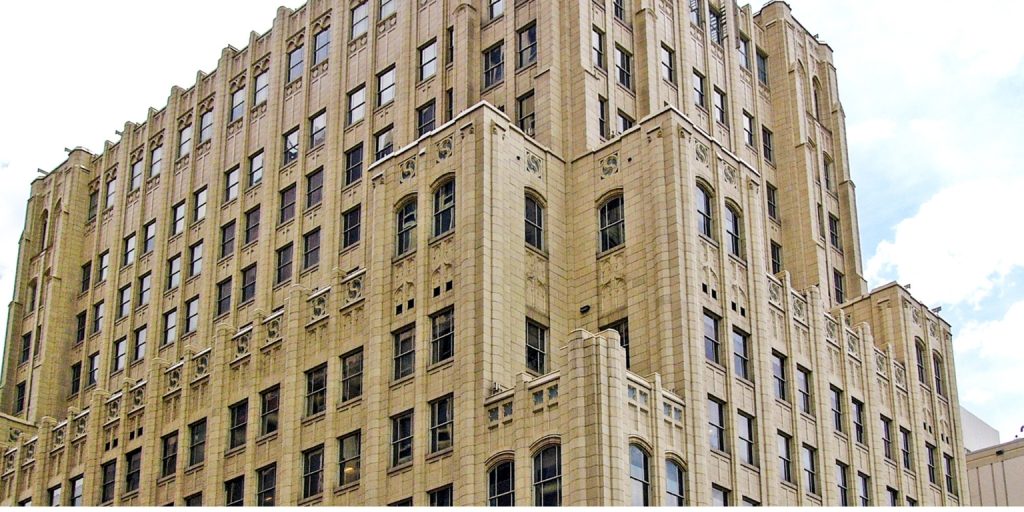
Architectural Splendor: “Modern American Perpendicular Gothic”
The Mountain States Telephone Building in Denver was designed by prominent local architect William N. Bowman. Bowman adopted a unique architectural style that the company itself dubbed “Modern American Perpendicular Gothic.” This style is a sophisticated blend of Art Deco and Gothic Revival, drawing inspiration from towering Neo-Gothic skyscrapers of the era, such as New York’s Woolworth Building, and the then-under-construction Art Deco New York Telephone Company headquarters.
The building’s design emphasizes soaring verticality, characteristic of the Perpendicular Gothic style, giving it an imposing and elegant presence. Its ten stories (originally, before later additions) made it the tallest building in Denver and the entire Rocky Mountain region until the 1950s, dominating the city’s skyline. The exterior is clad in buff-colored terra cotta over a pink granite base, showcasing intricate ornamentation that hints at its Gothic influences.
Beyond its exterior, the building’s inner lobbies feature remarkable mural cycles by acclaimed Denver artist Allen Tupper True. These Art Deco murals, created between 1927 and 1929, depict the heroic history of communications in the American West, from smoke signals and the Pony Express to the construction of telephone lines. True’s work extends to other notable Denver landmarks, but his contribution to the Telephone Building’s interiors is particularly significant, embodying the era’s grand visions of progress.

A Legacy of Communication and Preservation
Upon its completion in 1929, the Mountain States Telephone Building was at the forefront of telecommunications technology. It housed equipment that brought automated dialing service to Denver residents for the first time, and its specially designed fireproof core protected vital infrastructure. The building was fully occupied by its 1,510 workers by the end of July 1929, with a grand opening attracting over 20,000 visitors.
Over the decades, as telephone service continued to grow, the building saw several expansions. Additions were made in the late 1940s and late 1950s, and a connected International-style building was added in the 1960s. While Mountain States moved its headquarters in 1984, the original Telephone Building at 931 14th Street continues to serve as a vital central office for telecommunications, providing dial tone and other services for Colorado and connecting calls nationally and internationally.
The building’s historical and architectural significance was recognized when it was listed on the National Register of Historic Places in 2005. Although the interior is generally not open to the public (except for the outer lobbies with True’s murals), its enduring presence on the Denver skyline and its continuous function in telecommunications make the Mountain States Telephone Building in Denver a powerful symbol of the city’s growth, technological advancement, and architectural heritage.
Further reading on Wikipedia: Allen Tupper True