
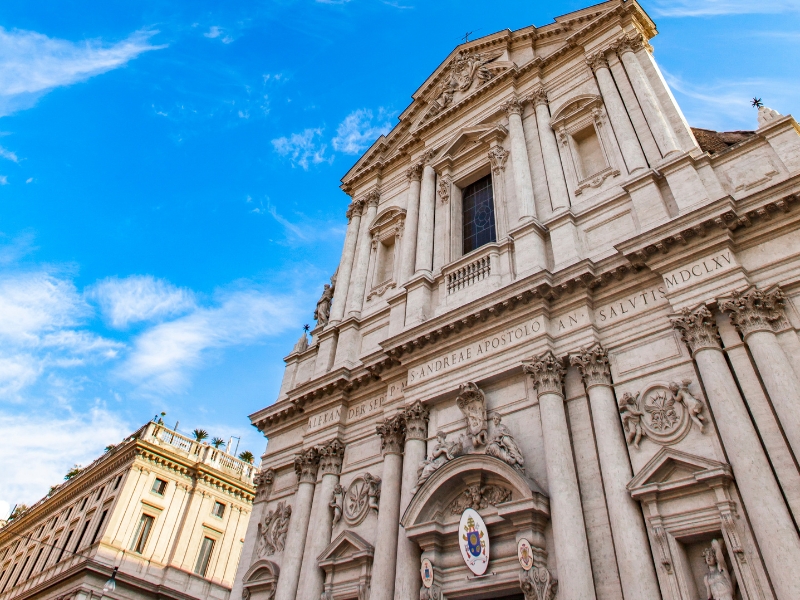
Between Campo de' Fiori and the Roman Forum, three places show how Rome kept rebuilding itself on the same ground: a Baroque church with a famous dome, a square remodelled around a national monument, and the hill where Michelangelo designed a new civic centre on top of ancient Rome's most sacred temple site. They lie in a line along one walk, and all three are stops on our Rome scavenger hunt.
Sant'Andrea della Valle
This church on Corso Vittorio Emanuele II was begun in 1591 for the Theatines, a religious order founded in the early 16th century, to designs by Giacomo della Porta and other architects. Carlo Maderno took over in 1608, enlarged the transept and raised the dome, which was inaugurated in 1622 and was then the second highest in Rome after St Peter's. Carlo Rainaldi added the travertine facade in the second half of the 17th century.
Inside, the dome is painted with Giovanni Lanfranco's Glory of Paradise, one of the first great illusionistic Baroque ceilings in Rome, while Domenichino painted the four Evangelists in the pendentives and scenes from the life of St Andrew in the apse area. Opera lovers know the church for another reason: Puccini set the first act of Tosca, first performed in Rome in 1900, inside it. It is a stop on our scavenger hunt.
- The single angel on the upper left of the facade, by Ercole Ferrata; the matching spot on the right is empty. The story goes that Pope Alexander VII criticised the angel and the sculptor refused to carve a second, but treat that as an anecdote.
- The dome frescoes seen from directly below the crossing, where Lanfranco's crowd of saints seems to rise into the lantern.
- The tombs of two popes of the Piccolomini family, Pius II and Pius III, moved here in 1614 from old St Peter's.
Piazza Venezia
Piazza Venezia takes its name from Palazzo Venezia on its western side, begun in 1455 by the Venetian cardinal Pietro Barbo, who became Pope Paul II. From the 16th century it housed the embassy of the Republic of Venice. In the 20th century Mussolini made it his headquarters and addressed crowds from its balcony, including on 10 June 1940, when he announced Italy's entry into the Second World War. Today it is a museum.
The south side of the square is filled by the Vittoriano, the white marble monument to Victor Emmanuel II, the first king of united Italy. Giuseppe Sacconi won the design competition, the monument was inaugurated in 1911 for the fiftieth anniversary of unification, and work went on until 1935. Since 1921 it has held the Tomb of the Unknown Soldier at the Altar of the Fatherland. Romans have never quite loved it and call it the typewriter or the wedding cake. It is a stop on our scavenger hunt.
- The bronze equestrian statue of Victor Emmanuel II in the centre of the monument, and the two bronze chariots on top of the colonnade. A lift at the back takes visitors up to a panoramic terrace.
- The Tomb of the Unknown Soldier, guarded by soldiers and flanked by an eternal flame.
- The balcony in the middle of Palazzo Venezia's front facing the square, the one Mussolini spoke from.
Capitoline Hill
The Capitoline is the smallest of Rome's seven hills, but it was the religious centre of the ancient city: the great Temple of Jupiter Optimus Maximus stood on its southern summit, and parts of its foundations can still be seen inside the Capitoline Museums. In the 1530s Pope Paul III commissioned Michelangelo to redesign the square on top, the Piazza del Campidoglio, which he turned to face the papal city rather than the Forum. His plan was completed over more than a century after his death, and the star-shaped paving was only laid in 1940, following his design.
Three palaces frame the square. The Palazzo Senatorio at the back is the seat of Rome's city government, and the two side palaces hold the Capitoline Museums, whose origins go back to 1471, when Pope Sixtus IV gave a group of ancient bronzes to the people of Rome. They are often described as the oldest public museum in the world. The hill is a stop on our scavenger hunt.
- The Cordonata, Michelangelo's gentle ramp of shallow steps, with the giant statues of Castor and Pollux at the top.
- The equestrian statue of Marcus Aurelius in the centre: the one outside is a copy, and the 2nd-century bronze original stands indoors in the Capitoline Museums.
- The view over the Roman Forum from the terraces on either side of the Palazzo Senatorio, and the steep flight of steps beside the Cordonata that leads up to the church of Santa Maria in Aracoeli.
How to see them in one walk
Start at Sant'Andrea della Valle and look inside before following Corso Vittorio Emanuele II east to Largo di Torre Argentina, a sunken square of Republican-era temples; the remains of the Curia of Pompey, where Julius Caesar was murdered in 44 BC, lie at its western edge. Continue along Via del Plebiscito, which brings you out beside Palazzo Venezia, and cross to the Vittoriano. From the foot of the monument, the Cordonata climbs to the Piazza del Campidoglio; walk round the Palazzo Senatorio for the view over the Forum. The ruins of Trajan's Forum and the Colosseum are close by if you want to keep going.
See Rome with World City Trail
Our Rome scavenger hunt turns the historic centre into a game you play on your phone. The route links 10 stops, from Castel Sant'Angelo to the Colosseum, and Sant'Andrea della Valle, Piazza Venezia and the Capitoline Hill are all stops on it, along with Piazza Navona, the Pantheon and Trajan's Forum. At each stop you solve a puzzle and learn a story, at your own pace.
There is also a self-guided walking tour and an outdoor escape game in Rome, for people who prefer a different format.
Play the Rome scavenger hunt →
Take the self-guided walking tour of Rome →
Play the outdoor escape game in Rome →
Facts checked in October 2026.