
This guide covers five places in the old east side of Glasgow, from St Enoch Square through the Merchant City to Glasgow Green: the little red station building in St Enoch Square, the City Halls and Old Fruitmarket, the People's Palace with the Doulton Fountain, and, a short walk north, the Cathedral House Hotel beside the cathedral and the Necropolis. They belong together as the oldest part of the city, where medieval Glasgow grew up between the cathedral and the river.
St Enoch Travel Centre
In the middle of St Enoch Square stands a small, ornate building in red sandstone that looks like a miniature castle. It was designed by James Miller and built in 1896 as the entrance and ticket office of St Enoch station on the Glasgow Subway, the third-oldest underground railway in the world after London and Budapest. After the subway was modernised in 1977–80 it lost that role, became a travel information centre run by the transport authority SPT, and is now a café. The square takes its name from St Enoch, a corruption of St Thenew, the mother of Glasgow's patron saint, St Mungo. St Enoch Square is the first stop of our Glasgow scavenger hunt.
- The turrets, gables and carved details of the Jacobean-style façade, unusual for such a small building.
City Halls & Old Fruitmarket
On Candleriggs, in the Merchant City, the Grand Hall of the City Halls opened in 1841, designed by George Murray; the surrounding market buildings followed in 1882 to plans by John Carrick. Over the years its guests included Charles Dickens, Benjamin Disraeli and William Gladstone. Next door, the Old Fruitmarket was a working market hall until the 1970s. After an extensive renovation, both reopened in January 2006, and the Grand Hall is now the home of the BBC Scottish Symphony Orchestra. The venue is a stop on the scavenger hunt.
- The Old Fruitmarket's cast-iron roof and upper gallery, reminders of its long life as a market hall.
- The Candleriggs façade, at the end of a street that has been part of Glasgow's market quarter for centuries.
People's Palace
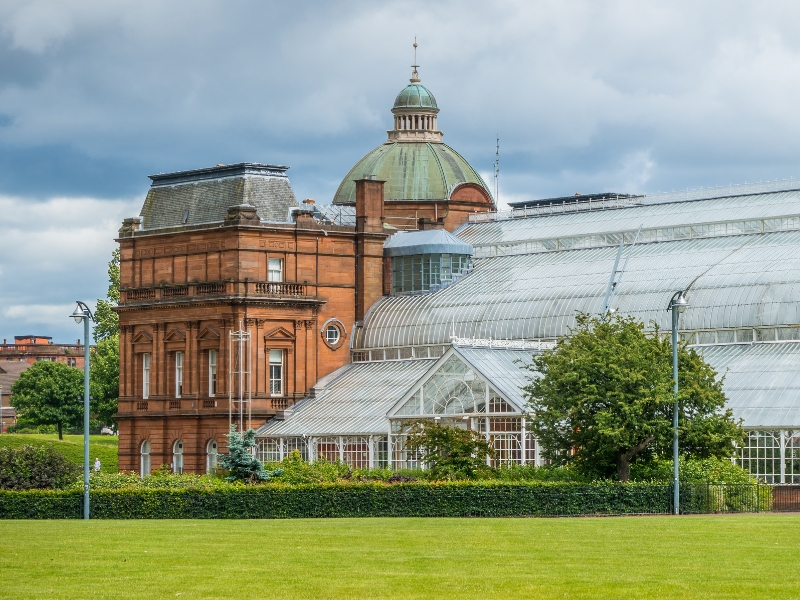
On Glasgow Green, the oldest park in the city, the People's Palace opened in 1898 as a museum and cultural centre for the people of the crowded East End. Behind the red sandstone building is the Winter Gardens, a large Victorian glasshouse. The museum tells the social history of Glasgow from the 18th century onwards: work, housing, shops, pubs, football and the city's sense of humour. One of its best-loved exhibits is a pair of giant banana boots worn on stage by the Glasgow comedian Billy Connolly.
The People's Palace and the Winter Gardens closed in 2024 for a major refurbishment. The project stalled for lack of money until the Scottish Government pledged funding in September 2026, and no reopening date had been set when we checked; check before you go. You can still see the building from outside, and it is the last stop of the scavenger hunt.
- The red sandstone front with its sculptures, facing the open lawns of Glasgow Green.
- The curved iron and glass roof of the Winter Gardens behind the museum.
Doulton Fountain
In front of the People's Palace stands the Doulton Fountain, made by the Doulton company for the 1888 International Exhibition in Kelvingrove Park and moved to Glasgow Green a few years later. It is the largest terracotta fountain in the world. Queen Victoria stands on top, and below her are figures representing parts of the British Empire, a reminder of the age in which it was made. After years of decay it was restored and moved to its present site in front of the museum in the early 2000s. It is one of the scavenger hunt stops.
- The figure of Queen Victoria on top and the groups representing Canada, Australia, India and South Africa below.
Cathedral House Hotel
A short walk north of the Merchant City, on Cathedral Square, stands the Cathedral House Hotel. The red sandstone building, in the style of a 16th-century Scottish tower house, was built in 1896 to designs by Campbell Douglas for the Discharged Prisoners' Aid Society, which used it as an office and hostel for people leaving prison. Today it is a listed building and a small hotel. It is not a scavenger hunt stop, but it is the natural base for a visit to Glasgow Cathedral, the only medieval cathedral on the Scottish mainland to come through the Reformation of 1560 almost intact, and the Necropolis, the Victorian cemetery on the hill behind it.
- The turret and crow-stepped gables, typical of Scottish Baronial style.
- The view up to the Necropolis, with its monuments on the skyline above the cathedral.
How to see them in one walk
Start in St Enoch Square, then walk north through the Merchant City to the City Halls and the Old Fruitmarket on Candleriggs. From there, go east to Glasgow Cross and the Tolbooth Steeple, another scavenger hunt stop: the seven-storey tower, built in the 1620s, is all that remains of the old Tolbooth, which served as town hall and jail. Continue south through St Andrew's Square to Glasgow Green, the Doulton Fountain and the People's Palace. If you have time, take the High Street north from Glasgow Cross to Cathedral Square for the Cathedral House Hotel, Glasgow Cathedral and the Necropolis, where the view over the city from the top of the hill is worth the climb.
See Glasgow with World City Trail
Our Glasgow scavenger hunt turns the city into a game you play on your phone. The route links 10 stops, from St Enoch Square to the People's Palace, and four of the places in this guide are among them: St Enoch Square, the City Halls and Old Fruitmarket, the Doulton Fountain and the People's Palace.
If you prefer a different format, there is also a self-guided walking tour and an outdoor escape game in Glasgow.
Play the Glasgow scavenger hunt →
Take the self-guided walking tour of Glasgow →
Play the outdoor escape game in Glasgow →
Facts checked in October 2026.