What is the Glasgow outdoor escape game?
Think of an escape room that has walked out into the city centre. The Glasgow outdoor escape game sends you from one landmark to the next on your smartphone, and each of the 10 stops holds a puzzle that you crack by studying your surroundings and thinking it through. Roughly 2 hours is enough time for the 2.9 km route, with 40 minutes of that spent walking.
The puzzles sit at places such as George Square, the City Chambers, the Merchant City, the City Halls, the Tolbooth Steeple, St Andrew's in the Square, the Doulton Fountain and the People's Palace. Each puzzle stands alone with no storyline to follow, and up to three levels of hints are available. Glasgow suits this format because its Victorian civic core and the Merchant City grid are compact enough to explore on foot, with plenty of places to pause.
- Durationabout 2 hours
- Walkingabout 40 min · 2.9 km
- Stops10
- LanguagesEnglish, German, French, Italian, Spanish, Dutch
What you do on the escape game
Solve
Work out each puzzle from what surrounds you. You do not need to know the city beforehand.
Look closer
The answers are in the façades, the statues, the fountain and the layout of each square.
Walk
Google Maps guides you across 2.9 km, about 40 minutes on foot, from one landmark to the next.
Take your time
No countdown runs. Ask for a hint when you need one, stop for a coffee, and carry on later or another day.
See the route and attractions →
How it works
- Book online Choose the number of players. Your booking reference arrives by email straight away.
- Get the app Download the World City Trail app from the App Store or Google Play and enter your booking reference.
- Play when you like Start whenever you are ready, walk at your own pace and pause any time. No guide, no fixed schedule.
Who it suits
Groups of friends
Each puzzle gives the group something to argue about at the next landmark, with no local knowledge needed.
Couples
A shared challenge to solve as you stroll between the squares, with no clock setting the pace.
Team building
Teams of up to 5 play on their own phones, so colleagues can share the reasoning and compare notes.
Good to know
- Bring a charged smartphone with mobile data; a power bank helps.
- Best started in daylight, so you can see the details the puzzles ask about.
- No entry tickets needed: everything happens outside the buildings. Going inside is optional and paid separately.
- Family friendly; children must be accompanied by an adult.
- Not suitable for wheelchair users and difficult with strollers.
- Teams of up to 5 work best; bigger groups split into several teams, one ticket per player.
- Every purchase helps support stray cats and dogs in Greece.
Puzzle route: from St Enoch Square to the People's Palace
10 stops · about 40 min walking · start: St Enoch Square · finish: People's Palace
The first puzzle waits on St Enoch Square and the last one at the People's Palace on Glasgow Green. In between, the trail passes the Gallery of Modern Art, George Square and the City Chambers, then the Merchant City, the City Halls and Old Fruitmarket, the Tolbooth Steeple and St Andrew's in the Square, before the Doulton Fountain. Google Maps guides you between stops, the app lets you change the starting point and the order, and no entry tickets are needed for the puzzles.
Open the route map ↗
1St Enoch SquareStart
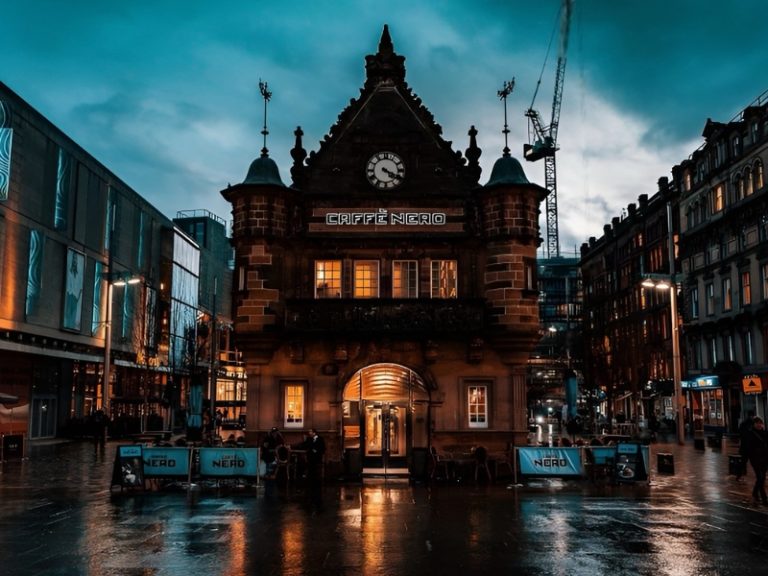
The square is named after Saint Enoch, or Thenew, the mother of Saint Mungo, Glasgow's patron saint. The small red sandstone building in the middle dates from 1896 and was built as an entrance to the Glasgow Subway, which opened that year as one of the oldest underground railways in the world.
2Gallery of Modern Art (GoMA)
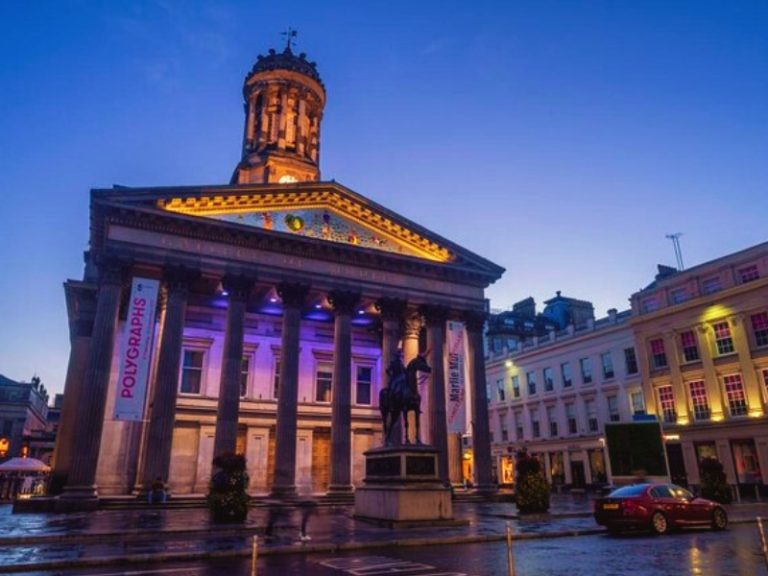
This columned building began in 1778 as the townhouse of William Cunninghame, one of the tobacco lords, and was turned into the Royal Exchange in the 1820s and 1830s. Since 1996 it has been the Gallery of Modern Art. Outside, the statue of the Duke of Wellington on horseback usually wears a traffic cone on its head, a Glasgow tradition.
3George Square
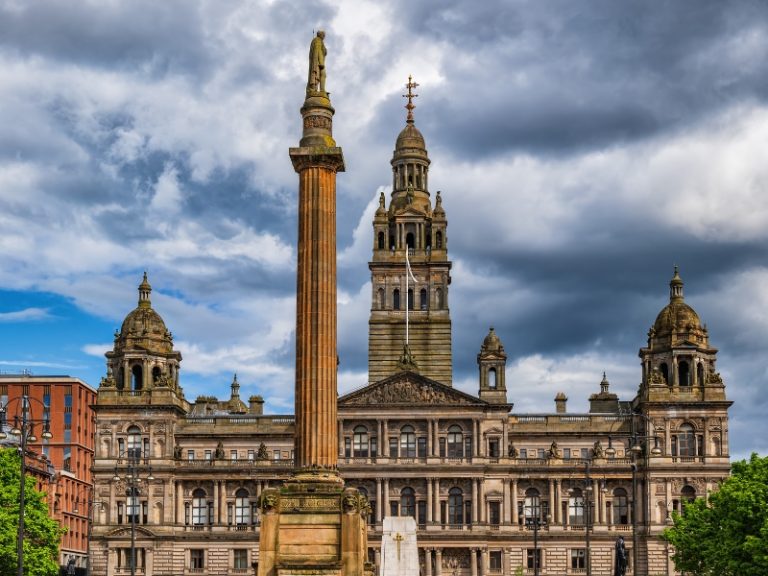
Glasgow's main civic square was laid out in the late 18th century and named after King George III. Its statues include Robert Burns, James Watt, Queen Victoria and Prince Albert on horseback, and a tall column topped by Sir Walter Scott. The city's war memorial, the Cenotaph, stands on its east side.
4Glasgow City Chambers
Queen Victoria opened Glasgow's city hall in 1888, when the city called itself the second city of the British Empire. Designed by William Young, its richly sculpted façade and tower fill the east side of George Square. It is still the seat of Glasgow City Council.
5Merchant City
In the 18th century, Glasgow's tobacco lords grew rich on tobacco grown by enslaved people in Virginia and built their mansions and warehouses in this grid of streets. Names such as Virginia Street and Glassford Street still recall that trade. Today its restored buildings hold bars, restaurants and shops, around landmarks such as Robert Adam's Trades Hall.
6City Halls & Old Fruitmarket
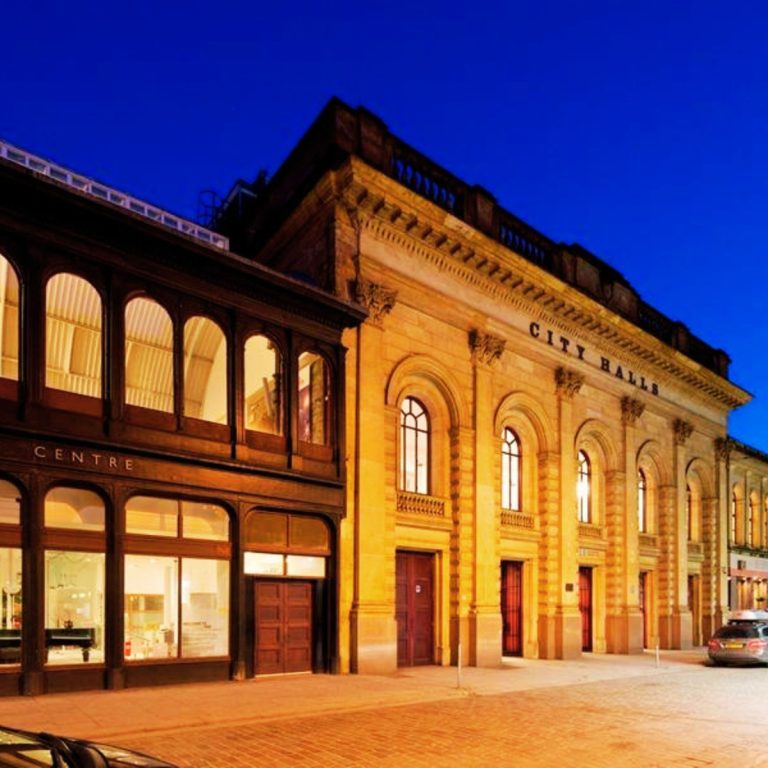
On Candleriggs, a street named after the candle makers who once worked here, the City Halls were built in the 1840s for concerts and public meetings. Next to them, the Old Fruitmarket was the city's fruit and vegetable market hall, with an iron roof and gallery. Both are now concert venues, and the City Halls are home to the BBC Scottish Symphony Orchestra.
7Tolbooth Steeple
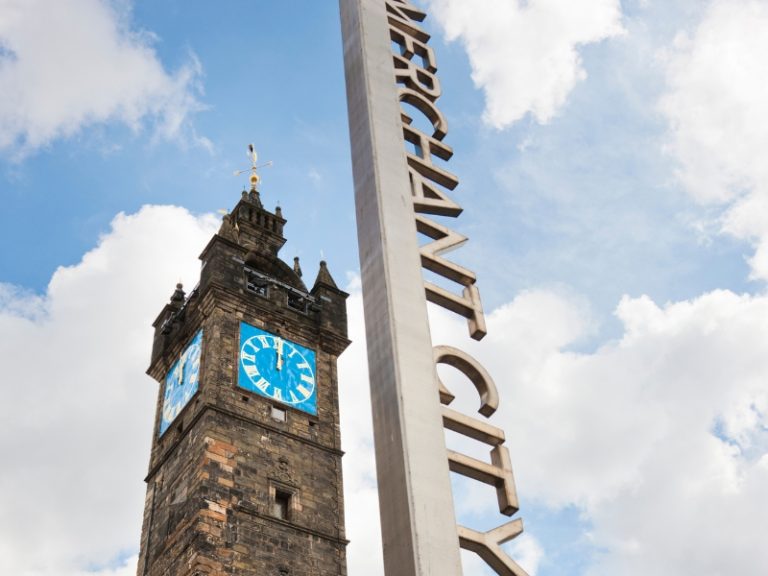
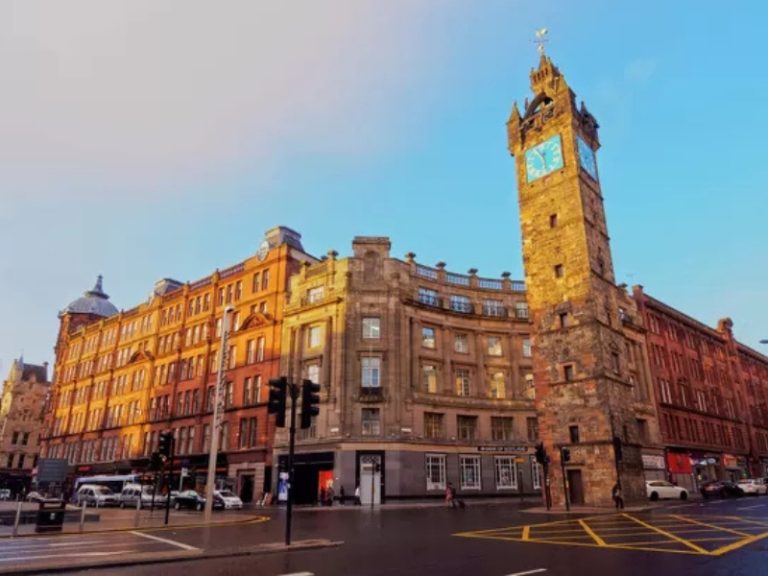
The Tolbooth Steeple at Glasgow Cross is all that remains of the tolbooth built between 1626 and 1634, which served as town hall, courthouse and prison. Its seven stages rise to a stone crown about 38 metres high. The main building was demolished in 1921, leaving the steeple standing alone in the traffic.
Read the full story →
8St Andrew's in the Square
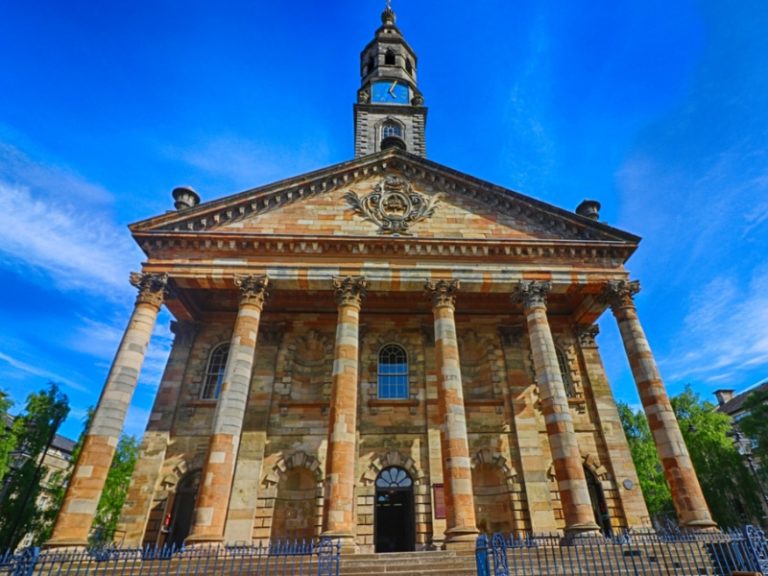
Built between 1739 and 1756, St Andrew's in the Square is one of the finest Georgian churches in Scotland. Its portico of Corinthian columns and its steeple were modelled on St Martin-in-the-Fields in London. It was designed by Allan Dreghorn and built by the mason Mungo Naismith.
9Doulton Fountain
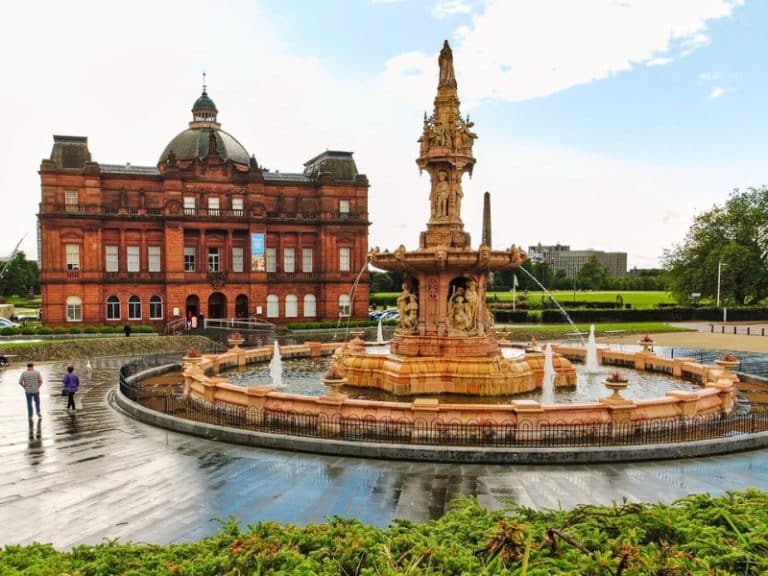
Made by the Doulton pottery company for Glasgow's International Exhibition of 1888, this is said to be the largest terracotta fountain in the world. Queen Victoria stands on top, above figures representing Canada, Australia, South Africa and India. It was moved to Glasgow Green after the exhibition and now stands in front of the People's Palace.
Read the full story →
10People's PalaceFinish
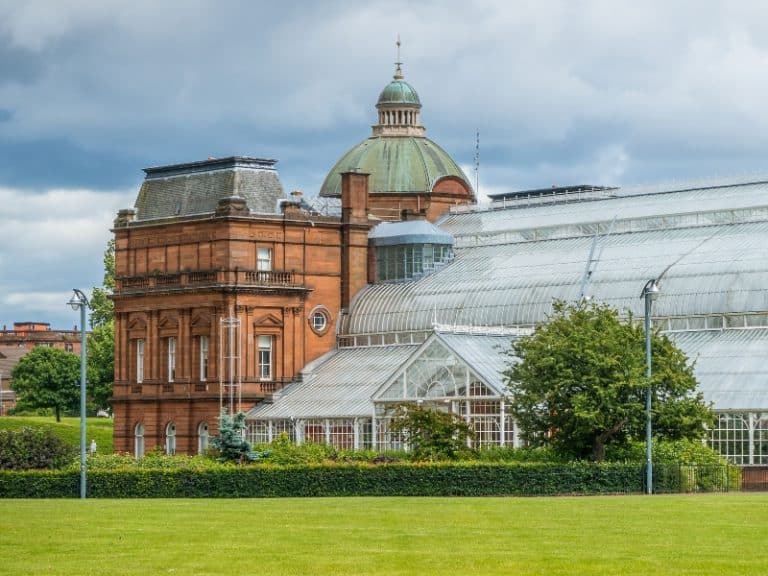
Opened in 1898 on Glasgow Green, the city's oldest park, the People's Palace is a museum about the everyday life of Glaswegians. The large glasshouse of the Winter Gardens is joined to its back. Nearby, the former Templeton carpet factory copies the Doge's Palace in Venice in colourful brick.
Only logged in customers who have purchased this product may leave a review.






Anonymous (verified owner) –
Very nice!