
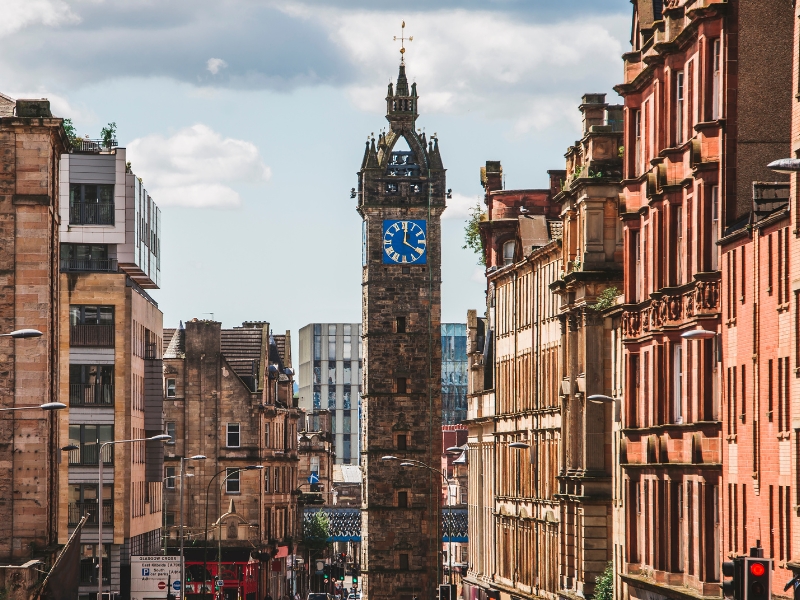
The Tolbooth Steeple is the tall stone tower with a crown-shaped spire standing on its own at Glasgow Cross, where five of the city's oldest streets meet. It was finished in 1634 as part of the Glasgow Tolbooth, the building that served as town hall, courthouse and prison. The rest of the tolbooth was pulled down in 1921, and the steeple is all that is left: a 17th-century tower now surrounded by traffic lights and buses.
Tolbooth Steeple at a glance
- Where: at Glasgow Cross, the junction of High Street, Trongate, Gallowgate, London Road and Saltmarket, on the eastern edge of the Merchant City.
- Built: 1626–1634, on a site where a tolbooth had stood since at least the 14th century.
- By: John Boyd, the burgh's master of works.
- What it is today: a free-standing Category A listed tower, seen from the street; it is not open to visitors.
- Time needed: 10 minutes, or 20 if you walk round the whole of Glasgow Cross.
Town hall, court and jail
Glasgow's tolbooth was the centre of town life. When the old building became ruinous, a new one was begun in 1626 in the Scottish Baronial style: a five-storey main block facing Trongate and a seven-stage steeple at its east end, about 38 metres high. The council met here, the courts sat here and prisoners were held here. In the 17th century Covenanters such as the preacher Donald Cargill were locked up in poor conditions, and over the 17th and 18th centuries 22 executions took place at the tolbooth.
In 1814 the council and courts moved to new public offices on the Saltmarket. The tolbooth was sold, used as a drapery warehouse from 1874 and later as auctioneers' offices. By the early 20th century the main block was in very poor condition and it was demolished in 1921. Only the steeple was kept, and in 1923 its west face, where it had joined the rest of the building, was repaired to a design by the architects Keppie Henderson.
What to look for
- The crown spire at the top: a stone 'crown' of flying ribs, a typically Scottish design also found on St Giles' Cathedral in Edinburgh.
- The clock faces on the seventh and highest stage, just below the corbelled parapet.
- The small leaded windows on each of the stages in between, showing that the tower once held rooms on several floors.
- The gilded weather vane on the very top, catching the light above the traffic.
- The plain west face, rebuilt in 1923 where the main block of the tolbooth was once attached.
From prison to Climate Clock
In June 2021, a few months before the COP26 climate summit came to Glasgow, the steeple was given a new role. A night-time light projection turned it into a Climate Clock, showing how much time was left before 1.5 °C of global warming would become unavoidable, and what share of the world's energy came from renewables. It was a striking use for a tower that had spent most of its life announcing the hours to the city.
Tips for your visit
- Stand at the top of Saltmarket or at the corner of Trongate for the clearest view of the whole tower; the junction is busy, so use the crossings.
- Look up at the crown spire in the late afternoon, when the low sun from the west lights the stone.
- Read the steeple together with the Mercat Cross a few steps away: together they mark the old centre of the medieval town.
- Combine it with a walk down Saltmarket to Glasgow Green, or west along Trongate into the Merchant City.
Nearby
- Mercat Cross: the market cross at Glasgow Cross, a replica commissioned in 1929 and designed by the architect Edith Hughes.
- Tron Theatre: on Trongate, in the former Tron Kirk, one of the oldest buildings in the city; today a theatre with a café-bar.
- Glasgow Green and the People's Palace: the city's oldest park, a short walk south, with a museum of Glasgow life.
- Merchant City: the grid of 18th- and 19th-century streets west of the Cross, full of restaurants and converted warehouses.
See Glasgow with World City Trail
Our Glasgow scavenger hunt turns the city centre into a game you play on your phone. The route links 10 stops and takes around 3 hours, with about 40 minutes of walking. It includes St Enoch Square and the Gallery of Modern Art. You can play in English, German, French, Italian, Spanish and Dutch.
If you prefer a different format, there is also a self-guided walking tour and an outdoor escape game in Glasgow.
Play the Glasgow scavenger hunt →
Take the self-guided walking tour of Glasgow →
Play the outdoor escape game in Glasgow →
Facts checked in October 2026.