
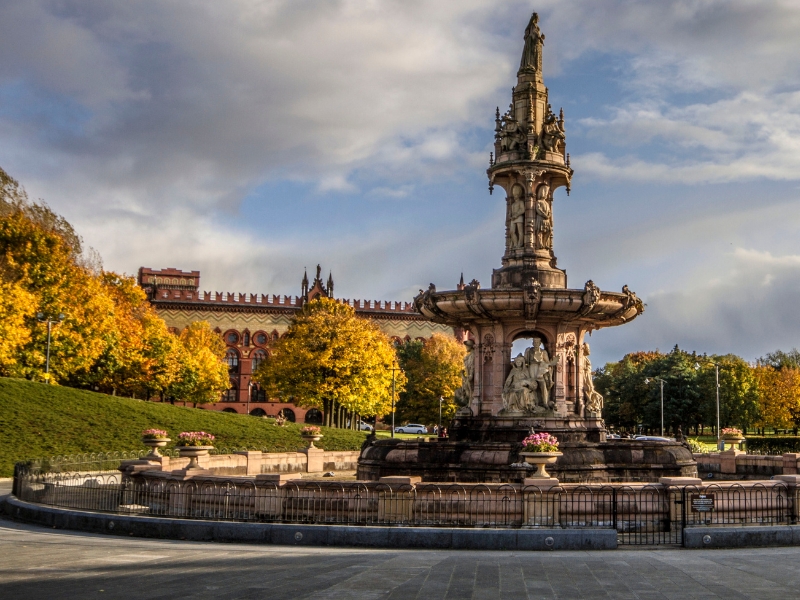
The Doulton Fountain stands on Glasgow Green, in front of the People's Palace, and at 46 feet (about 14 metres) high it is thought to be the largest terracotta fountain in the world. Made by the Royal Doulton pottery for the 1888 International Exhibition, it is a picture of the British Empire in clay: Queen Victoria at the top, her soldiers and sailor below, and four of her colonies around the base.
The Doulton Fountain at a glance
- Where: on Glasgow Green, the city's oldest park, directly in front of the People's Palace and Winter Gardens in the East End.
- Built: 1887–1888, for Queen Victoria's Golden Jubilee and the 1888 International Exhibition in Kelvingrove Park; moved to Glasgow Green in 1890.
- By: designed by Arthur Edward Pearce of Doulton & Co.; the figure of Queen Victoria is by John Broad.
- What it is today: a Category A listed monument, restored and working again since the mid-2000s.
- Time needed: 15–20 minutes to walk around it and look at the figures.
From exhibition showpiece to East End landmark
Doulton & Co. of Lambeth built the fountain to celebrate Queen Victoria's Golden Jubilee in 1887, and it was the company's main display at Glasgow's great International Exhibition in Kelvingrove Park the following year. It was a showcase for what the pottery could do with terracotta, a hard-wearing fired clay that could be moulded into complex figures. When the exhibition closed, the fountain was moved in 1890 across the city to Glasgow Green, a park on the north bank of the River Clyde whose origins go back to the 15th century.
Its life there was not easy. In 1894 the statue of Queen Victoria at the top was hit by lightning, and replacing her proved difficult because the original moulds had been broken. Over the 20th century the fountain was neglected; by the early 1990s it was in such poor condition that at least one figure was taken into the People's Palace for safekeeping. Between 2003 and 2005 it was taken apart, restored and rebuilt in its current position in front of the People's Palace, where it now works again and is floodlit at night.
What to look for
- Queen Victoria at the very top, standing above everything else on the fountain.
- The four kneeling young women just below her, each emptying a water pitcher.
- The middle tier with sentries from Scottish, English and Irish regiments and a sailor representing the Royal Navy.
- The four groups around the lower basin, representing Canada, South Africa, Australia and India, each with people, animals and plants chosen to stand for that part of the empire.
- The size of the base, about 70 feet (21 metres) across: walk all the way around to see every group.
An empire in one fountain
The fountain was made at the height of Victorian confidence and shows the empire exactly as its rulers wanted to see it, with the Queen above, Britain's armed forces in the middle and the colonies below, offering up their wealth. Today it is worth looking at both ways: as an impressive piece of Victorian ceramics, and as a frank record of how the British Empire presented itself in the 1880s.
Tips for your visit
- Come back after dark if you can: the fountain is floodlit and looks very different at night.
- The People's Palace and Winter Gardens behind the fountain have been closed for a major refurbishment since 2024; check before you plan to go inside.
- Combine the fountain with a walk across Glasgow Green to the River Clyde and the St Andrew's Suspension Bridge.
Nearby
- People's Palace and Winter Gardens: the red sandstone museum of Glasgow's social history with its large Victorian glasshouse behind it.
- Templeton on the Green: a former carpet factory facing the park, its colourful brick façade inspired by the Doge's Palace in Venice.
- Nelson's Monument: a tall stone obelisk on Glasgow Green, put up in 1806 in memory of Admiral Nelson.
- The Barras: Glasgow's famous weekend market, just north of the park in the Calton area.
See Glasgow with World City Trail
Our Glasgow scavenger hunt turns the city centre into a game you play on your phone. The route links 10 stops and takes around three hours, with about 40 minutes of walking, and includes places such as St Enoch Square and the Gallery of Modern Art. You can play in English, German, French, Italian, Spanish or Dutch.
If you prefer a different format, Glasgow also has a self-guided walking tour and an outdoor escape game.
Play the Glasgow scavenger hunt →
Take the self-guided walking tour of Glasgow →
Play the outdoor escape game in Glasgow →
Facts checked in October 2026.