
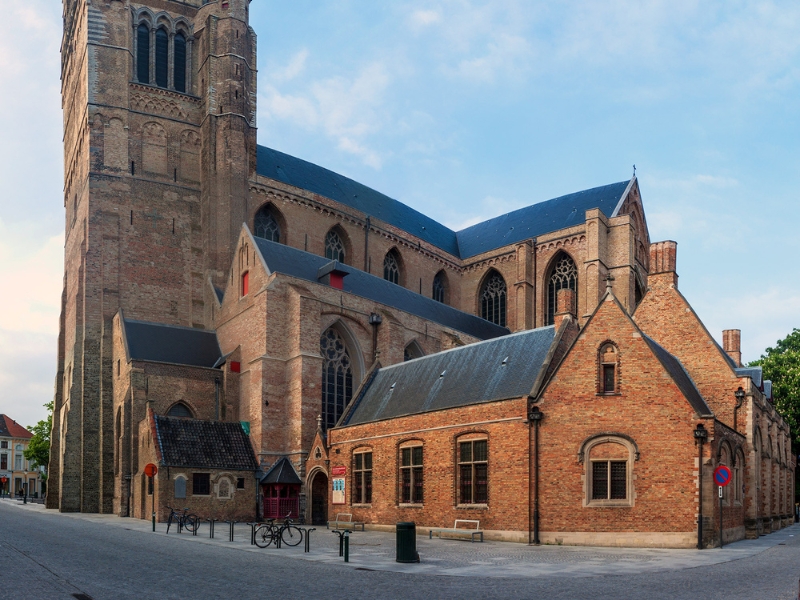
St Salvator's Cathedral is the cathedral of Bruges and the oldest parish church in the city, a few minutes' walk from the Markt. It only became a cathedral in 1834, after the French had demolished the old one, and its choir stalls still carry the coats of arms of the knights of the Golden Fleece who met here in 1478.
St Salvator's Cathedral at a glance
- Where: on the Sint-Salvatorskerkhof, just off the Steenstraat shopping street, between the Markt and the 't Zand square.
- Built: the present Gothic church from 1250 for about a century; the top of the tower was added in the 1840s.
- By: the top of the tower was designed by the English architect Robert Chantrell.
- What it is today: the cathedral of the Diocese of Bruges, with a treasury of Flemish paintings and church art.
- Time needed: 30 to 45 minutes, a bit more if you visit the treasury.
From parish church to cathedral
A church stood here from the 10th century. After a fire in 1116, a larger Romanesque church was begun in 1127, and in 1250 work started on the Gothic brick church you see today, which took about a hundred years. For centuries St Salvator's was the main parish church, while the city's cathedral was St Donatian's on the Burg square.
In 1799, under French rule, St Donatian's was sold and demolished. When a new bishop was installed in Bruges in 1834, St Salvator's became the cathedral, but it looked too modest next to the Church of Our Lady. After a fire destroyed the roof in 1839, Robert Chantrell restored the church and gave the tower a new neo-Romanesque top. Critics found his design too flat, and the Royal Commission for Monuments added a small spire without his approval. Many treasures from the lost St Donatian's ended up here.
What to look for
- The tower: a massive brick tower whose lower part is the oldest surviving section of the church, topped by Chantrell's 19th-century crown and the extra spire.
- The choir stalls: 48 Gothic stalls from around 1430, above which hang the painted coats of arms of the knights of the Order of the Golden Fleece, who held a chapter here in 1478.
- The tapestries: a series of Brussels tapestries from 1731, made in the workshop of Jasper van der Borcht for St Donatian's; the painted designs by Jan van Orley hang in the transept.
- The rood screen: a Baroque screen of 1679 topped by a statue of God the Father by Artus Quellinus the Younger.
- The organ: built by Jacob Van Eynde in 1717–19 and enlarged several times, it is still used in a concert series founded in 1952.
- The treasury: its highlight is the triptych of the Martyrdom of Saint Hippolytus by Dirk Bouts and Hugo van der Goes, from around 1475.
The knights of the Golden Fleece
The Order of the Golden Fleece was founded in Bruges in 1430 by Philip the Good, Duke of Burgundy, and its knights met in chapters in different churches. In 1478, after the death of Charles the Bold, the order held its chapter in St Salvator's. The shields above the choir stalls record the members of that meeting, so the choir is still a kind of roll call of the Burgundian elite.
Tips for your visit
- Go in the morning on a weekday, when the cathedral is quiet and the light falls through the high windows of the nave.
- Remember that this is a working cathedral: dress respectfully and avoid walking around during Mass.
- For a view of the whole tower, step back into the small square in front of the entrance or look from the Steenstraat.
- Combine the visit with the Church of Our Lady, a short walk away, to compare Bruges's two great medieval churches.
Nearby
- Church of Our Lady: its brick tower is one of the tallest in the Low Countries, and inside is Michelangelo's marble Madonna and Child.
- St John's Hospital: one of Europe's oldest surviving hospital buildings, now a museum with works by Hans Memling.
- Markt: the main square with the Belfry, about five minutes' walk along the Steenstraat.
- Simon Stevinplein: a small square close to the cathedral with a statue of the Bruges-born mathematician Simon Stevin.
See Bruges with World City Trail
Our Bruges scavenger hunt turns the old town into a game you play on your phone. The route links 10 stops and takes around 2 hours, with about 24 minutes of walking. It includes places such as the Jan van Eyckplein, the Belfry and the Burg square.
If you prefer a different format, there is also a self-guided walking tour of Bruges and an outdoor escape game in the city.
Play the Bruges scavenger hunt →
Take the self-guided walking tour of Bruges →
Play the outdoor escape game in Bruges →
Facts checked in October 2026.