What is the Granada self-guided walking tour?
The Granada self-guided walking tour is a walk you take at your own speed, with audio narration on your phone doing the job a guide would do. Allow about 3 hours: 33 minutes of that is spent walking, the route covers 2.4 km, and at each of the 10 stops you pause to listen. There is no start time to keep and no group to wait for.
At the first fountain the narration explains why pomegranates, granadas in Spanish, turn up on fountains, gates and the city's coat of arms. On Plaza de Bib-Rambla you hear that the name comes from Bab al-Ramla, the Gate of the Sand, and at the Madraza that Sultan Yusuf I founded an Islamic university here in 1349. Plaza Isabel la Católica recalls the agreement the queen signed with Columbus at Santa Fe in 1492.
- Durationabout 3 hours
- Walkingabout 33 min · 2.4 km
- Stops10
- LanguagesEnglish, German, French, Italian, Spanish, Dutch
What you do on the walking tour
Hear the stories
The audio tells each stop's history, a legend or two and a few fun facts, and the full text is on screen for anyone who prefers to read.
Follow the map
Google Maps points the way from stop to stop: 33 minutes on foot over 2.4 km altogether.
Pause when you like
Coffee, lunch or a museum fit in whenever you want, and the walk picks up where you left it, today or another day.
Find food and shops
The app suggests places to eat and local shops close to the route, and lets you begin at any stop and change the order.
See the route and attractions →
How it works
- Book online Choose the number of people. Your booking reference arrives by email straight away.
- Get the app Download the World City Trail app from the App Store or Google Play and enter your booking reference.
- Walk when you like Start whenever you are ready, walk at your own pace and pause any time. No guide, no fixed schedule.
Who the walking tour is for
First time here
One walk links the squares of the centre, the cathedral quarter and the way up to the Alhambra, and explains what you see.
Independent travellers
Nobody sets the pace but you: linger at the stops you like and move quickly past the others.
The day you visit the Alhambra
The walk ends at the Pilar de Carlos V beside an Alhambra gate, so it fits neatly into the day you see the palaces.
Good to know
- Bring a charged smartphone with mobile data; a power bank helps.
- No entry tickets needed: everything happens outside the buildings. Going inside is optional and paid separately.
- Family friendly; children must be accompanied by an adult.
- Not suitable for wheelchair users and difficult with strollers.
- Groups of up to 5 work best; larger groups split up, one ticket per person.
- Every purchase helps support stray cats and dogs in Greece.
The walk stop by stop: Basílica de las Angustias, Plaza Nueva, the cathedral, the Alhambra gates
10 stops · about 33 min walking · start: Fuente de las Granadas · finish: Pilar de Carlos V
First comes the Fuente de las Granadas, then the Basílica de las Angustias, the church of Granada's patron saint. Plaza Nueva and City Hall follow, before Plaza de Bib-Rambla, the cathedral, the Madraza and Plaza Isabel la Católica take you through the old Moorish and Christian centre. The last stretch climbs the Cuesta de Gomérez to the Puerta de las Granadas and ends at the Pilar de Carlos V near the Alhambra. In the app you can change the first stop or the order, and none of the stops asks for a ticket.
Open the route map ↗
1Fuente de las GranadasStart
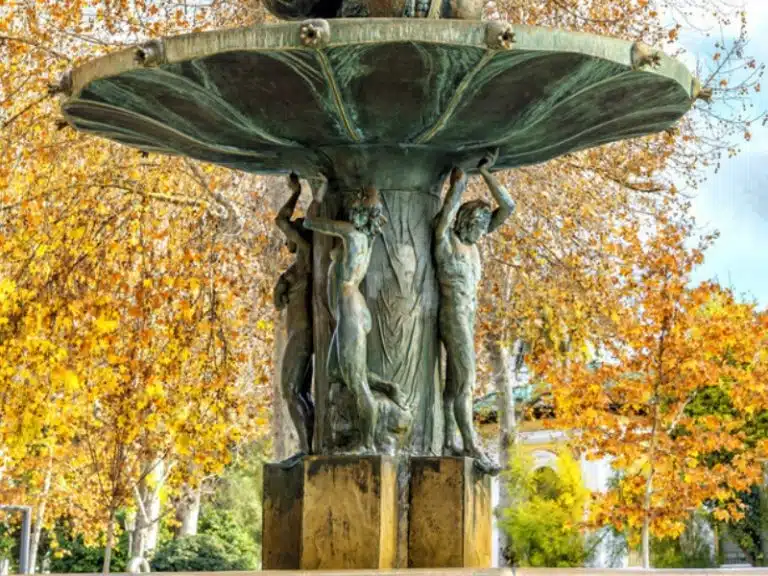
This fountain takes its name from the pomegranates, granadas in Spanish, that decorate it. The pomegranate shares its Spanish name with the city and appears on Granada's coat of arms, so you will spot it on fountains, gates and street details all over town.
2Basílica de las Angustias
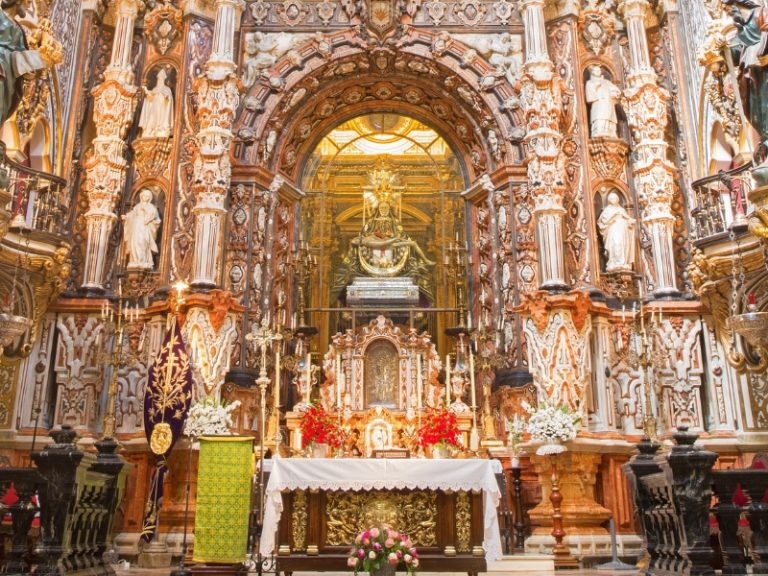
The Basílica de Nuestra Señora de las Angustias on Carrera de la Virgen is dedicated to the patron saint of Granada. It was built in the second half of the 17th century, with a baroque façade between two towers, and the image of the Virgin is carried through the city every year in a large procession.
3Fuente de Plaza Nueva
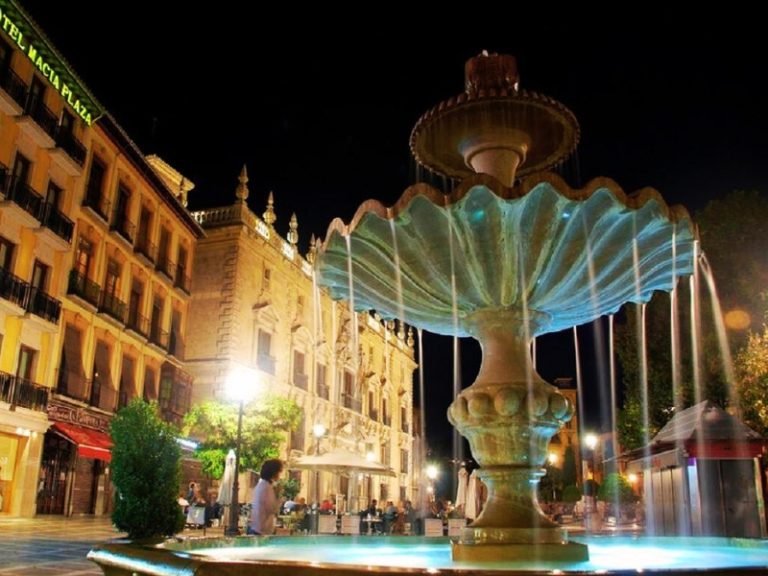
Plaza Nueva was laid out in the 16th century over the covered course of the river Darro and is one of the oldest squares in Granada. Its fountain stands in front of the Real Chancillería, the former royal court of justice, with the Alhambra hill rising behind.
4Granada City Hall
Granada's City Hall stands on Plaza del Carmen and occupies a former Carmelite convent. Its long façade with balconies faces the square, where official ceremonies and city events take place.
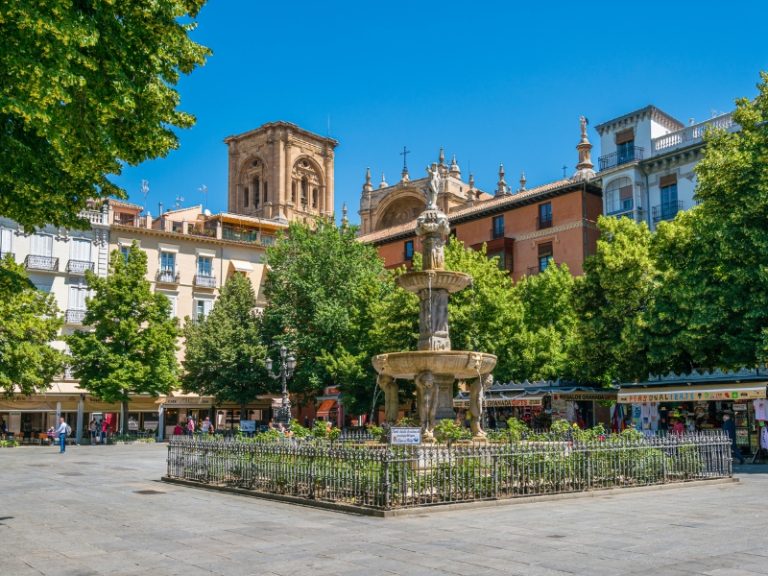
5Plaza de Bib-Rambla
The name of this square comes from the Arabic Bab al-Ramla, the Gate of the Sand, one of the gates of the Moorish city. Today it is lined with flower stalls and café terraces, and in the middle stands the Fountain of the Giants, with grotesque faces supporting its basin.
6Granada Cathedral
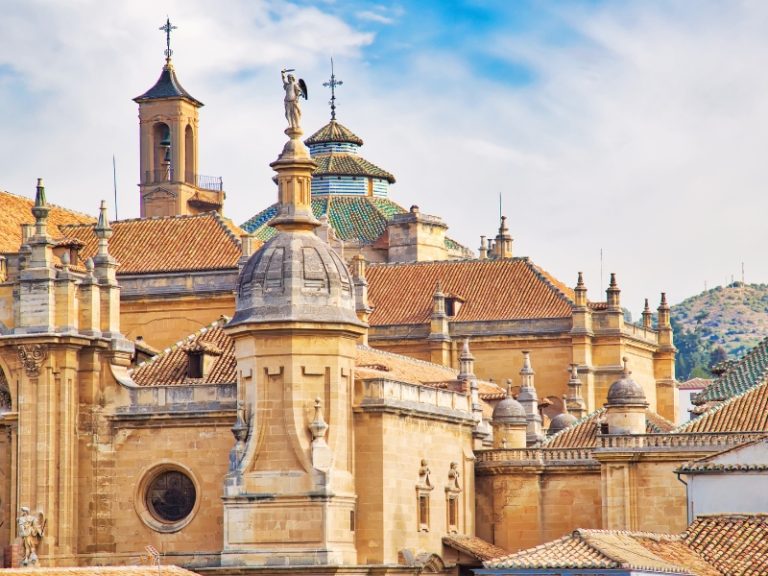
Granada Cathedral was begun in 1523 on the site of the city's main mosque and continued by Diego de Siloé, who gave it its Renaissance form. The main façade, designed by the painter and architect Alonso Cano in the 17th century, looks like a huge triumphal arch, and next door the Royal Chapel holds the tombs of the Catholic Monarchs.
7Palacio de la Madraza
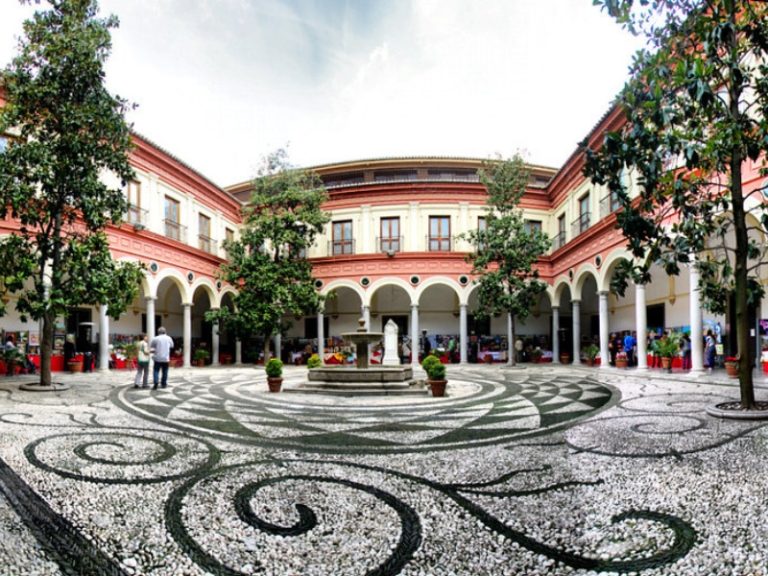
The Madraza was founded in 1349 by the Nasrid sultan Yusuf I as Granada's Islamic university. Behind its later baroque façade a richly decorated prayer hall survives, and the building now belongs to the University of Granada.
8Plaza Isabel la Católica
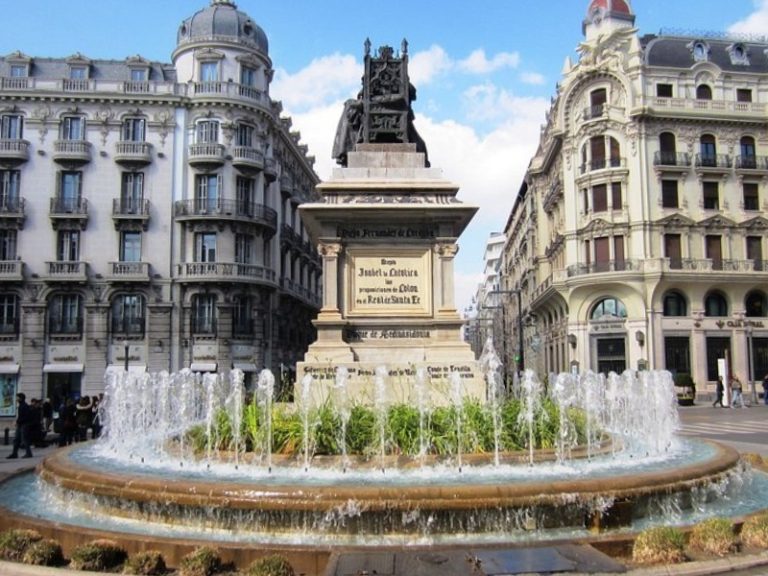
This square where Gran Vía de Colón meets Calle Reyes Católicos is named after Queen Isabella I of Castile. Its monument by the sculptor Mariano Benlliure, unveiled in 1892, shows Christopher Columbus presenting his plans to the queen, recalling the agreement signed at Santa Fe near Granada in 1492.
Read the full story →
9Puerta de las Granadas
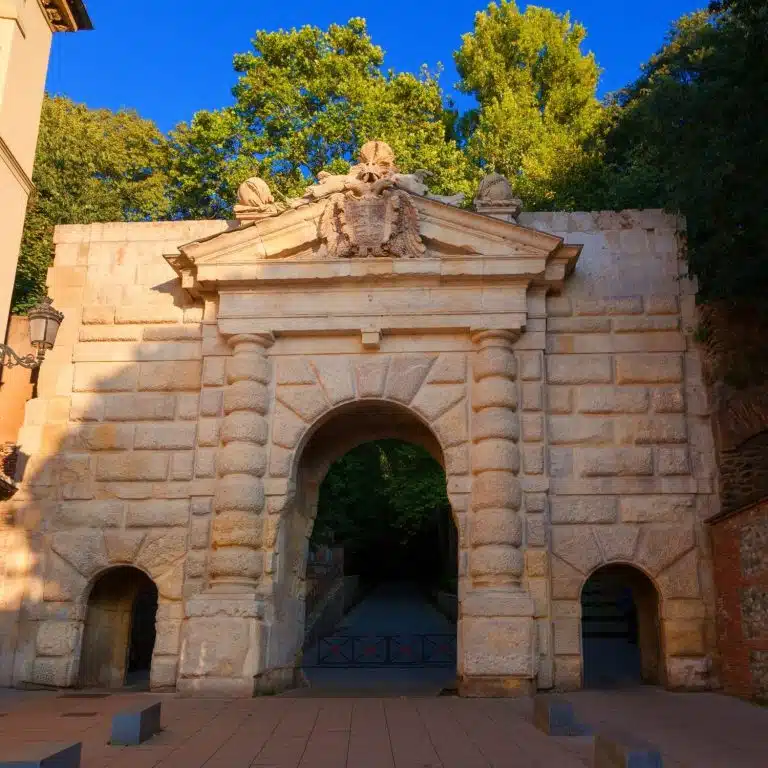
This Renaissance gate at the top of the Cuesta de Gomérez marks the entrance to the Alhambra woods. It was built in the 16th century under Emperor Charles V and is crowned by three split-open pomegranates, the symbol of the city.
10Pilar de Carlos VFinish
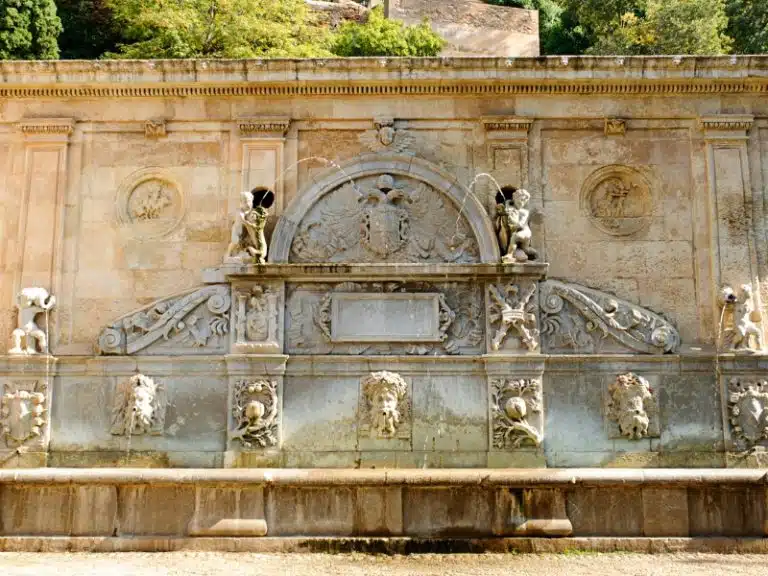
This Renaissance wall fountain stands near the Puerta de la Justicia, one of the gates of the Alhambra. It was built in the 16th century in honour of Emperor Charles V and carries his coat of arms, while its carved faces are said to symbolise the rivers of Granada.
Only logged in customers who have purchased this product may leave a review.




Raffaele– Italy –
Collected on GetYourGuide
Brittany– United States –
Collected on GetYourGuide
I really enjoyed the flexible and informative way to view the city. There were some really interesting facts in there. I found the app a little difficult to navigate. It wasn’t the most intuitive or easy to use but overall enjoyed the information I learned.
United States –
Collected on GetYourGuide
Buena