
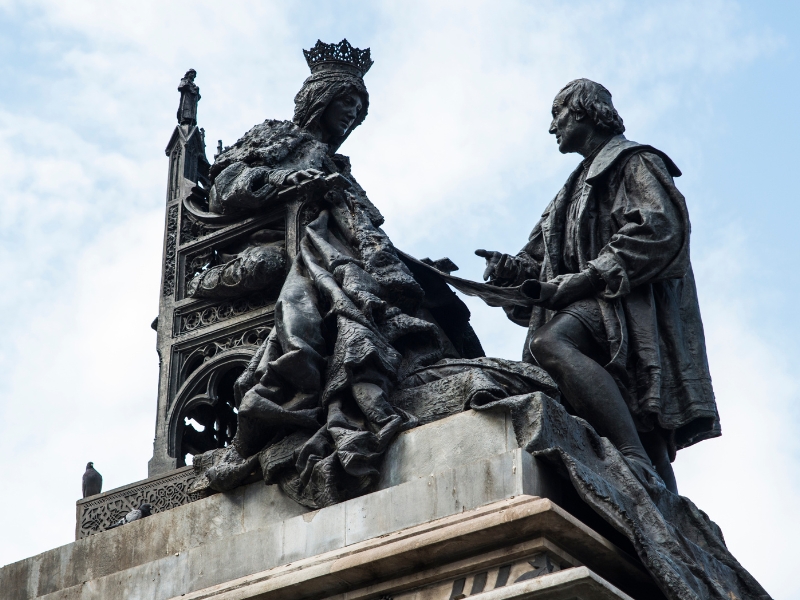
Plaza de Isabel la Católica is the busy square where Granada's Gran Vía de Colón meets Calle Reyes Católicos, a few steps from the Royal Chapel where Queen Isabella is buried. In its centre stands Mariano Benlliure's bronze monument showing Christopher Columbus bowing before the seated queen. The monument had such a troubled start that the people of Granada unveiled it themselves in 1892, in the middle of a riot.
Plaza de Isabel la Católica at a glance
- Where: at the junction of Gran Vía de Colón and Calle Reyes Católicos, between Plaza Nueva and the cathedral quarter.
- Created: the monument dates from 1892; it was moved to this square, laid out in its present form in the early 1960s, in 1962.
- By: the monument is the work of the Valencian sculptor Mariano Benlliure, who made it in Rome.
- What it is today: a traffic junction and meeting point in the centre of Granada, with the monument as its focus.
- Time needed: 10–15 minutes, or a short stop on the way to the Royal Chapel and the cathedral.
From the Paseo del Salón to Reyes Católicos
Around 1890 several Spanish cities were planning monuments for the 400th anniversary of Columbus's first voyage. Granada first considered a huge triumphal arch mixing Aztec, Hispano-Moorish and Renaissance styles, designed by Justo de Gandarias, but the nearly bankrupt city could not pay for it. A public competition produced no winner, and in the end Prime Minister Antonio Cánovas del Castillo gave the commission to Mariano Benlliure. The first stone was laid in June 1892 and the bronzes arrived from Rome that August.
The monument first stood on the Paseo del Salón, the tree-lined promenade along the river Genil. Following a council decision in 1961, it was moved in 1962 to this square, which had just been opened up to link the new Gran Vía with the Realejo district. The choice of site was symbolic: the Royal Chapel, where Isabella and Ferdinand lie, is only a short walk away.
What to look for
- The meeting: Isabella sits on her throne at the top while Columbus, a few steps below, pauses and bows to her.
- The steps: the upper part of the pedestal is shaped as a staircase, so Columbus seems to be climbing towards the queen.
- The reliefs: walk around the pedestal to find the bronze panels on its sides, one of them showing the signing of the Capitulations of Santa Fe.
- The missing figure: Benlliure's group was reportedly meant to include Boabdil, the last Nasrid sultan of Granada, but the idea was dropped.
Unveiled by a riot
The anniversary celebrations in Granada went badly wrong. The festivities did not take place on 12 October as planned, and the queen regent, Maria Christina of Austria, refused to travel to Granada to inaugurate the monument. The city took the snub badly: there were fires, riots and barricades, and the ornamental arches put up to welcome the royal party were set alight. On 2 November 1892, with the town in uproar, the people of Granada unveiled the monument themselves.
Tips for your visit
- This is a busy junction with buses and taxis: cross at the lights and view the monument from the pavement around it.
- Combine it with the Royal Chapel, where you can see the tombs of Isabella and Ferdinand, to complete the story.
- Stand on the Gran Vía side to see Columbus and the queen facing each other, then walk round to the back for the reliefs.
Nearby
- Royal Chapel: the late Gothic burial chapel of the Catholic Monarchs, a couple of minutes' walk away.
- Granada Cathedral: the huge Renaissance cathedral right next to the Royal Chapel.
- Alcaicería: the narrow lanes of the former silk market, now full of small shops, beside the cathedral.
- Corral del Carbón: a 14th-century Nasrid inn for merchants, with a carved horseshoe gateway, just off Calle Reyes Católicos.
See Granada with World City Trail
Our Granada scavenger hunt turns the old town into a game you play on your phone. The route links 10 stops and takes around 2 hours, with about 31 minutes of walking. It includes the Fuente de las Granadas and the Basílica de la Virgen de las Angustias. You can play in English, German, French, Italian, Spanish and Dutch.
If you prefer a different format, there is also a self-guided walking tour and an outdoor escape game in Granada.
Play the Granada scavenger hunt →
Take the self-guided walking tour of Granada →
Play the outdoor escape game in Granada →
Facts checked in October 2026.