What is the Leipzig self-guided walking tour?
The Leipzig self-guided walking tour is an audio walk you take on your own with the World City Trail app: the app leads you through the streets and, at every stop, tells you what happened there and who left their mark on it. Reckon on about 2 hours in total for 2.2 km and 10 stops, of which only 30 minutes are actual walking. Everything lies inside the old ring, so the route stays short and flat as it moves from concert halls to market squares and church towers.
On Augustusplatz the narration tells how the University Church was blown up in 1968 and why the Paulinum now recalls its gable. At St Nicholas Church you hear about the Monday prayers for peace that grew into the demonstrations of 1989, and about columns that open out into palm fronds. Outside Auerbachs Keller the story turns to Goethe's Faust and to the legend that Faust rode out of the cellar on a wine barrel; at St Thomas Church you learn that Johann Sebastian Bach was cantor here for 27 years and now lies buried in the chancel.
- Durationabout 2 hours
- Walkingabout 30 min · 2.2 km
- Stops10
- LanguagesEnglish, German, French, Dutch, Polish
From stop to stop
Stories, not a lecture
History, local legends and fun facts come in short audio chapters at each stop, with the full text on screen for anyone who prefers reading.
No getting lost
Google Maps shows the way between stops, about 30 minutes of walking spread over 2.2 km.
Pause and pick up again
There is no group waiting and no meeting point. Step into a café or a museum and continue in an hour or tomorrow.
Local tips included
The app points out cafés, restaurants and shops close to the route, and you decide where to start and in which order to go.
See the route and attractions →
How it works
- Book online Choose the number of people. Your booking reference arrives by email straight away.
- Get the app Download the World City Trail app from the App Store or Google Play and enter your booking reference.
- Walk when you like Start whenever you are ready, walk at your own pace and pause any time. No guide, no fixed schedule.
Who this walk suits
First time in Leipzig
You see the main sights of the centre in one go, each with the story that explains why it matters.
Independent travellers
No flag to follow and no headcount: stay longer where something interests you and move on where it does not.
Tight schedules
Around 2 hours is all it takes, so the rest of the day stays free.
Good to know
- Bring a charged smartphone with mobile data; a power bank helps.
- No entry tickets needed: everything happens outside the buildings. Going inside is optional and paid separately.
- Family friendly; children must be accompanied by an adult.
- Not suitable for wheelchair users and difficult with strollers.
- Groups of up to 5 work best; larger groups split up, one ticket per person.
- Every purchase helps support stray cats and dogs in Greece.
Opera, markets and Bach: the route stop by stop
10 stops · about 30 min walking · start: Augustusplatz · finish: New Town Hall
The walk starts on Augustusplatz, framed by the Opera and the Gewandhaus, and passes the Krochhochhaus with its two bell-striking figures on the way to St Nicholas Church and the glass cube of the Museum of Fine Arts. It then reaches the Markt and the Old Town Hall of 1556, the Naschmarkt with the Old Stock Exchange, and Auerbachs Keller below the Mädler Passage. After St Thomas Church the route ends at the New Town Hall, whose tower rises about 115 metres. You can reorder the stops in the app, and none of them requires an entry ticket.
Open the route map ↗
1AugustusplatzStart
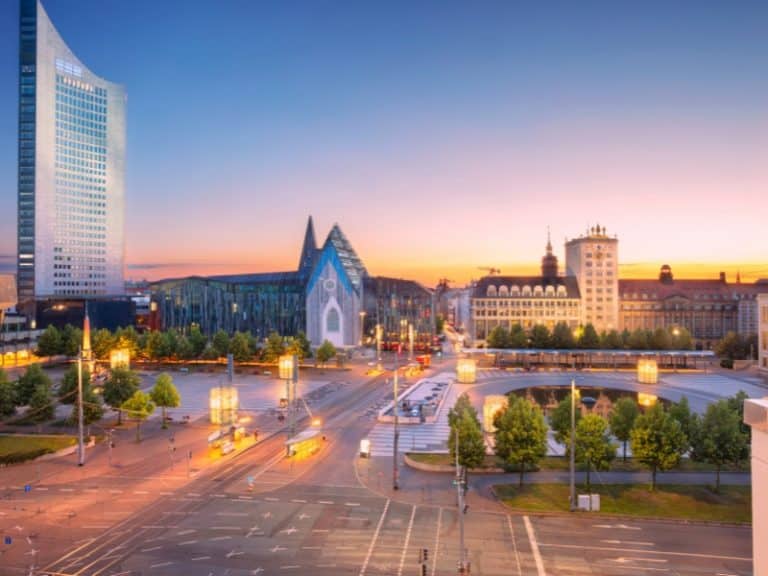
Augustusplatz is one of the largest squares in Germany, framed by the Opera House of 1960, the Gewandhaus concert hall of 1981 and the main building of Leipzig University. The university's Paulinum, with its church-like gable, recalls the University Church that the East German authorities blew up in 1968.
2Krochhochhaus
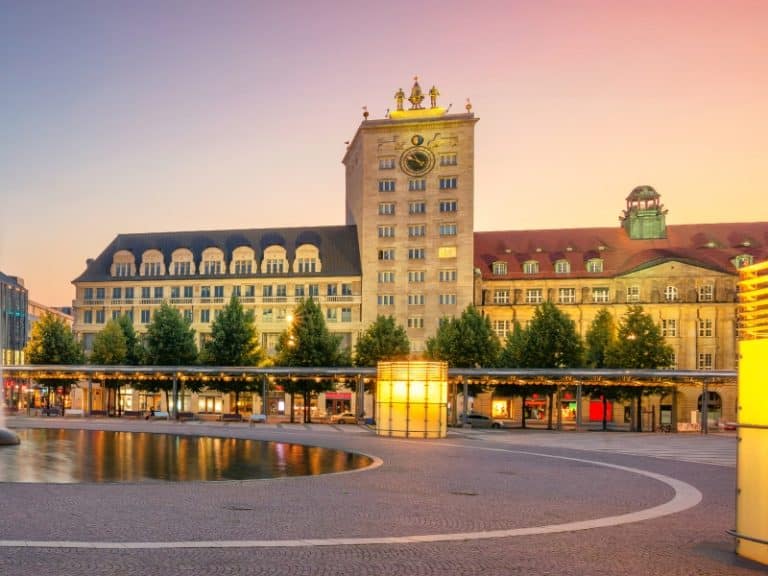
Built in 1927 and 1928 for the banker Hans Kroch to a design by German Bestelmeyer, this tower is regarded as Leipzig's first high-rise. On its roof two bronze figures strike a large bell, an idea taken from the clock tower on St Mark's Square in Venice, above the Latin motto Omnia vincit labor.
3St Nicholas Church (Nikolaikirche)
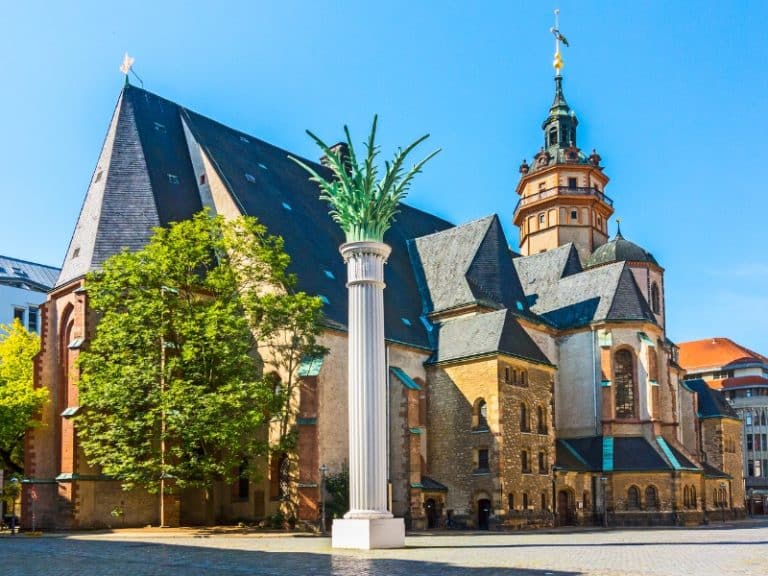
St Nicholas Church goes back to around 1165, but its interior was redesigned in classical style in the late 18th century, with columns that open out into palm fronds. Its Monday prayers for peace became the starting point of the peaceful demonstrations of 1989, and a copy of a palm column stands outside in the churchyard.
Read the full story →
4Museum of Fine Arts
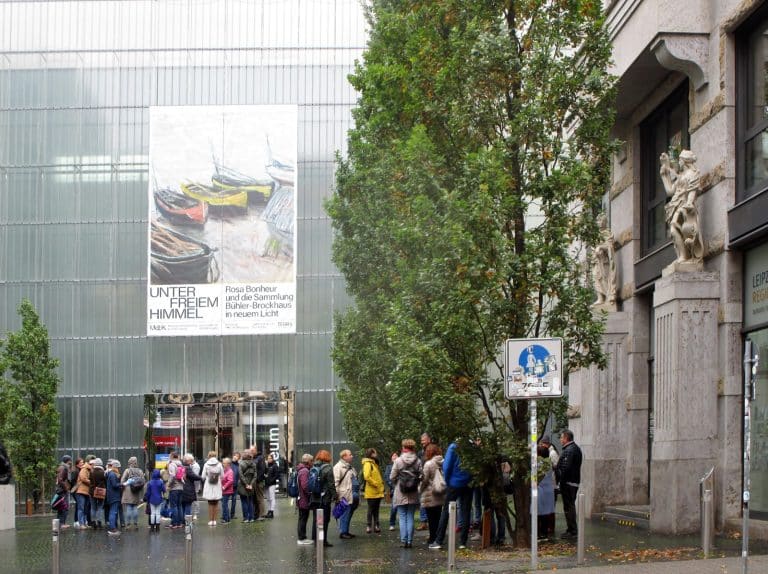
Since 2004 Leipzig's Museum of Fine Arts has occupied this large glass cube, built on the former Sachsenplatz. Its collection runs from the late Middle Ages to the present day and includes Max Klinger's famous statue of Beethoven.
5Markt
Leipzig's market square has been the centre of trade since the Middle Ages, and in 1497 the emperor granted the city its trade fair privilege, which drew merchants from across Europe. The Old Town Hall takes up the whole east side, while baroque and later merchants' houses frame the rest.
6Old Town Hall
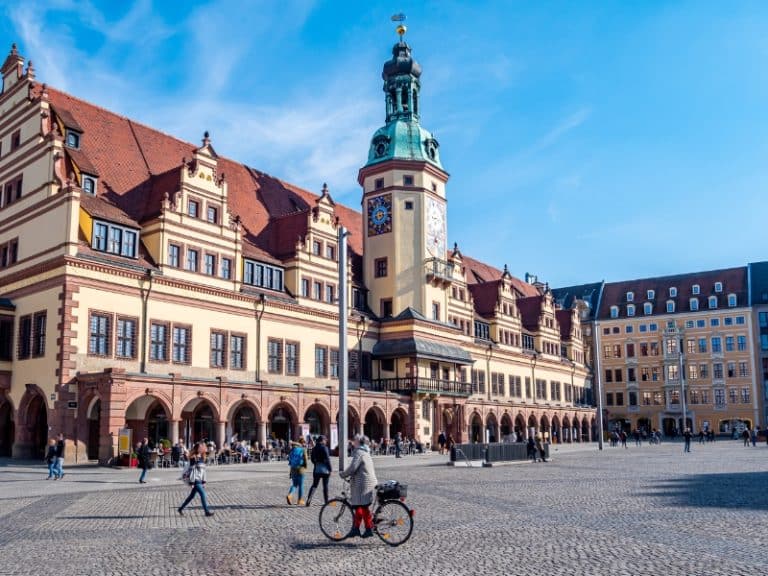
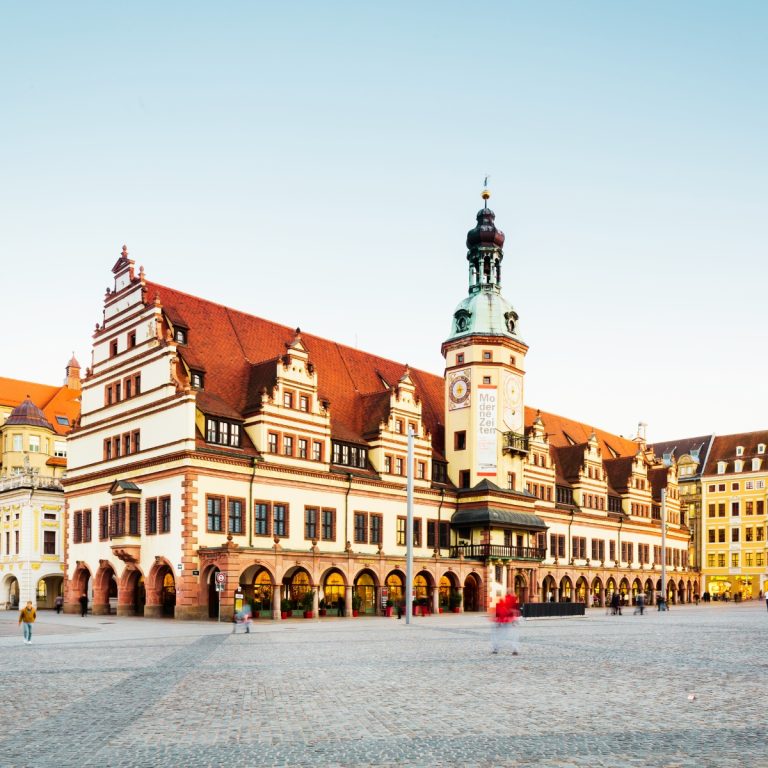
The Old Town Hall was built in 1556 and 1557 under the direction of Hieronymus Lotter in less than a year and is one of the most important Renaissance town halls in Germany. Notice the tower set off-centre and the long arcade along the market front, and inside is the Museum of City History.
7Naschmarkt
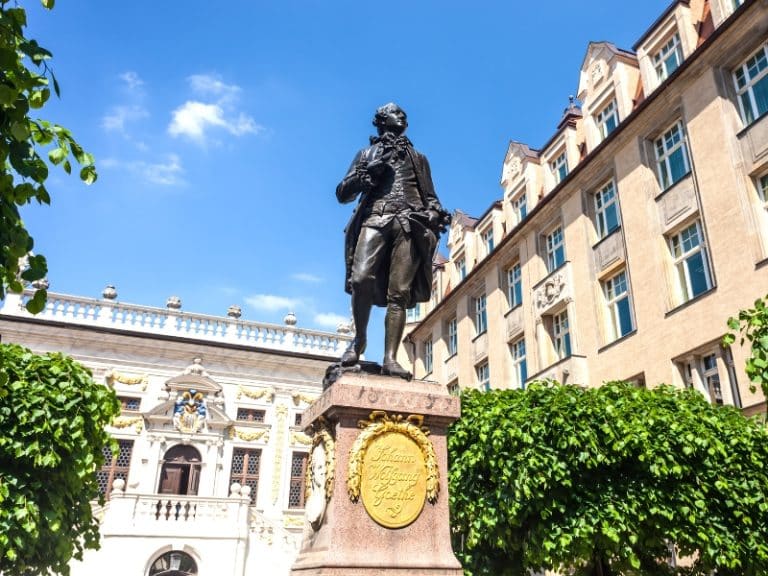
Behind the Old Town Hall lies the Naschmarkt, a small square dominated by the Old Stock Exchange, a baroque building completed in 1687 as a meeting place for merchants. In front of it stands a statue of the young Goethe, who studied law in Leipzig.
8Auerbachs Keller
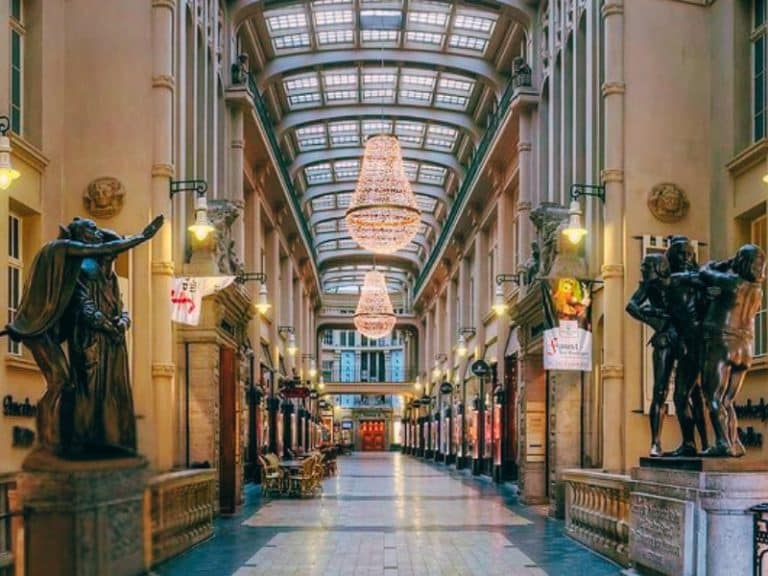
This wine cellar beneath the Mädler Passage dates back to the 16th century and owes its fame to Goethe, who set a scene of Faust here. At the entrance stairs stand bronze groups of Faust with Mephisto and of the bewitched students, and according to legend Faust rode out of the cellar on a wine barrel.
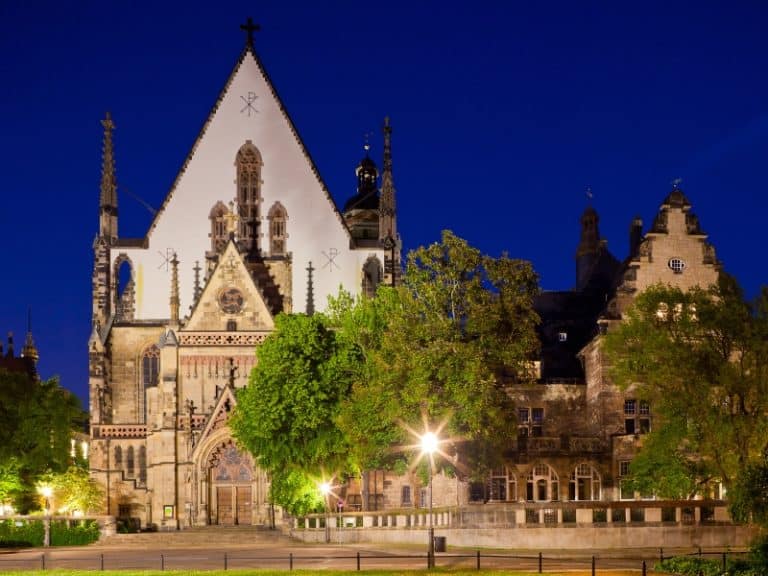
9St Thomas Church (Thomaskirche)
Johann Sebastian Bach was cantor here from 1723 until his death in 1750, and since 1950 his grave has been in the chancel. The church is home to the St Thomas Boys Choir, founded in 1212, and a bronze statue of Bach stands on the square outside.
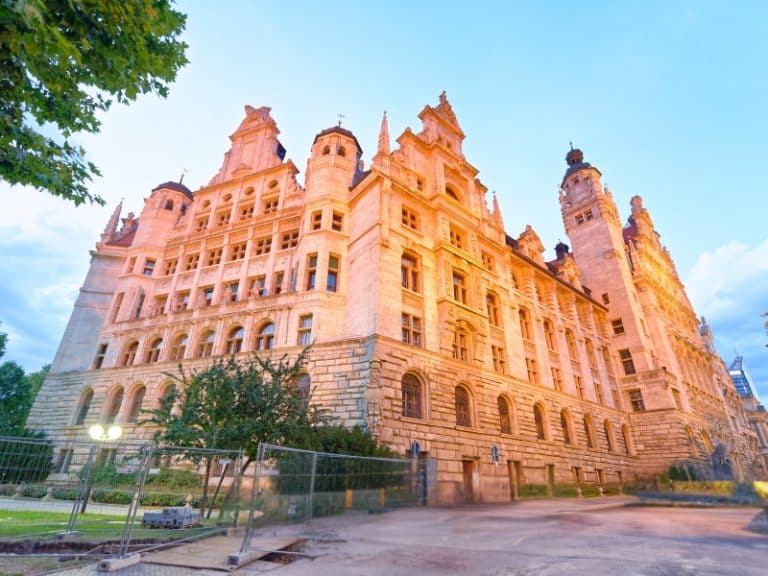
10New Town HallFinish
The New Town Hall was built between 1899 and 1905 to designs by Hugo Licht on the site of the old Pleissenburg castle. Its tower, about 115 metres high, rises on the base of the castle tower and is one of the tallest town hall towers in Germany.
Only logged in customers who have purchased this product may leave a review.





Anonymous (verified owner) –
erg Leuk