
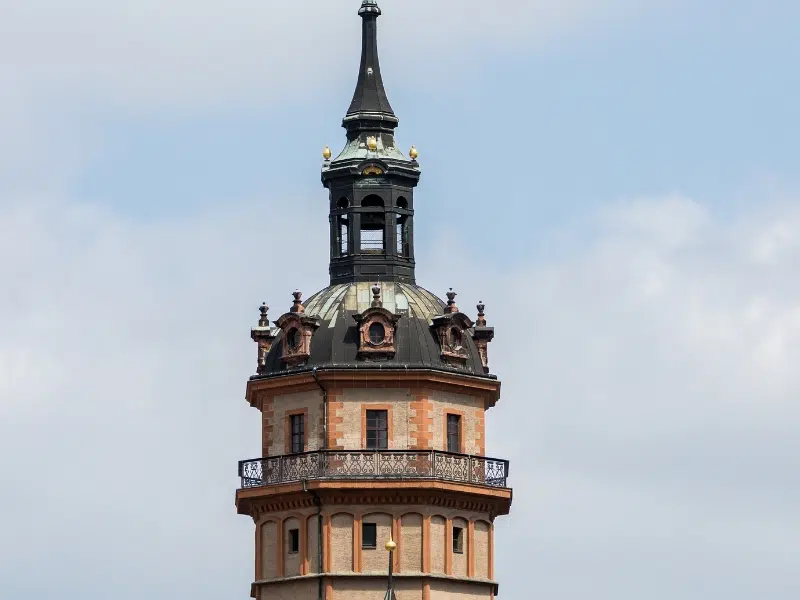
The Nikolaikirche (St Nicholas Church) is the oldest and largest church in central Leipzig, begun around 1165 and transformed over the centuries from Romanesque to Gothic to a light-filled Neoclassical interior with columns shaped like palm trees. Johann Sebastian Bach premiered his St John Passion here. In 1989 its Monday prayers for peace became the starting point of the peaceful revolution in East Germany.
The Nikolaikirche at a glance
- Where: on the Nikolaikirchhof in the centre of Leipzig, a few minutes' walk from Augustusplatz and the Markt.
- Built: from around 1165; rebuilt as a late-Gothic hall church in the 15th and 16th centuries; Baroque tower 1730; Neoclassical interior 1784–1797.
- By: the interior was redesigned by the architect Johann Carl Friedrich Dauthe.
- What it is today: a Lutheran parish church with more than 1,400 seats, still holding its Monday peace prayers, and one of the stops on our Leipzig scavenger hunt.
- Time needed: 20 to 30 minutes, more if you stay for an organ recital or service.
From a market town church to a symbol of 1989
The church was begun around 1165, soon after Leipzig received its town and market rights, and was named after St Nicholas, patron of merchants and travellers. Its Romanesque origins are still visible on the west side. Silver from the Ore Mountains made Leipzig rich in the 15th and 16th centuries, and the church was rebuilt as a large Gothic hall church. Martin Luther preached in Leipzig in 1539, when the Reformation was introduced, and the philosopher Gottfried Wilhelm Leibniz was baptised here in 1646. Bach, as Thomaskantor from 1723 to 1750, was responsible for music here, and the St John Passion had its premiere in the church in 1724.
Weekly prayers for peace began in the church in the early 1980s, attended at first by only a few people. By autumn 1989 they had become the meeting point for thousands of East Germans demanding change. After the prayers, people walked out onto the ring road in the Monday demonstrations, and on 9 October 1989 tens of thousands marched peacefully without the security forces intervening. A month later the Berlin Wall fell. A local cabaret artist summed it up: there was no leader of the revolution, only a meeting time, Monday, 5 pm, St Nicholas Church.
What to look for
- The columns of the nave, which open out at the top into green palm leaves, part of Dauthe's Neoclassical vision of an ideal, natural architecture.
- The pastel colours and light of the interior, very different from the dark Gothic outside.
- The organ, built by Friedrich Ladegast in 1862 and enlarged and restored since; it is the largest organ in Saxony.
- The Romanesque west front, the oldest visible part of the church.
- The palm column in the churchyard: a copy of one of Dauthe's columns, set up in 1999 to remember the Monday demonstrations.
Monday, 5 pm
The prayers for peace that began here are still held on Monday evenings, and the church keeps the memory of 1989 alive with information boards and events, especially on 9 October each year, when Leipzig celebrates its Festival of Lights. Standing in the nave, it is worth imagining it full to the last seat with people who did not know whether the police would let them leave peacefully.
Tips for your visit
- Enter quietly and check for services or rehearsals; the church is in daily use.
- Look up at the ceiling and the tops of the columns from the middle of the nave for the full effect of the palm leaves.
- If you can, time your visit for an organ recital or the Monday prayers to hear the church as it is meant to be used.
Nearby
- Thomaskirche: Bach's main church, where he is buried and the Thomanerchor still sings, a few minutes' walk west.
- Augustusplatz: the large square with the Gewandhaus concert hall, the Opera and the University's Paulinum.
- Old Town Hall and Markt: Leipzig's Renaissance town hall and main square, in the middle of the old town.
- Museum in der Runden Ecke: the former Stasi district headquarters, now a museum on the secret police, a short walk away.
See Leipzig with World City Trail
Our Leipzig scavenger hunt turns the city centre into a game you play on your phone. The route links 10 stops and takes around two hours, with about 30 minutes of walking. The Nikolaikirche is one of the stops, along with Augustusplatz and the Krochhochhaus. You can play in English, German, French, Dutch or Polish.
If you prefer a different format, Leipzig also has a self-guided walking tour and an outdoor escape game.
Play the Leipzig scavenger hunt →
Take the self-guided walking tour of Leipzig →
Play the outdoor escape game in Leipzig →
Facts checked in October 2026.