What is the Montmartre outdoor escape game?
Imagine a puzzle trail that winds through the hillside streets of Montmartre. The Montmartre outdoor escape game takes you from landmark to landmark on your phone, and each of the 10 stops holds a puzzle you crack by reading the surroundings and reasoning it through. Allow about 2 hours, with 25 minutes of walking over 1.6 km, and choose a day that suits you.
The puzzles sit near the Wall of Love, the Bateau-Lavoir, Place du Tertre, La Maison Rose, the Sacré-Cœur basilica and the terraces of Square Louise-Michel, among other places. Each puzzle stands alone, so no storyline needs following, and up to three levels of hints are available. Montmartre suits this format well: the sights sit close together on the hill, and the stairways and terraces give you natural places to stop and look around.
- Durationabout 2 hours
- Walkingabout 25 min · 1.6 km
- Stops10
- LanguagesEnglish, German, French, Italian, Spanish, Dutch, Portuguese
What you do on the escape game
Solve
Work out each puzzle from what surrounds you. No knowledge of art history is needed beforehand.
Look closer
The answers are in the façades, the sculptures and the layout of each square and staircase.
Walk
Google Maps guides you across 1.6 km, about 25 minutes on foot, up and down the hill from one stop to the next.
Take your time
There is no countdown. Use a hint when you need one, rest in a café on the square, and carry on later or another day.
See the route and attractions →
How it works
- Book online Choose the number of players. Your booking reference arrives by email straight away.
- Get the app Download the World City Trail app from the App Store or Google Play and enter your booking reference.
- Play when you like Start whenever you are ready, walk at your own pace and pause any time. No guide, no fixed schedule.
Who it suits
Groups of friends
Each puzzle gives the group a fresh topic to argue about at the next corner, and no local knowledge is needed.
Couples
A shared challenge for strolling through the streets on the hilltop, with no clock to race.
Team building
Teams of up to 5 play on their own phones, so colleagues can share out the reasoning.
Good to know
- Bring a charged smartphone with mobile data; a power bank helps.
- Best started in daylight, so you can see the details the puzzles ask about.
- No entry tickets needed: everything happens outside the buildings. Going inside is optional and paid separately.
- Family friendly; children must be accompanied by an adult.
- Not suitable for wheelchair users and difficult with strollers.
- Teams of up to 5 work best; bigger groups split into several teams, one ticket per player.
- Every purchase helps support stray cats and dogs in Greece.
Puzzle route: from the Wall of Love to Square Louise-Michel
10 stops · about 25 min walking · start: Wall of Love (Le Mur des je t'aime) · finish: Square Louise-Michel
The first puzzle waits at the Wall of Love and the last one in Square Louise-Michel, a terraced garden below Sacré-Cœur. On the way you pass Le Bateau-Lavoir, Place du Tertre, Le Passe-Muraille, the bust of Dalida, La Maison Rose, the Clos Montmartre vineyard, the Musée de Montmartre and the basilica. Google Maps guides you between stops, the app lets you change the starting point and the order, and the puzzles need no entry tickets.
Open the route map ↗
1Wall of Love (Le Mur des je t'aime)Start
Created in 2000 by Frédéric Baron and Claire Kito, this 40-square-metre wall in the Square Jehan-Rictus on Place des Abbesses is covered with 612 enamelled lava tiles. They carry the words I love you 311 times in 250 languages, and the red splashes stand for the pieces of a broken heart.
2Le Bateau-Lavoir
Poor artists lived and worked in this modest building on Place Émile-Goudeau in the early 1900s, and Picasso painted Les Demoiselles d'Avignon here in 1907. The poet Max Jacob named it after the laundry boats on the Seine; it burned down in 1970 and was rebuilt in 1978.
3Place du Tertre
Montmartre was a separate village until it became part of Paris in 1860, and this square near the top of the hill was its main square. Painters, songwriters and poets gathered here from the late 18th century until the First World War, and artists still set up their easels to paint visitors.
4Le Passe-Muraille
On Place Marcel-Aymé, a man seems to be stuck halfway through a stone wall. The sculpture was made in 1989 by the actor Jean Marais and shows the hero of Marcel Aymé's short story Le Passe-muraille, a modest office clerk who discovers that he can walk through walls.
Read the full story →
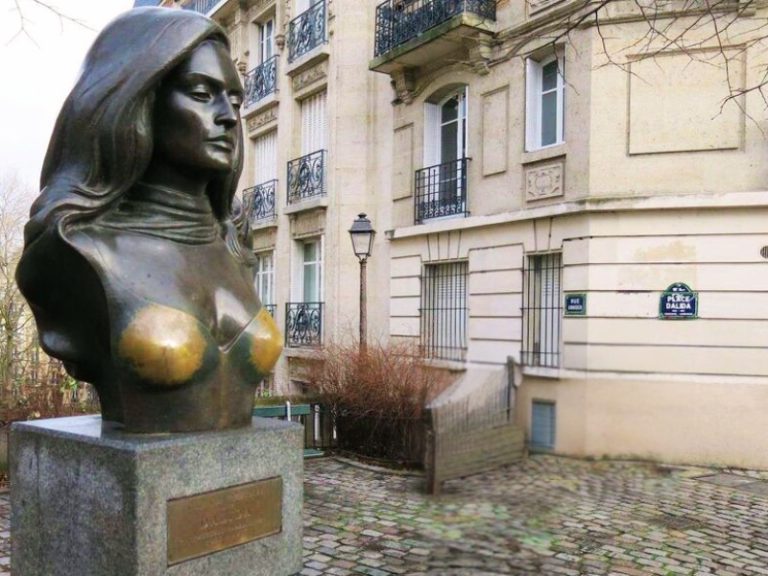
5Bust of Dalida
The bronze bust on Place Dalida honours the singer Dalida, who lived in Montmartre and died in 1987. It is the work of the French artist Aslan and was unveiled in April 1997, ten years after her death, on the small square the city had named after her the year before.
Read the full story →
6La Maison Rose
This small pink house with green shutters stands at the corner of Rue de l'Abreuvoir and Rue des Saules. It became famous through the paintings of Maurice Utrillo, who grew up in Montmartre, and in the early 20th century it was turned into a little restaurant by Germaine Pichot, a friend of Picasso and his circle.
7Clos Montmartre Vineyard
The slopes of Montmartre were covered with vines for centuries, and in 1933 local residents replanted this small vineyard on Rue des Saules to save the land. It has more than 1,700 vines of many grape varieties, and since 1934 the harvest has been celebrated every October with the Fête des Vendanges.
8Musée de Montmartre
Founded in 1960, the museum occupies old houses on Rue Cortot. Renoir painted Bal du moulin de la Galette here in 1876, Suzanne Valadon later had her studio here and lived with her son Maurice Utrillo, and the gardens have been recreated after Renoir's paintings.
9Sacré-Cœur Basilica
The white basilica on the summit of Montmartre, the highest point in Paris, was begun in 1875 to designs by Paul Abadie, finished in 1914 and consecrated in 1919. It is built of travertine from Château-Landon, and its great bell, the Savoyarde, weighs almost 19 tonnes.
10Square Louise-MichelFinish
This terraced garden below Sacré-Cœur was created in 1927 and in 2004 was renamed after Louise Michel, the anarchist who took part in the Paris Commune of 1871. From its stairways and paths, with a fountain by Paul Gasq and the funicular running alongside, you look out over the rooftops of Paris.
Only logged in customers who have purchased this product may leave a review.












Reviews
There are no reviews yet.