What is the Zaragoza self-guided walking tour?
The Zaragoza self-guided walking tour is an audio walk through the centre of Zaragoza: you follow the route on your phone and the narration tells you what you are looking at. Allow roughly 3 hours for the whole thing; the walking itself takes just 48 minutes, spread over 3.8 km and 10 stops. Islamic, Roman, Baroque and Mudéjar Zaragoza all fit into one walk, from the Aljafería to the old centre by the Ebro.
At the Aljafería the narration starts with the Banu Hud rulers who built the palace in the 11th century and the kings of Aragon who took it over after 1118. By the Roman walls you hear how Caesaraugusta gave the city its name, and at the Pilar the legend of the Virgin appearing to the apostle James in AD 40. Plaza del Justicia brings the beheading of Juan de Lanuza in 1591, and Plaza San Felipe a leaning tower that is now only an outline in the paving.
- Durationabout 3 hours
- Walkingabout 48 min · 3.8 km
- Stops10
- LanguagesEnglish, German, French, Italian, Spanish, Dutch
How the walk works
Listen
The narration starts as you reach each stop: the history of the place, the legends told about it and the details most people walk past. Prefer reading? The same text is on screen.
Walk
Between stops you simply follow Google Maps. The whole route is 3.8 km, roughly 48 minutes on foot, and the speed is yours.
Pause
Stop for lunch, a coffee or a museum and carry on later, the same day or another one.
Eat and shop
The app suggests places to eat and local shops near the route, and that is also where you change the first stop and the order.
See the route and attractions →
How it works
- Book online Choose the number of people. Your booking reference arrives by email straight away.
- Get the app Download the World City Trail app from the App Store or Google Play and enter your booking reference.
- Walk when you like Start whenever you are ready, walk at your own pace and pause any time. No guide, no fixed schedule.
Who will enjoy it
Curious walkers
If you like knowing the story behind a façade or a square, every stop gives you one.
Couples and families
Children hear the legends, adults get the history, and nobody has to keep up with a group.
Return visitors
Even if you know the streets, the stories add history and legends you may not have heard before.
Good to know
- Bring a charged smartphone with mobile data; a power bank helps.
- No entry tickets needed: everything happens outside the buildings. Going inside is optional and paid separately.
- Family friendly; children must be accompanied by an adult.
- Not suitable for wheelchair users and difficult with strollers.
- Groups of up to 5 work best; larger groups split up, one ticket per person.
- Every purchase helps support stray cats and dogs in Greece.
The walk stop by stop: the Aljafería, the Pilar, the Puente de Piedra, Plaza San Felipe
10 stops · about 48 min walking · start: Aljafería Palace · finish: Plaza San Felipe
The Aljafería Palace is the starting point, with the bullring of La Misericordia close behind. Heading into the centre, you reach the iron-and-glass Mercado Central and the Roman walls beside it, then the riverside, where the Basilica of Our Lady of the Pillar faces the Puente de Piedra. La Seo and the Goya Museum are next, and the walk finishes in the lanes of the old town at Plaza del Justicia and Plaza San Felipe. The start and the order can be changed in the app, and no stop requires a ticket.
Open the route map ↗
1Aljafería PalaceStart
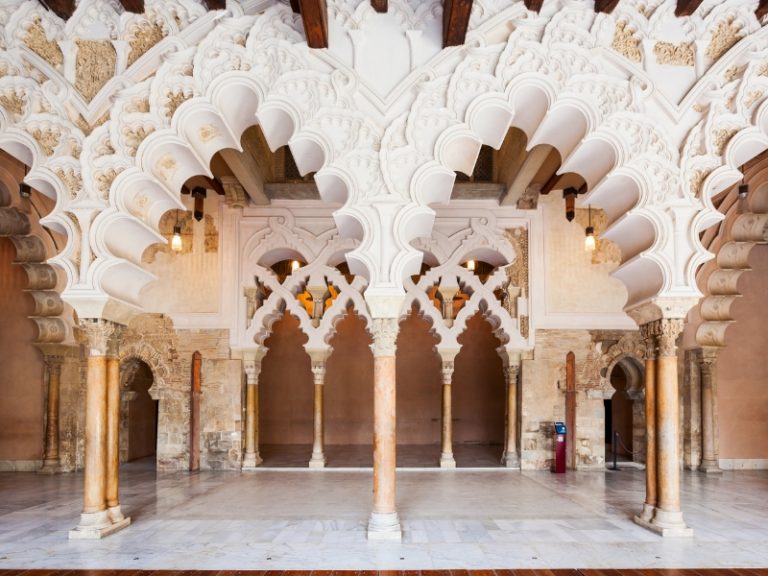
This fortified palace was built in the 11th century for the Muslim Banu Hud rulers of Zaragoza, and after the Christian conquest of 1118 it became a residence of the kings of Aragon. Behind its sturdy walls and towers, among them the Troubadour Tower, lie delicate interlaced Islamic arches. Today it also houses the Cortes de Aragón, the regional parliament.
2Plaza de Toros de La Misericordia
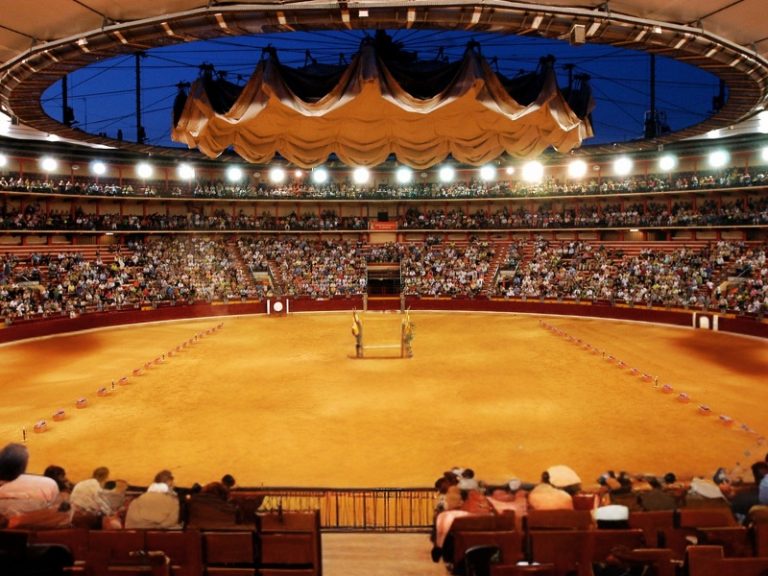
Opened in 1764, this is one of the oldest bullrings in Spain. It was built on the initiative of Ramón de Pignatelli so that its income would support the Casa de Misericordia, a charity hospice, which gave the arena its name. Today a modern roof covers the ring.
Read the full story →
3Mercado Central
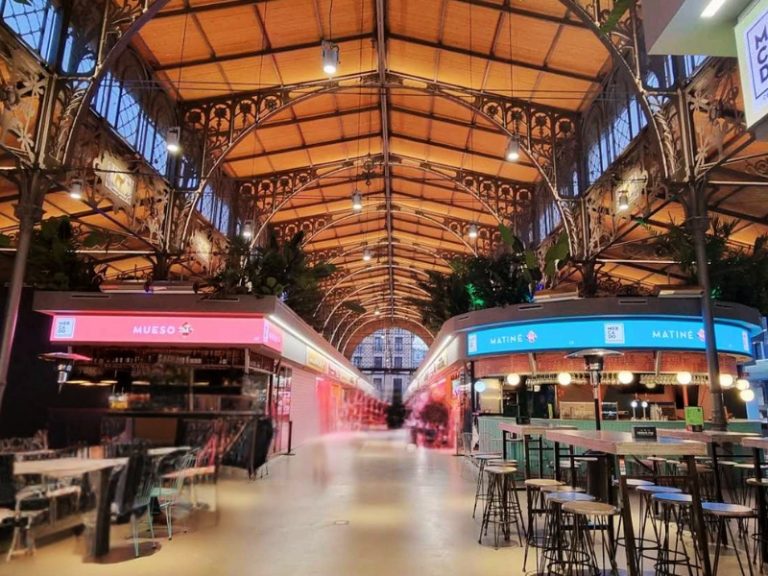
Zaragoza's central market opened in 1903 in a modernist building of iron and glass designed by Félix Navarro. It stands on the site of the city's old market square, right next to the Roman walls. Inside, stalls sell Aragonese produce such as ham, cheese and fresh vegetables.
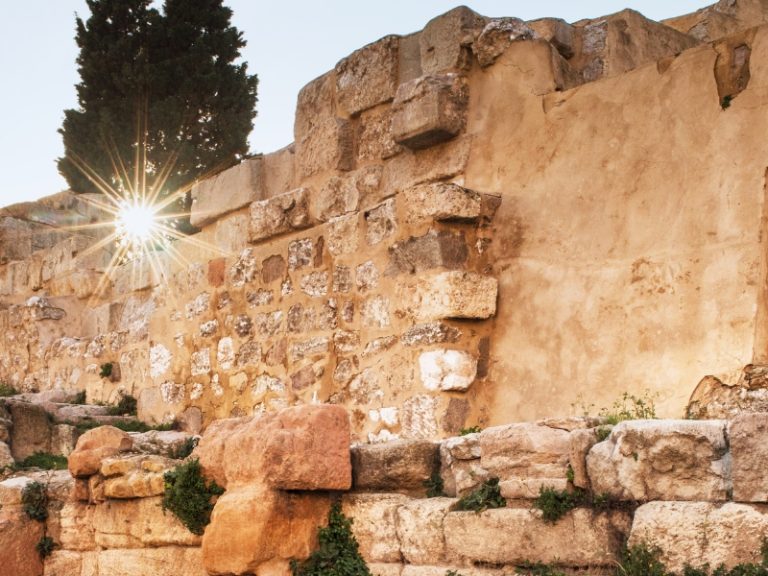
4Roman Walls
Zaragoza began as the Roman colony of Caesaraugusta, founded under Emperor Augustus, and the city's name comes from it. This stretch of the Roman wall, with its massive round towers, is one of the main surviving sections. Beside it stands a bronze statue of Augustus, a copy of the famous Augustus of Prima Porta.
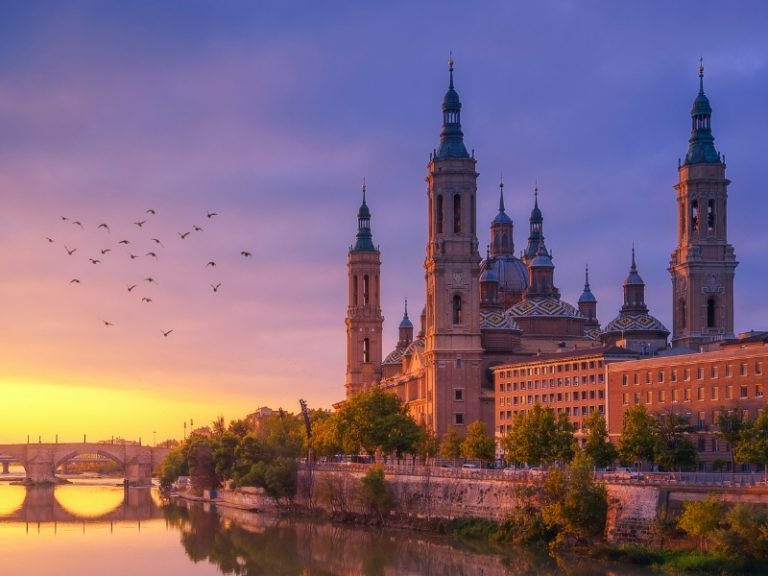
5Basilica of Our Lady of the Pillar
According to tradition, the Virgin Mary appeared here in AD 40 to the apostle James, standing on a pillar of jasper by the river Ebro. The Baroque basilica that honours her was begun in 1681, and its four towers and tiled domes rise above the riverside. Francisco de Goya painted one of its domes.
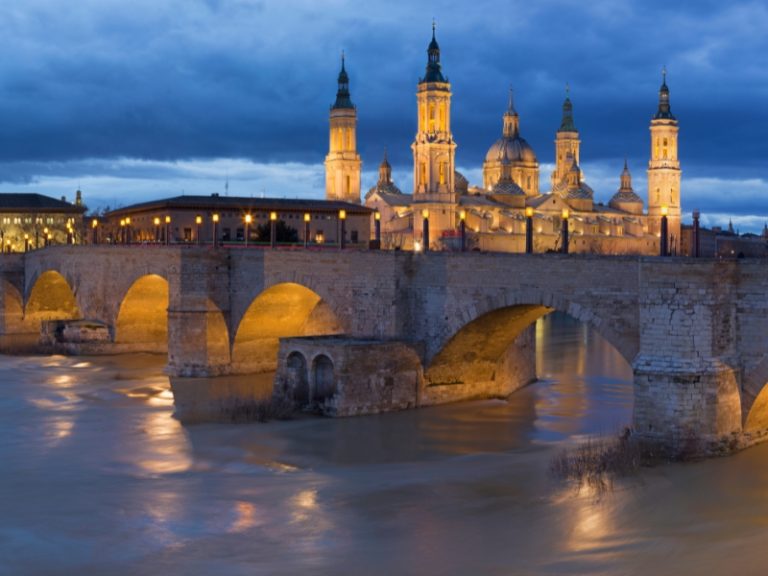
6Puente de Piedra
The Stone Bridge has crossed the Ebro since the 15th century, replacing earlier bridges on the same spot. Bronze lions, the symbol of Zaragoza, sit on tall columns at both ends. From the middle you get one of the classic views of the Basilica of the Pillar reflected in the river.
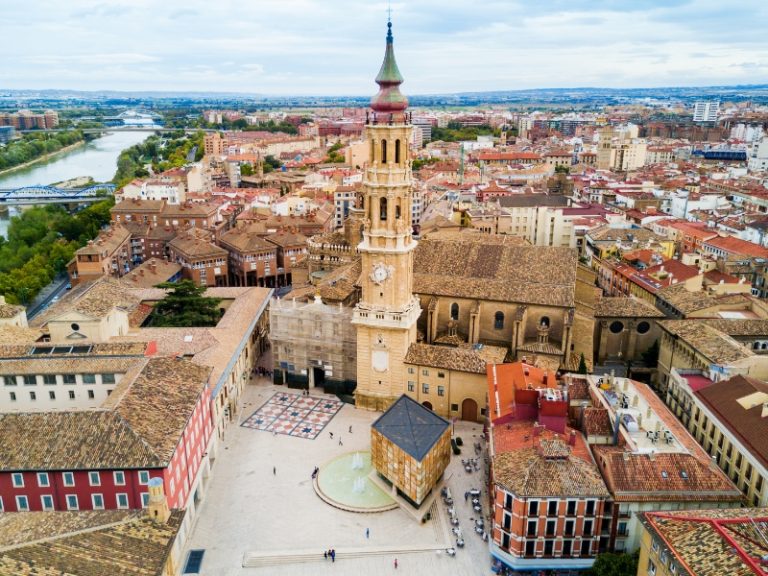
7Cathedral of the Saviour (La Seo)
Zaragoza's cathedral, known as La Seo, stands where the Roman forum and later the city's main mosque once stood. Its walls combine Romanesque, Gothic, Mudéjar and Baroque styles. Look for the outer wall of the Parroquieta chapel, covered in Mudéjar brickwork and green and white ceramics and part of the UNESCO-listed Mudéjar architecture of Aragon.
8Goya Museum
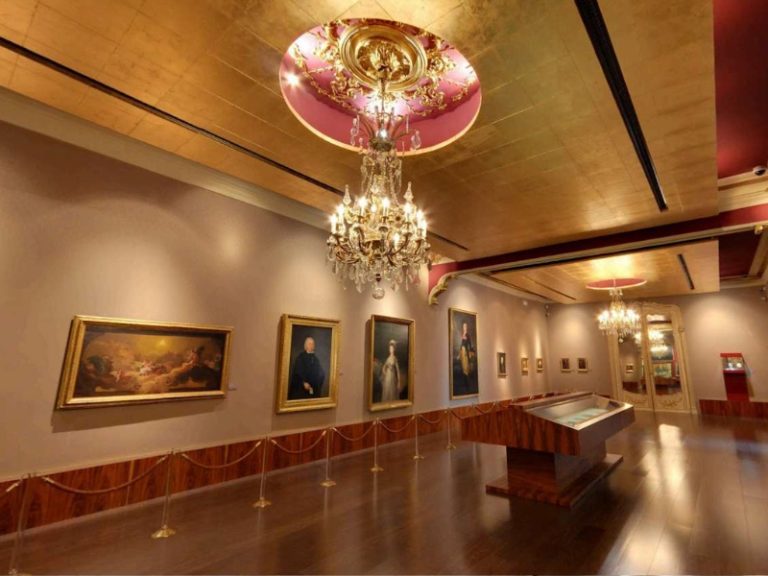
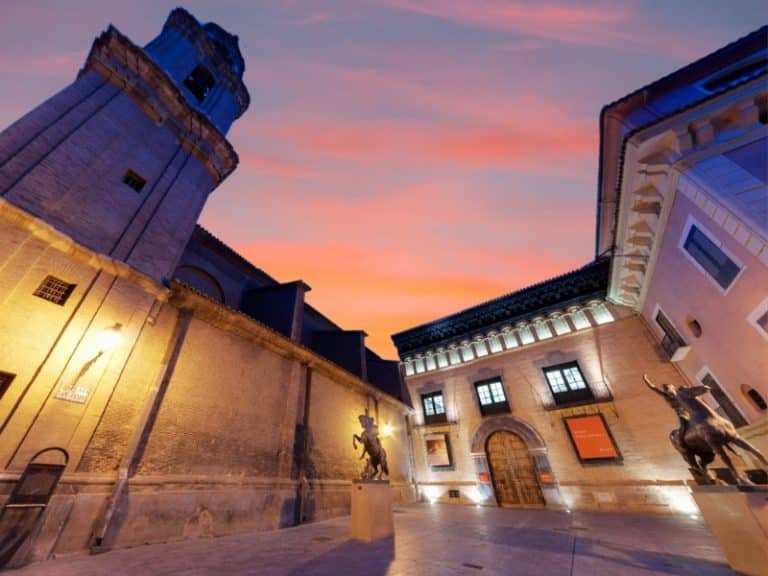
Francisco de Goya was born in 1746 in Fuendetodos, a village near Zaragoza, and trained as a painter in the city. This museum, set in a 16th-century Renaissance palace, shows paintings by Goya together with his famous series of prints, such as Los Caprichos and The Disasters of War.
9Plaza del Justicia
The square is named after the Justicia de Aragón, a medieval high judge whose task was to protect the laws and liberties of Aragon, even against the king. In 1591 the Justicia Juan de Lanuza was beheaded in Zaragoza on the orders of Philip II. Look at the Baroque façade of the Church of Santa Isabel de Portugal, known locally as San Cayetano.
10Plaza San FelipeFinish
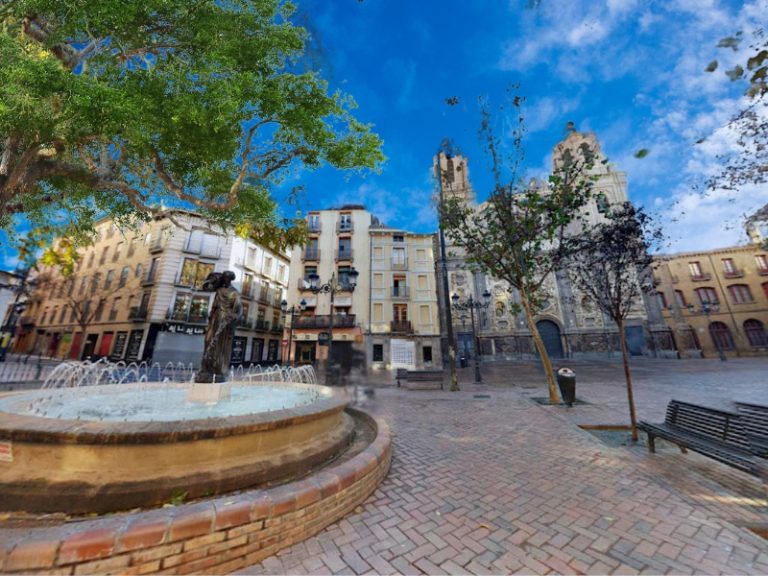
This small square was home to the Torre Nueva, a leaning Mudéjar clock tower begun in 1504 and pulled down in the 1890s. Its outline is marked in the paving, and a bronze boy sits looking up at where it once stood. The Renaissance Argillo palace on the square houses the Pablo Gargallo Museum.
Only logged in customers who have purchased this product may leave a review.




Anonymous (verified owner) –
Not much to this offering. Not worth the fee.
Aurélie– France –
Collected on GetYourGuide
Une activité interactive à faire en famille et à sa vitesse très bien pour découvrir la ville.