
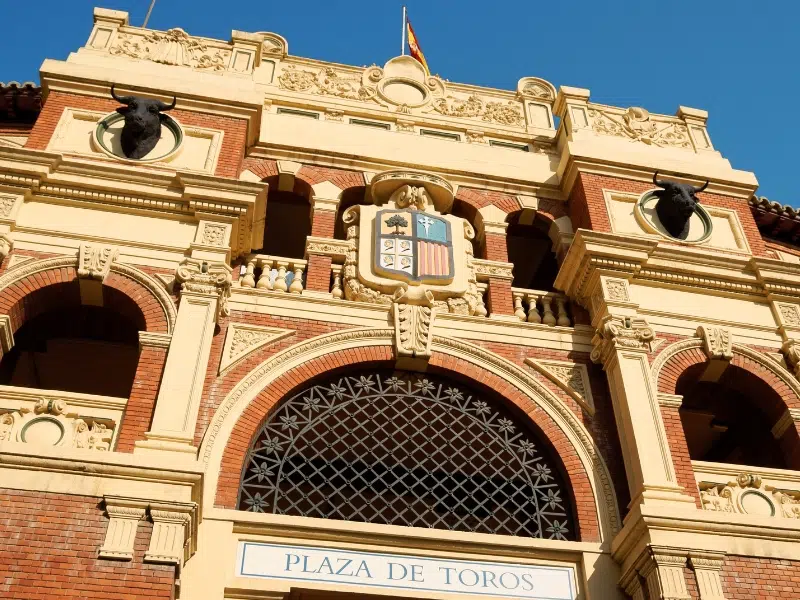
The Plaza de Toros de la Misericordia is Zaragoza's bullring, a round brick arena a short walk west of the old town. It was built in 1764 to raise money for the city's charity home for the poor and orphans, the Casa de Misericordia, which gave it its name, and in 1990 it became the first bullring in Spain with a roof.
The Plaza de Toros at a glance
- Where: Glorieta de Aznárez, on the western edge of the city centre, next to the Pignatelli building.
- Opened: 8 October 1764, the eve of the Pilar festival; rebuilt in its current form in 1916.
- By: commissioned by Ramón Pignatelli; the 1916 reform was by architects Miguel Ángel Navarro and Manuel Martínez de Ubago.
- What it is today: a first-category bullring with room for about 10,000 people, also used for concerts and other events, and owned by the provincial council.
- Time needed: 15 minutes outside; about an hour if you join a guided visit.
From charity arena to covered ring
The bullring was the idea of Ramón Pignatelli, an enlightened canon who ran the Casa de Misericordia. Bullfights were popular and profitable, so he had an arena built to fund the home. It went up in just 70 days, in rubble stone, brick and wood, and opened on 8 October 1764, the eve of the feast of the Virgin of the Pillar. The charity building next door is now the Pignatelli building, the seat of the Government of Aragón. In 1858 the provincial council took over the bullring, and it still belongs to it today.
The biggest change came in 1916, during what fans call the golden age of bullfighting. The architects enlarged the stands, added the outer porch on the ground floor, an infirmary and offices, and gave the facade the look you see now. The rebuild was so thorough that it is counted as a new bullring. In 1989–90 a movable Teflon roof was added over the ring, making it the first covered bullring in Spain and letting it host events all year. New, wider seats in 2002 reduced the capacity from about 14,300 to around 10,300.
What to look for
- The brick facade with its round arches and the porch running around the ground floor, both from the 1916 rebuild.
- The roof: from outside you can see the structure that carries the fixed cover over the stands and the movable one over the ring.
- The neighbouring Pignatelli building, the former Casa de Misericordia that the bullring was built to support.
- The mosaic of Ramón Pignatelli, the founder, where the guided visits begin.
- Inside, if you join a guided visit: the chapel, a small museum of posters and trophies, and a series of Goya's bullfighting prints.
The first Goyesca
On 12 May 1927, to mark 100 years since the death of Francisco de Goya, who was born near Zaragoza, the city held what is recorded as the first goyesca bullfight in Spain, with the bullfighters dressed in costumes of Goya's era. Spectators joined in too, many women wearing lace mantillas, and a procession of carriages came from the Teatro Principal to the ring. The idea spread, and goyesca bullfights are now held in other Spanish cities as well.
Tips for your visit
- Check the provincial council's website for guided visits, which run on set days and are the only way to see the inside outside events.
- In October, during the Fiestas del Pilar, the bullring hosts its main fair and the area is busy; on other days the outside is quiet.
- Walk all the way around the building to see the porch and the different gates; it takes only a few minutes.
- Combine it with the Aljafería Palace to the west and the Mercado Central to the east, both on foot.
Nearby
- Aljafería Palace: an 11th-century Islamic palace, later a royal residence and now the seat of the Aragonese parliament, a short walk west.
- Pignatelli building: the large former charity home next door, worth a look for its long facade.
- Mercado Central: Zaragoza's early 20th-century iron-and-glass market, good for a snack after your visit.
- Plaza del Portillo: a square with the Baroque church of Nuestra Señora del Portillo, linked to the siege of Zaragoza in 1808.
See Zaragoza with World City Trail
Our Zaragoza scavenger hunt turns the old town into a game you play on your phone, and the Plaza de Toros de la Misericordia is one of the stops. The route links 10 stops and takes around three hours, with about 48 minutes of walking, and also includes the Aljafería Palace and the Mercado Central. You can play in English, German, French, Italian, Spanish and Dutch.
If you prefer a different format, Zaragoza also has a self-guided walking tour and an outdoor escape game.
Play the Zaragoza scavenger hunt →
Take the self-guided walking tour of Zaragoza →
Play the outdoor escape game in Zaragoza →
Facts checked in October 2026.