

Table of Contents
The Aljafería Palace, a fortress-palace that dominates Zaragoza’s skyline, is more than just an architectural marvel—it is a living chronicle of power and artistic expression. Unlike a static monument, the Aljafería is a palimpsest where successive rulers etched their identities onto its walls, transforming it into a tangible reflection of shifting sovereignties. A fusion of Islamic, Mudéjar, and Renaissance influences, this extraordinary structure serves as a compelling window into the interplay between art, authority, and cultural adaptation.
A Chronicle of Shifting Power
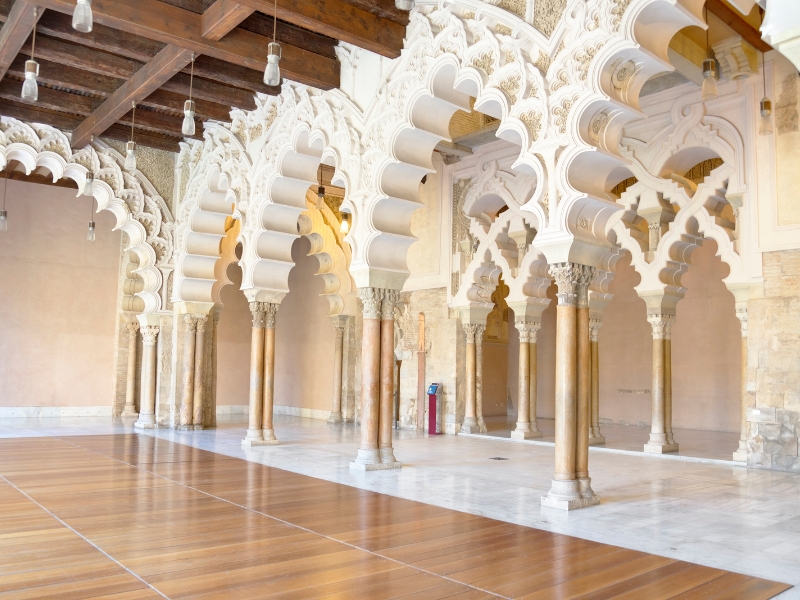
The Aljafería Palace’s origins lie in the vibrant period of the Taifa kingdoms. Built in the 11th century by the Banu Hud dynasty, it symbolized their aspiration for power and cultural refinement. Its ornate Islamic artistry, intricate stucco work, and elegant courtyards reflected a sophisticated court eager to rival the grandeur of Córdoba and Seville.
Following the Christian reconquest, the Kings of Aragon inherited this architectural gem, choosing not to erase its Islamic past but to redefine it. Mudéjar artisans—Muslim craftsmen working under Christian rule—were commissioned to blend Christian motifs with Islamic techniques, a testament to the complex fusion of traditions in medieval Spain. The Palace of Peter IV stands as a striking example of this artistic dialogue, where geometric Mudéjar patterns interweave with Christian iconography.
Architecture as a Narrative of Power
The Aljafería Palace is not just a collection of aesthetic elements; it is a visual language, where each decorative choice communicates the ambitions of its rulers.
- The original Islamic palace, with its delicate arabesques, horseshoe arches, and intricate stucco patterns, speaks of a court that prized intellectual sophistication and artistic excellence. The Golden Salon, a masterpiece of Islamic decorative arts, embodies this flourishing era of Taifa creativity.
- The Mudéjar additions, seen in brickwork, tile mosaics, and coffered ceilings, introduce a unique hybrid style, where Islamic geometric precision meets Christian symbolic representation.
- The Renaissance modifications, with their grand staircases, classical columns, and intricate carvings, reflect the Habsburg court’s desire to align with European artistic trends while asserting their royal dominance.
A Marker of Cultural Heritage
The Aljafería Palace is more than an architectural masterpiece; it is a living testament to Zaragoza’s diverse cultural legacy. As a symbol of the region’s rich Islamic past, a center of Mudéjar artistry, and a former royal residence, the palace embodies centuries of artistic and political evolution. Beyond its historical importance, it continues to serve as a vibrant cultural hub, hosting exhibitions, events, and research initiatives that foster civic pride and cultural awareness. By preserving and celebrating its multifaceted influences, the Aljafería ensures that its historical resonance endures for future generations.
A Contemporary Landmark
Today, the Aljafería Palace stands as a beacon of cultural fusion, seamlessly intertwining Islamic, Mudéjar, and Renaissance artistry. As one of Zaragoza’s most treasured landmarks, it offers visitors an immersive journey through the city’s architectural and historical splendor.
Its central location and accessibility make it a destination for both residents and tourists, enriching the city’s cultural landscape and reinforcing Zaragoza’s reputation as a hub of artistic and historical convergence. Beyond its role as a monument, the Aljafería continues to shape the identity of Zaragoza, serving as a dynamic link between past and present and a testament to the enduring power of cultural exchange.
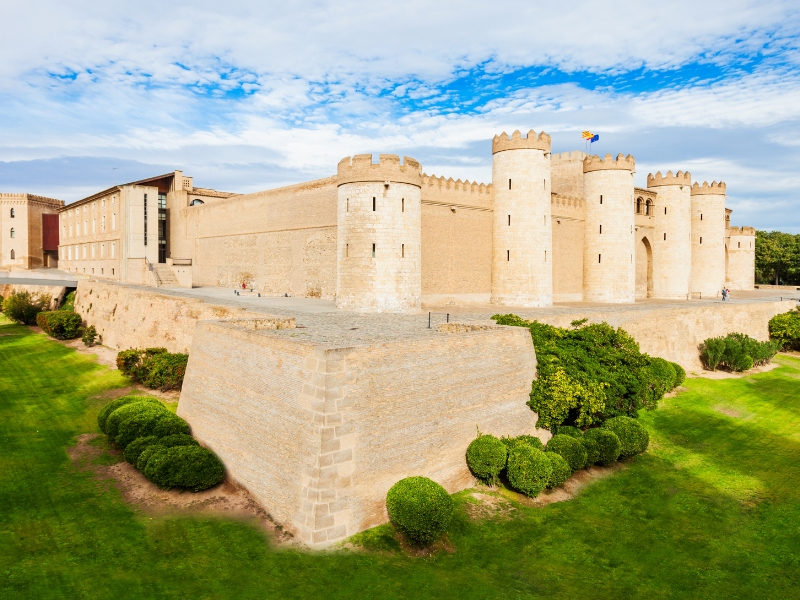
Aljafería Palace is part of Zaragoza scavenger hunt and walking tour!
Embark on an unforgettable journey through the enchanting city of Zaragoza with World City Trail. Our interactive walking tour combines the thrill of exploration with the rich history and culture of this beautiful city.
Key Features:
Interactive gameplay: Solve engaging puzzles and challenges as you explore the city.
Hidden gems: Uncover lesser-known spots.
Cultural insights: Learn about the city’s fascinating history.
Flexibility: Explore at your own pace and create your own itinerary.
Family friendly activity and a great way to explore the city!
Further reading on Wikipedia: Zaragoza