
Zaragoza has been a Roman colony, the capital of a Muslim kingdom and the seat of the kings of Aragon, and each of these layers left something you can still walk past. This guide covers nine places, roughly in the order you meet them crossing the city from west to east: the Aljafería Palace, the Mercado Central, the Roman walls, the Basilica of the Pillar, the Puente de Piedra, La Seo cathedral, the Goya Museum, Plaza del Justicia and Plaza San Felipe.
Aljafería Palace
The Aljafería was built mostly between 1065 and 1081 for Abu Jafar al-Muqtadir, ruler of the Muslim taifa kingdom of Zaragoza, who called it the Palace of Joy. Its name probably comes from his own name, Abu Jafar. The Islamic palace was built around a courtyard, whose original southern pool still survives.
After the Christian conquest it became a residence of the kings of Aragon. The Catholic Monarchs, Ferdinand and Isabella, added a palace on the north wing between 1488 and 1495, and from 1486 the Inquisition had its tribunal here. Since the 1980s part of the building has housed the Cortes of Aragon, the regional parliament, and it is part of the UNESCO-listed Mudéjar architecture of Aragon since 2001.
- The Troubadour Tower, the oldest part of the palace, named after the 1836 play El Trovador that inspired Verdi's opera Il trovatore; the Courtyard of Santa Isabel with its pool; and the coffered ceiling of the Throne Room, with the date 1492 and the yoke-and-arrows emblem of the Catholic Monarchs.
Mercado Central
Zaragoza's central market, also called the Mercado de Lanuza, was designed in 1895 by the Aragonese architect Félix Navarro and finished by 1903. It is a long hall of iron and glass with neoclassical touches on its doorways and column capitals. After a full renovation in 2018 and 2019 it reopened on 5 February 2020, and it is still a working food market.
- A plaque inside recalls Juan de Lanuza, Justicia of Aragon, who was beheaded on this square on 20 December 1591 by order of King Philip II for defending the kingdom's old laws.
Roman walls
A short walk from the market stands the longest surviving stretch of the walls of Caesaraugusta, the Roman colony that gave Zaragoza its name. The walls were first built in the 1st century AD under Tiberius and rebuilt until the 3rd century; the part you see today is dated to the second half of the 3rd century. They once ran for about three kilometres around the town, with some 120 towers.
- The section of about 80 metres beside the Torreón de la Zuda, a later medieval tower, where you can see the thick stone base and the round towers.
Basilica of Our Lady of the Pillar
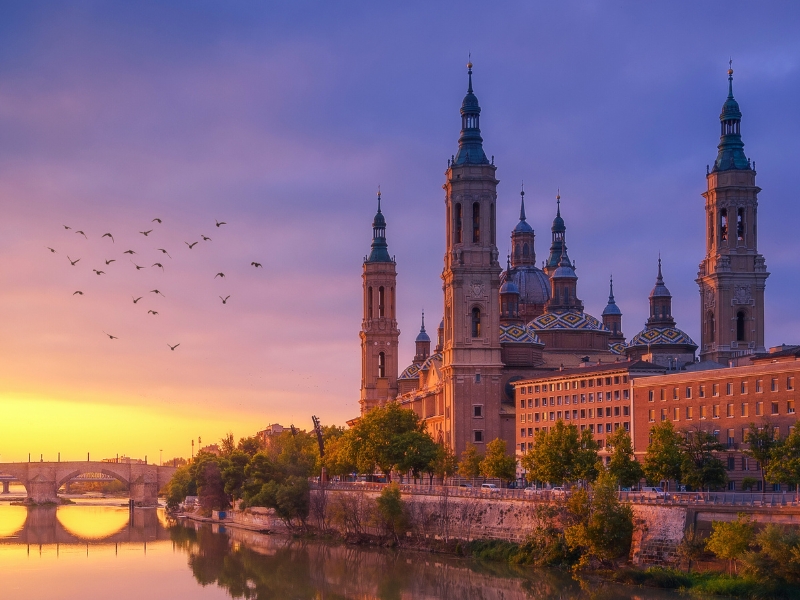
According to tradition, on 2 January in the year 40 the Virgin Mary appeared to the apostle St James while he was praying by the Ebro and gave him a jasper pillar, asking for a church to be built there. The present baroque basilica was begun in 1681, and Ventura Rodríguez later redesigned the Holy Chapel that holds the pillar. With eleven domes and four towers, it dominates the riverside.
Francisco de Goya painted frescoes on the vaults and domes around the Holy Chapel, including the Queen of Martyrs dome. The feast of Our Lady of the Pillar is celebrated on 12 October, also Spain's national day.
- Two of the three bombs that hit the basilica during the Civil War and failed to explode; they are on display inside.
- The cluster of domes and the four corner towers, best seen from the Puente de Piedra.
Puente de Piedra
The Stone Bridge over the Ebro was begun in 1401 under Gil de Menestral and finished around 1440, replacing older bridges going back to Roman times. It has seven arches and has survived floods and war: a flood in 1643 brought down two central arches, and in 1813 retreating French troops blew up the northern arch. The old towers at its ends were pulled down in 1906.
- The four bronze lions by the sculptor Francisco Rallo, added in 1991, and the view back to the Pilar from the middle of the bridge.
La Seo (Cathedral of the Saviour)
Zaragoza has two cathedrals, and La Seo is the older one. It stands on the site of the Roman forum and of the main mosque of Muslim Zaragoza, and it mixes almost every style: Romanesque apses from the 12th century, Gothic and Mudéjar work, a baroque tower and a neoclassical main door from the 18th century.
Inside, the main altarpiece is carved mostly in painted alabaster between 1434 and 1480, by Pere Johan and Hans of Swabia. The cathedral also has a museum of Flemish tapestries from the 15th to the 17th century, one of the largest such collections in the world.
- The Mudéjar wall of the Parroquieta of San Miguel, on the outside, built in 1360 for Archbishop Lope Fernández de Luna, with geometric patterns in brick and glazed tiles.
Goya Museum
The Goya Museum fills a Renaissance palace of 1535 on Calle Espoz y Mina, with a courtyard of marble columns. It opened in 1979 as the Museo Camón Aznar and reopened under its present name in 2015. Its collection runs from the 15th to the 20th century, but its highlight is Goya: paintings such as an early self-portrait of 1775, and the four great print series in full.
- Los Caprichos, The Disasters of War, La Tauromaquia and Los Disparates, the only complete set of Goya's print series on show in a museum.
Plaza del Justicia
This small square is named after the Justicia of Aragon, the high judge of the kingdom whose office stood for Aragon's old laws and freedoms. On it stands the baroque church of Santa Isabel de Portugal, also called San Cayetano, built between 1682 and 1704 with a facade of alabaster, marble and plaster with gilded statues. In 1914 the remains of Juan de Lanuza, the Justicia executed in 1591, were moved into this church.
Plaza San Felipe
A few steps away, Plaza San Felipe was once a market for local craftsmen. Here stood the Torre Nueva, a leaning Mudéjar brick tower built between 1504 and 1512 that tilted about three metres from the vertical; the city council pulled it down in 1892 despite strong protests. Around the square are the baroque church of San Felipe, the Renaissance Palacio de Argillo, now the Pablo Gargallo Museum, and the 15th-century Mudéjar Torreón de Fortea.
- The figure of a boy sitting on the ground and looking up at where the tower stood, and the mark in the paving that traces the tower's outline.
How to see them in one walk
Start at the Aljafería, west of the centre, and walk east past the Plaza de Toros de la Misericordia to the Mercado Central and the Roman walls beside it. From there it is a short walk to the Basilica of the Pillar and down to the river and the Puente de Piedra. Walk back along Plaza del Pilar to La Seo, then turn south to the Goya Museum, and finish in the old streets of Plaza del Justicia and Plaza San Felipe.
See Zaragoza with World City Trail
Our Zaragoza scavenger hunt turns the city into a game you play on your phone. The route links 10 stops, from the Aljafería Palace to Plaza San Felipe, and all nine places in this guide are stops, along with the Plaza de Toros de la Misericordia. At each stop you solve a puzzle and learn a story, at your own pace.
There is also a self-guided walking tour and an outdoor escape game in Zaragoza, for people who prefer a different format.
Play the Zaragoza scavenger hunt →
Take the self-guided walking tour of Zaragoza →
Play the outdoor escape game in Zaragoza →
Facts checked in October 2026.