
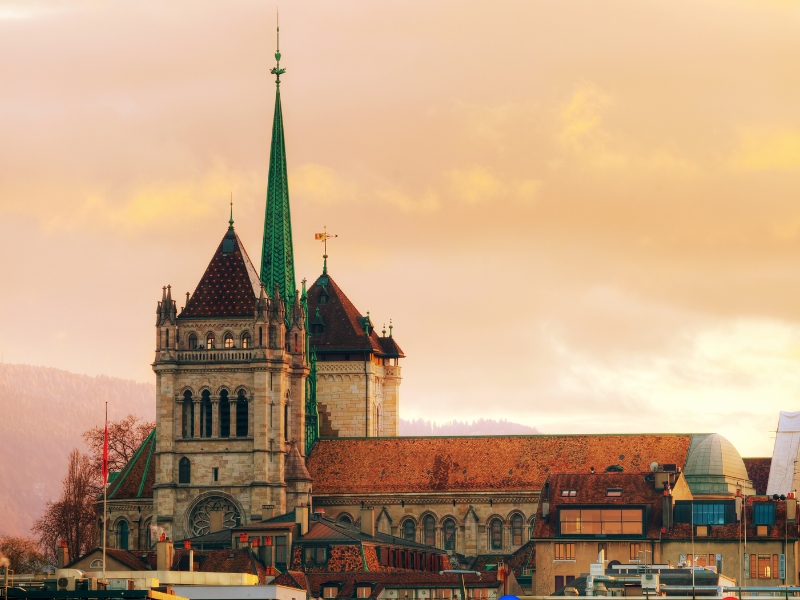
Geneva is the city of Calvin's Reformation, but also of the bankers and patrons who filled it with music halls and museums in the 19th century. This guide covers seven places on one walk from the right bank of the Rhône up to the old town and down to the Bastions: the Basilica of Notre-Dame, the National Monument, St Pierre Cathedral, the Musée d'Art et d'Histoire, Place de Neuve, the Grand Théâtre and Victoria Hall.
Basilica of Notre-Dame
Geneva's main Catholic church was built between 1852 and 1857 to designs by Alexandre Grigny, on the site of one of the old bastions of the city fortifications. In a city that had been Protestant since the Reformation, this large neo-Gothic church was a statement. After an anticlerical government came to power it was occupied and closed, and the Catholic Church had to buy it back in 1911 and 1912. It was made a minor basilica in 1954.
Its motto is Nuntia Pacis, 'messenger of peace'. The basilica also marks the end of the Swiss Way of St James from Rorschach and the start of the Via Gebennensis, the next stage of the route.
- The white statue of the Virgin given by Pope Pius IX and crowned in 1937, in the central chapel behind the altar, and the stained glass by Claudius Lavergne and, from the 20th century, by Alexandre Cingria and Maurice Denis.
National Monument
On the western edge of the Jardin Anglais, by the lake, the National Monument commemorates Geneva joining the Swiss Confederation in 1814. It is a reminder that Geneva, so closely tied to Switzerland today, became part of it only a little over two hundred years ago.
- Close by is the Flower Clock, created in 1955 by the city's gardeners: a working clock about four metres across, planted with flowers, as a tribute to Geneva's watchmaking.
St Pierre Cathedral
The cathedral on the hill of the old town was begun in 1160 under Bishop Arducius de Faucigny, and the nave vaults were finished at the end of the 13th century. In 1535 Guillaume Farel preached the Reformation here; iconoclasts smashed the statues and furnishings, the Mass was suspended that August, and in 1536 Geneva officially became Protestant. John Calvin later preached here, and the plain interior still shows the Reformation, when the statues and furnishings were removed.
In 1752 to 1756 the architect Benedetto Alfieri replaced the Gothic west front, which was in danger of collapse, with the neoclassical portico of columns you see now. Under the cathedral, an archaeological site opened in 1976 shows remains from the 3rd century BC up to the building of the cathedral, and it is one of the largest of its kind north of the Alps.
- The Chapel of the Maccabees, a flamboyant Gothic chapel built in 1405 and 1406 for Cardinal Jean de Brogny and restored in the 19th century.
- The north tower: 157 steps up to a view over the whole city and the lake.
- La Clémence, the great bell first cast in 1407; it cracked in 1866 and was recast the following year.
Musée d'Art et d'Histoire
The city's museum of art and history was built between 1903 and 1910 by the architect Marc Camoletti, though the collection goes back to 1826, when the city's first art museum opened in the Musée Rath. It holds more than 650,000 objects in archaeology, applied arts, watchmaking and fine arts, including the largest collection anywhere of works by the Genevan painter Jean-Étienne Liotard.
Its most famous painting is The Miraculous Draught of Fishes by Konrad Witz, painted in 1444 for an altarpiece in St Pierre Cathedral. It is often called the earliest surviving faithful portrait of a real landscape in European art, based on close observation of real places.
- The facade sculptures by Paul Amlehn: an allegory of the arts above the entrance, archaeology and applied art on the corners, and the names of Genevan artists along the frieze.
Place de Neuve
This square takes its name from the Porte Neuve, a city gate built in 1564 outside the old walls, which plays a part in the story of the Escalade of 1602. The gate was demolished in 1853 and the open space became Place Neuve. The square is ringed by culture: the Grand Théâtre, the Conservatoire de Musique, here since 1858, and the Musée Rath of 1824, while the Parc des Bastions opens behind its gates.
- In the middle, the equestrian statue of General Guillaume-Henri Dufour, set up in 1884 to honour a national hero who also produced the first great maps of Switzerland.
Grand Théâtre de Genève
Geneva's opera house was paid for largely with the fortune left to the city by Duke Charles II of Brunswick, who died in Geneva in 1873. Jacques-Élysée Goss drew the plans, taking the Palais Garnier in Paris as his model, and the theatre opened in 1879 with Rossini's William Tell.
On 1 May 1951 a fire, started while a pyrotechnic effect was being prepared for Wagner's Die Walküre, destroyed the auditorium; only the facades, the foyer and the library survived. A new hall opened in December 1962, and after a renovation from 2016 to 2018 the house is again one of the main opera stages in Europe.
Victoria Hall
This concert hall was built between 1891 and 1894 by the architect John Camoletti and paid for by Daniel Fitzgerald Packenham Barton, the British consul in Geneva, who named it after Queen Victoria and gave it to the city in 1901. It is the home of the Orchestre de la Suisse Romande, founded by Ernest Ansermet in 1918. On 16 September 1984 an arson fire destroyed much of the original decoration, including paintings by Ernest Biéler, and the organ.
- The large organ at the back of the stage, a new instrument installed in 1993 to replace the one lost in the fire.
How to see them in one walk
Start at the Basilica of Notre-Dame and walk down through the Pâquis to the lake and the Brunswick Monument, built for Duke Charles II of Brunswick. Cross the Rhône to the Jardin Anglais for the National Monument and the Flower Clock, then climb into the old town to St Pierre Cathedral. Continue to the Musée d'Art et d'Histoire, walk down to the Reformation Wall in the Parc des Bastions, and finish on Place de Neuve with the Grand Théâtre, with Victoria Hall a short walk beyond.
See Geneva with World City Trail
Our Geneva scavenger hunt turns the city into a game you play on your phone. The route links 10 stops, from the Basilica of Notre-Dame to Victoria Hall, and all seven places in this guide are stops, along with the Brunswick Monument, Place Franz-Liszt and the Reformation Wall. At each stop you solve a puzzle and learn a story, at your own pace.
There is also a self-guided walking tour and an outdoor escape game in Geneva, for people who prefer a different format.
Play the Geneva scavenger hunt →
Take the self-guided walking tour of Geneva →
Play the outdoor escape game in Geneva →
Facts checked in October 2026.