What is the Geneva self-guided walking tour?
The Geneva self-guided walking tour is a walk you take at the speed that suits you, with audio narration on your phone where a guide would otherwise stand. Allow about 3 hours: 45 minutes of that is walking, the route measures 3.5 km, and at 10 stops you stop and listen. Nothing is timed and nobody waits for a group to gather.
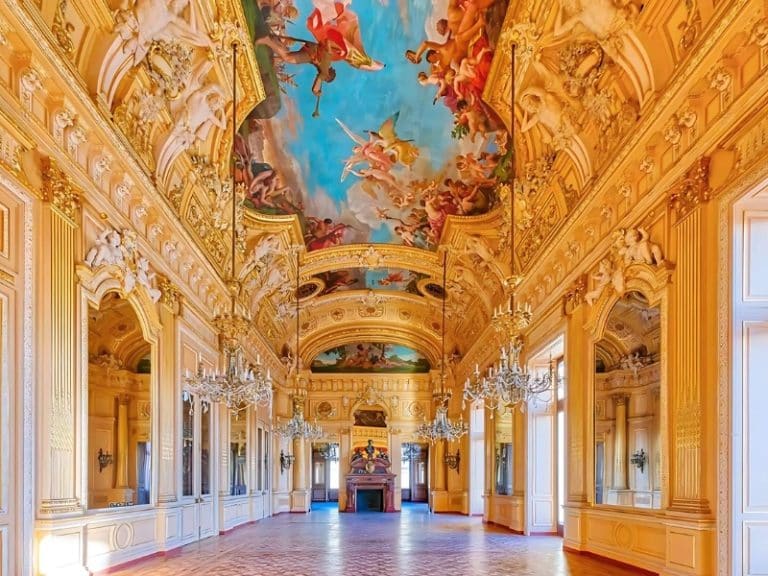
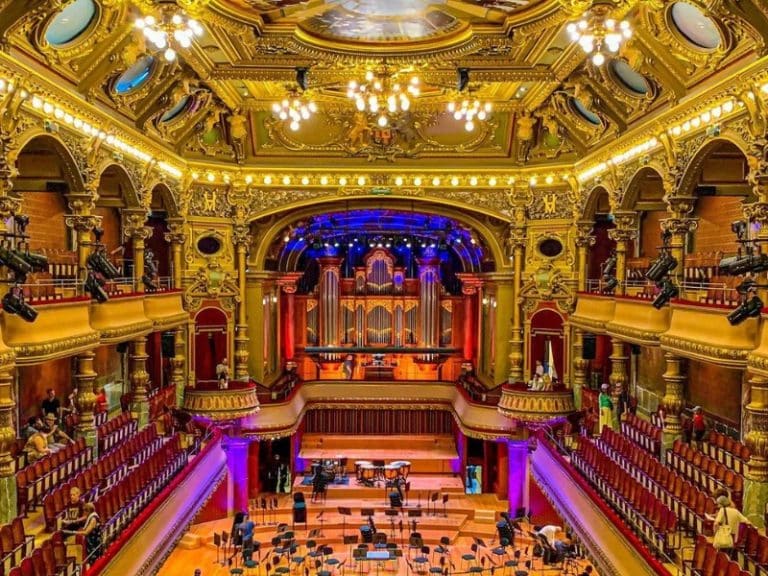
At the lakefront mausoleum the narration explains the bargain behind it: Duke Charles II of Brunswick left his fortune to Geneva in 1873 on condition that the city build him a worthy tomb, which it copied from the Scaliger tombs in Verona. In the Museum of Art and History hangs Konrad Witz's altarpiece of 1444, whose miraculous catch of fish is set on this very lake. Victoria Hall was paid for by a British consul and named after his queen.
- Durationabout 3 hours
- Walkingabout 45 min · 3.5 km
- Stops10
- LanguagesEnglish, German, French, Italian, Spanish, Dutch, Chinese
What you do on the walking tour
Listen
Each stop comes with the history of the place, the legends told about it and the carved details worth a second look. The same text sits on screen for anyone who prefers to read.
Walk on
Google Maps handles the stretches in between: 45 minutes on foot over 3.5 km, at the speed you choose.
Break off
Stop for a coffee by the lake or give an hour to a museum, then pick the walk up again, that day or another.
Eat and browse
Tips for food and shops near the route come with the stops. Where you begin and the order you take them in are set in the app.
See the route and attractions →
How it works
- Book online Choose the number of people. Your booking reference arrives by email straight away.
- Get the app Download the World City Trail app from the App Store or Google Play and enter your booking reference.
- Walk when you like Start whenever you are ready, walk at your own pace and pause any time. No guide, no fixed schedule.
Who the walking tour is for
A first visit
One walk puts the lakeshore and the hill town in order and explains what you are standing in front of.
Anyone who avoids groups
Nothing to follow and no roll call: you stay in front of a façade as long as it holds you and move on when you decide.
A day in Geneva
3 hours covers the centre, leaving the afternoon for the lake, the Palais des Nations or a boat.
Good to know
- Bring a charged smartphone with mobile data; a power bank helps.
- No entry tickets needed: everything happens outside the buildings. Going inside is optional and paid separately.
- Family friendly; children must be accompanied by an adult.
- Not suitable for wheelchair users and difficult with strollers.
- Groups of up to 5 work best; larger groups split up, one ticket per person.
- Every purchase helps support stray cats and dogs in Greece.
The walk stop by stop: Notre-Dame, St Peter's Cathedral, the Reformation Wall, Victoria Hall
10 stops · about 45 min walking · start: Basilica of Notre-Dame · finish: Victoria Hall
The Basilica of Notre-Dame, minutes from Cornavin station, is the first stop. From there it is downhill to the Brunswick Monument on the lakefront and over the water to Helvetia and Geneva in the Jardin Anglais. The streets then rise to St Peter's Cathedral, and above the old moat come the Museum of Art and History, the house Liszt shared with Marie d'Agoult and the Reformation Wall in the Parc des Bastions. The last three stops stand around Place de Neuve: the square itself, the Grand Théâtre and Victoria Hall. The app takes a different opening stop or a different order, and none of the stops asks for a ticket.
Open the route map ↗
1Basilica of Notre-DameStart
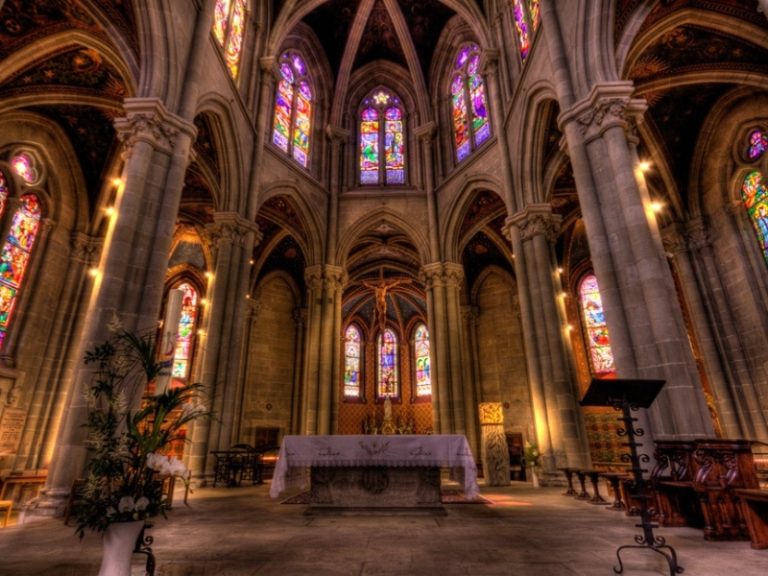
Geneva's main Catholic church stands a short walk from Cornavin station and was built in the mid-19th century in the Gothic Revival style. It reflected the growing Catholic community in the city of Calvin, and its pointed arches, pinnacles and tall windows deliberately recall the French cathedrals of the Middle Ages.
2Brunswick Monument
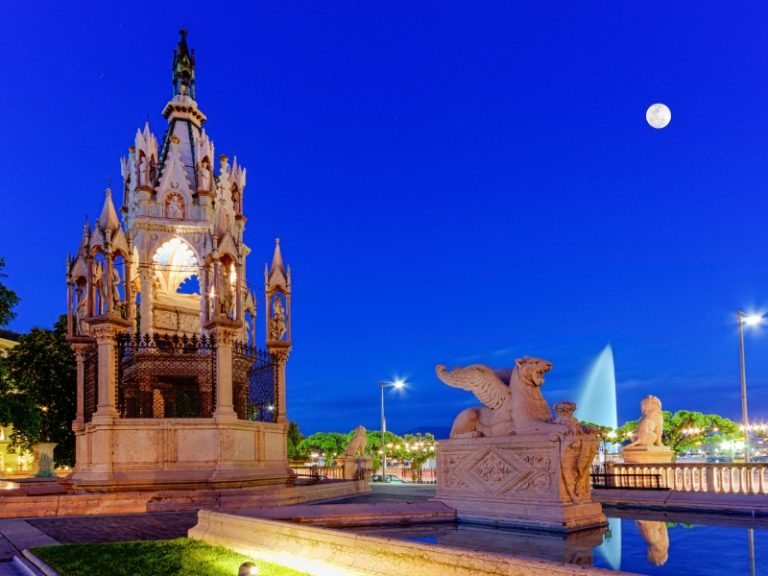
This richly decorated mausoleum on the lakefront holds Duke Charles II of Brunswick, who died in Geneva in 1873 and left his fortune to the city on condition that it build him a worthy tomb. The city modelled it on the Gothic tombs of the Scaliger family in Verona, so look up at its pinnacles and canopied niches.
Read the full story →
3National Monument
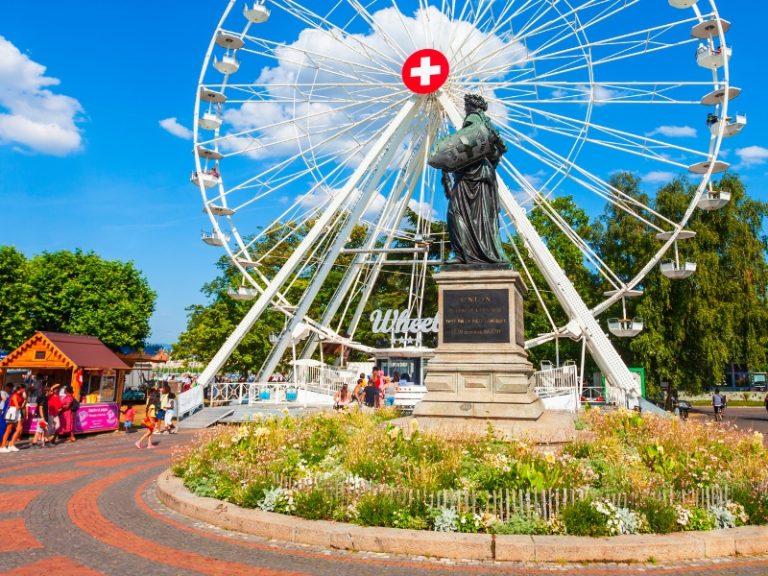
In the Jardin Anglais two bronze women stand together: Helvetia, who represents Switzerland, and Geneva. The monument by Robert Dorer was unveiled in 1869 and celebrates Geneva joining the Swiss Confederation in 1815.
4St Peter's Cathedral
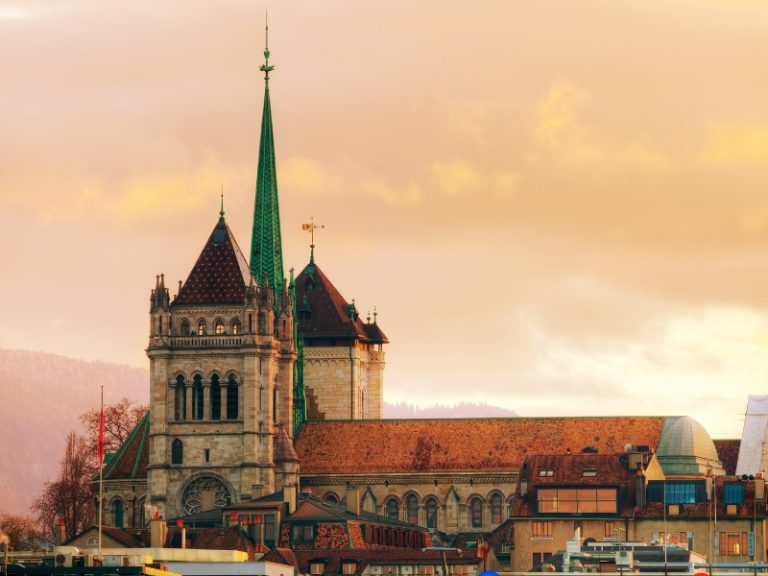
Building began around 1160 on a hill that was already a place of worship in Roman times, and the cathedral became Protestant during the Reformation in the 1530s. John Calvin preached here, and the neoclassical portico with its columns was added to the medieval church in the 18th century.
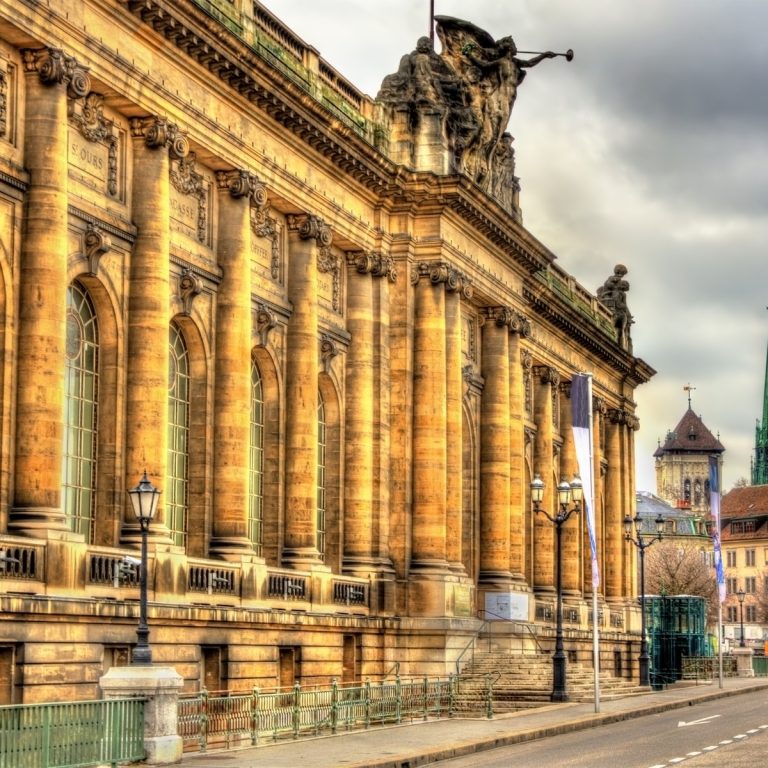
5Museum of Art and History
One of the largest museums in Switzerland, it opened in 1910 in a monumental building by the architect Marc Camoletti. Its collection includes Konrad Witz's altarpiece of 1444, whose Miraculous Draught of Fishes is set on Lake Geneva and is one of the earliest realistic landscapes in European painting.
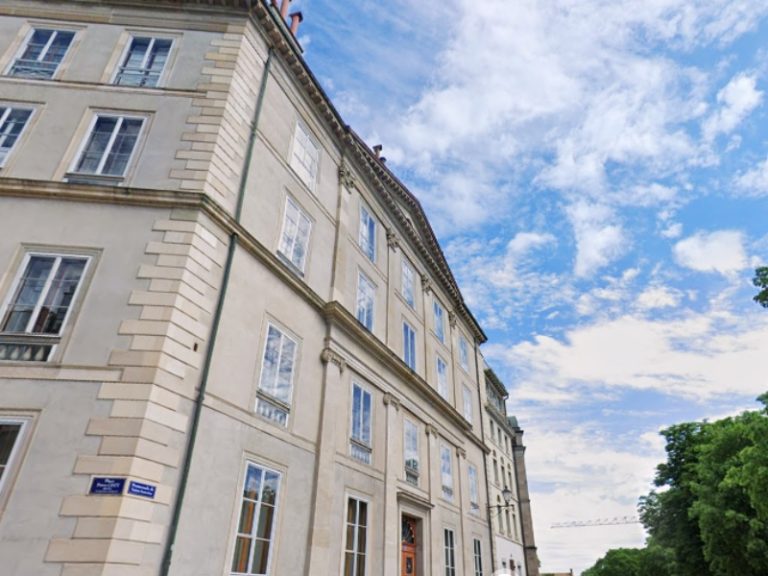
6Liszt and Marie d'Agoult's House
In 1835 the young pianist Franz Liszt and Countess Marie d'Agoult, who had left her husband for him, came to Geneva and lived in this house. Their first daughter, Blandine, was born in the city that year, and Liszt taught piano at the newly founded Geneva Conservatory.
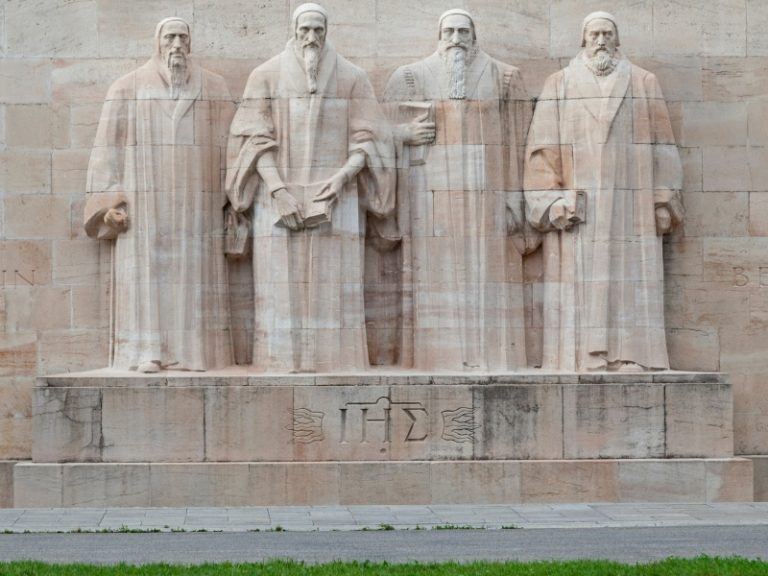
7Reformation Wall
This 100-metre wall in the Parc des Bastions was begun in 1909, the 400th anniversary of John Calvin's birth, and runs along the old city moat. Its central statues show William Farel, Calvin, Theodore Beza and John Knox, and above them is carved Geneva's motto, Post Tenebras Lux, light after darkness.
Read the full story →
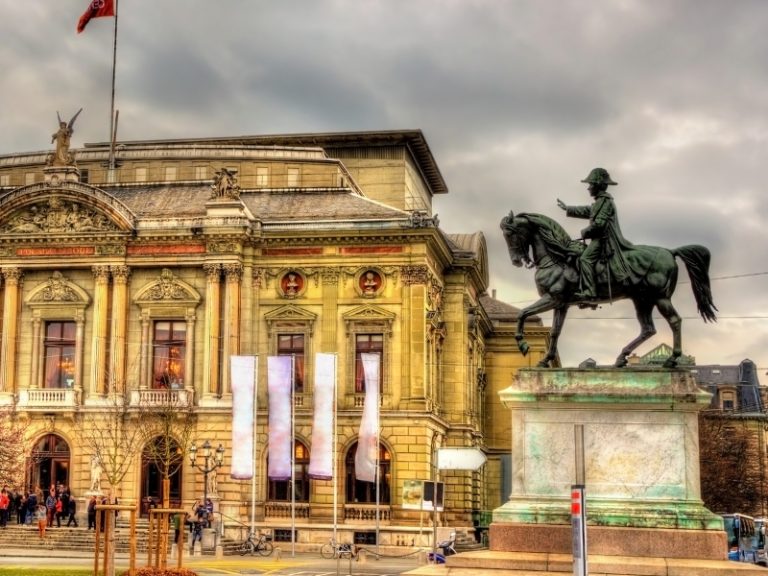
8Place de Neuve
Place de Neuve lies at the foot of the Old Town, where the Porte Neuve, one of the gates of the old city fortifications, once stood. Today it is framed by the Grand Théâtre, the Conservatoire de Musique and the Musée Rath, and at its centre stands the equestrian statue of General Guillaume-Henri Dufour, who led the federal army in 1847.
9Grand Théâtre de Genève
Geneva's opera house opened on Place de Neuve in 1879, and its richly decorated façade recalls the Paris Opera of the same period. A fire in 1951 destroyed the stage and much of the auditorium, which was rebuilt with a modern interior and reopened in 1962.
10Victoria HallFinish
This concert hall was paid for by Daniel Barton, the British consul in Geneva, and named after Queen Victoria when it opened in 1894. It is the home of the Orchestre de la Suisse Romande, and after a fire in 1984 its richly decorated hall was restored.
Only logged in customers who have purchased this product may leave a review.





United States –
Collected on GetYourGuide
Beatrice– Italy –
Collected on GetYourGuide