
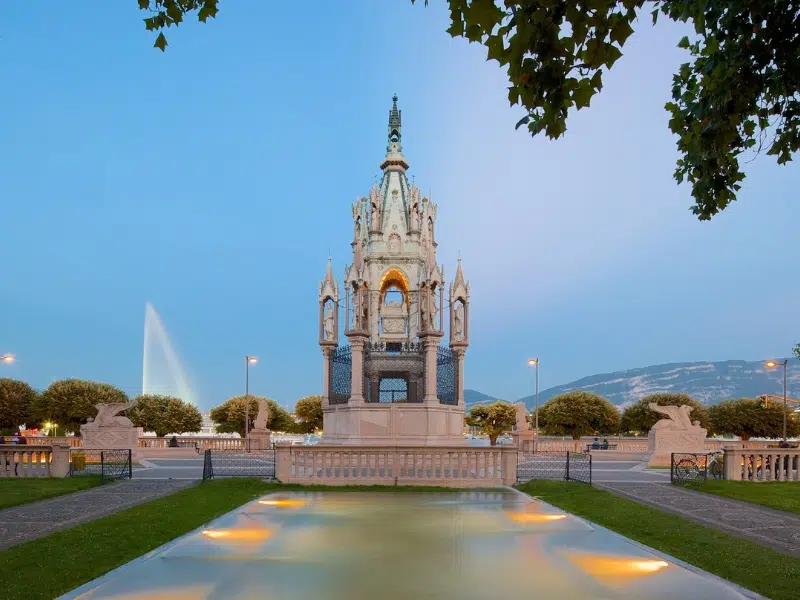
The Brunswick Monument is the white marble mausoleum of Charles II, Duke of Brunswick, on the Geneva lakefront facing the harbour. A deposed German duke who died in Geneva in 1873 left his whole fortune to the city on one condition: that it build him a prominent tomb copied from the Gothic tombs of the Scaliger family in Verona.
The Brunswick Monument at a glance
- Where: in the Jardin des Alpes on the Quai du Mont-Blanc, on the right bank of the lake, next to the Hôtel Beau-Rivage.
- Built: 1879, unveiled on 14 October 1879.
- By: the Geneva architect Jean Franel, with sculpture by several artists, among them Auguste Cain, Richard Kissling and Charles Iguel.
- What it is today: the duke's tomb and a listed monument of national importance in Switzerland, set in a small public garden on the quay.
- Time needed: 15 to 20 minutes to walk around it, more if you combine it with a stroll along the quays.
A runaway duke and his will
Charles II became Duke of Brunswick as a boy in 1815. His extravagant lifestyle and quarrels with the local estates made him deeply unpopular, and in 1830 an uprising drove him out; the next year his brother William replaced him. Charles lived in London and Paris, spent years trying to win back his throne, and was known mostly for scandals. In 1870 the Franco-Prussian War brought him to Geneva, where he died at the Hôtel Beau-Rivage on 18 August 1873, without direct heirs.
In his will of 1871 he made the city of Geneva his sole heir. After a settlement with his brother, Geneva kept about 24 million francs. Two million went on the tomb; much of the rest helped pay for new public buildings, including the Grand Théâtre. The design competition was won by Jean Franel, ahead of Eugène Viollet-le-Duc and Vincenzo Vela, and he took as his model the tomb of Cansignorio della Scala in Verona.
What to look for
- The canopy: a hexagonal, three-storey marble structure topped by a Gothic spire, with the sarcophagus on the upper level.
- The duke himself: a recumbent marble figure on the sarcophagus, surrounded by angels, with eight reliefs on scenes from Brunswick's history.
- Six ancestors from the House of Guelph at the corners, including Henry the Lion and the duke's father and grandfather.
- The bronze equestrian statue of Charles II by Auguste Cain. It was first placed on top of the spire but was taken down a few years later, as it was too heavy for the structure, and now stands on its own plinth at the end of the platform.
- The marble lions at the entrance and the chimeras around the platform, which is about 65 metres long and flanked by two pools.
Why Verona in Geneva?
The Scaliger tombs in Verona are open-air Gothic monuments to the lords who ruled that city in the 13th and 14th centuries, each crowned with a knight on horseback. A deposed duke clearly liked the idea of resting under the same kind of canopy, with his own statue riding on top. That Geneva, the city of Calvin, built such a princely tomb in return for his fortune is part of what makes the monument so curious.
Tips for your visit
- Come in the late afternoon: the white marble glows in the low sun, and the Jet d'Eau is right across the harbour.
- For the full outline, step back to the quay railing by the lake; the spire is easier to read from a distance.
- Walk on from here along the Quai du Mont-Blanc towards the Pont du Mont-Blanc and the Bains des Pâquis.
Nearby
- Jet d'Eau: Geneva's famous fountain, best seen from the right-bank quays across the harbour.
- Île Rousseau: a tiny island with a statue of Jean-Jacques Rousseau, reached from the Pont des Bergues, a few minutes' walk south.
- Bains des Pâquis: the public baths on a jetty in the lake, a pleasant walk north along the quay.
- Jardin Anglais and the Flower Clock: across the Pont du Mont-Blanc on the left bank.
See Geneva with World City Trail
Our Geneva scavenger hunt turns the old town into a game you play on your phone. The route links 10 stops and takes around 3 hours, with about 44 minutes of walking. The Brunswick Monument is one of the stops, along with St Pierre Cathedral, the Basilica of Notre-Dame and the National Monument. You can play in English, German, French, Italian, Spanish, Dutch and Chinese.
If you prefer a different format, there is also a self-guided walking tour and an outdoor escape game in Geneva.
Play the Geneva scavenger hunt →
Take the self-guided walking tour of Geneva →
Play the outdoor escape game in Geneva →
Facts checked in October 2026.