
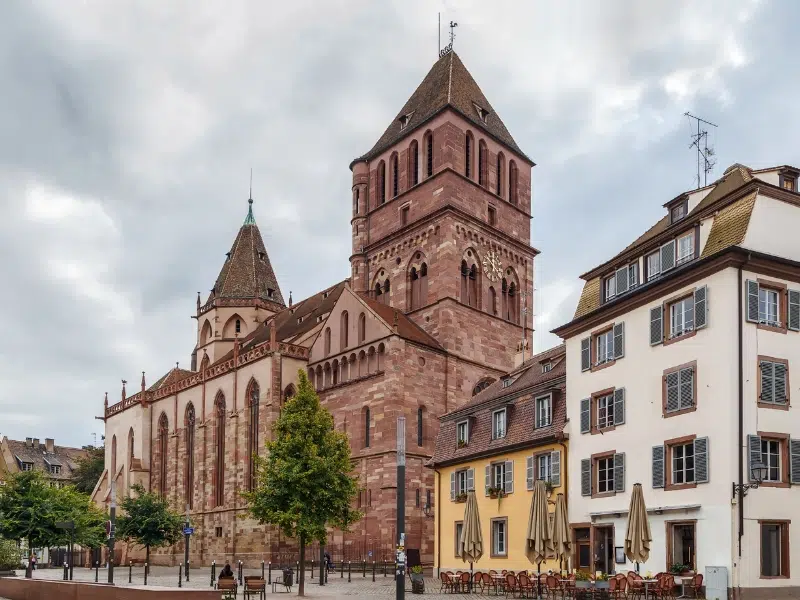
Saint Thomas Church is the main Lutheran church of Strasbourg, a sandstone giant on the edge of the Petite France district that locals call the 'Protestant cathedral' of Alsace. Inside are an organ that Mozart played in 1778, a second organ designed by Albert Schweitzer, and one of the most theatrical tombs in France: Marshal Maurice de Saxe walking down into his grave as Death holds the lid open.
Saint Thomas Church at a glance
- Where: Place Saint-Thomas, in the old town near the Petite France quarter and the river Ill.
- Built: from 1196, starting with the fortress-like west front and tower, and completed in late Gothic style in 1521.
- What it is today: the leading church of the Protestant Church of the Augsburg Confession of Alsace and Lorraine, and a concert venue known for its organs.
- Listed: a historic monument of France since 1862.
- Time needed: 30 to 45 minutes inside, longer if you catch an organ recital.
From Catholic collegiate church to Protestant cathedral
Christians have worshipped on this site, under the patronage of the apostle Thomas, since at least the 6th century. An earlier church founded by Bishop Adeloch in the 9th century burned in 1007 and again in 1144, and the present building was begun in 1196 with its massive Romanesque west tower. Work went on, with long interruptions, for more than three centuries, so the church moves from Romanesque at the front to late Gothic at the east end. It is a hall church, with aisles almost as high as the nave, the only example of this type in Alsace.
In 1524, during the Reformation, St Thomas became Protestant, and the reformer Martin Bucer served as one of its pastors. When Louis XIV annexed Strasbourg in 1681 and gave the cathedral back to the Catholics, St Thomas became the main church of the city's Lutherans, which it remains today. In the late 19th century it was a centre of liturgical renewal, and the young Albert Schweitzer, theologian, organist and later doctor in Gabon, played and preached here.
What to look for
- The Mausoleum of Maurice de Saxe: Jean-Baptiste Pigalle's marble monument of 1777 to the victorious marshal of Louis XV, with a weeping France, Hercules and Death opening the tomb.
- The Silbermann organ: built in 1741 by Johann Andreas Silbermann and played by Mozart on a visit in 1778; it was carefully restored in 1979.
- The Schweitzer organ: a second instrument of 1905 built by Fritz Haerpfer to a design by Albert Schweitzer.
- The tomb of Bishop Adeloch: a richly carved Romanesque sarcophagus from around 1130, one of the oldest monuments in the church.
- The Saint Michael fresco: a large late Gothic wall painting of the archangel, among the largest of its kind in France.
The marshal's tomb and its story
Maurice de Saxe, a son of Augustus the Strong of Saxony, became a marshal of France and won the Battle of Fontenoy in 1745. As a Lutheran he could not be buried in a Catholic church in France, so Louis XV had his body brought to St Thomas in Strasbourg. Pigalle took more than twenty years to complete the monument. The marshal, in armour, steps calmly towards an open coffin while France tries to hold him back; the defeated powers he fought are shown as a lion, a leopard and an eagle. It is worth walking all the way round it to see the details.
Tips for your visit
- Look out for organ concerts or recitals, especially in summer; hearing the Silbermann organ is the best way to experience the church.
- It is an active church, so visits pause during services; check the times at the entrance.
- Combine it with a walk through Petite France and along the Ill in the late afternoon, when the half-timbered houses catch the light.
Nearby
- Petite France: the old tanners' and millers' quarter with half-timbered houses and canals, a few minutes' walk away.
- Ponts Couverts and Barrage Vauban: medieval towers along the Ill and a 17th-century dam with a panoramic terrace on its roof.
- Strasbourg Cathedral: the red sandstone Gothic cathedral with its astronomical clock, about ten minutes' walk east.
See Strasbourg with World City Trail
Our Strasbourg scavenger hunt turns the old town into a game you play on your phone. The route links 10 stops and takes around 3 hours, with about 47 minutes of walking, and it includes places such as the Ponts Couverts, Strasbourg Cathedral and the Palais Rohan.
If you prefer a different format, Strasbourg also has a self-guided walking tour and an outdoor escape game.
Play the Strasbourg scavenger hunt →
Take the self-guided walking tour of Strasbourg →
Play the outdoor escape game in Strasbourg →
Facts checked in October 2026.